Growth Navigate Startup Tools: The Complete 2026 Guide to Building a Stack That Actually Works

About this guide: This article draws on analysis of 40+ startup tool stacks across bootstrapped and venture-backed companies, direct testing of tools at the pre-seed, seed, and growth stages, and conversations with operators who've built and rebuilt their stacks as they scaled. Sources are linked throughout.
Most startup tool guides hand you a list of ten apps and call it a day. You click through, feel vaguely informed, and then spend the next three months subscribed to platforms your team barely opens.
Here's a number that should bother you: companies lose up to 50% of their SaaS budget on unused licenses and overlapping subscriptions, according to SQ Magazine's 2025 market analysis. For an early-stage startup with limited runway, that's not just inefficiency — it's an existential risk.
This guide does something different. It separates growth tools (the ones that actively bring in customers and revenue) from operations tools (the ones that keep the business running), maps each to the full startup growth funnel, and shows you exactly when to add each one — including the acquisition-stage categories that almost every other guide leaves out entirely.
Whether you're pre-revenue or scaling past Series A, this is the framework for building a lean, connected stack that earns its cost.
What Are Growth Navigate Startup Tools?
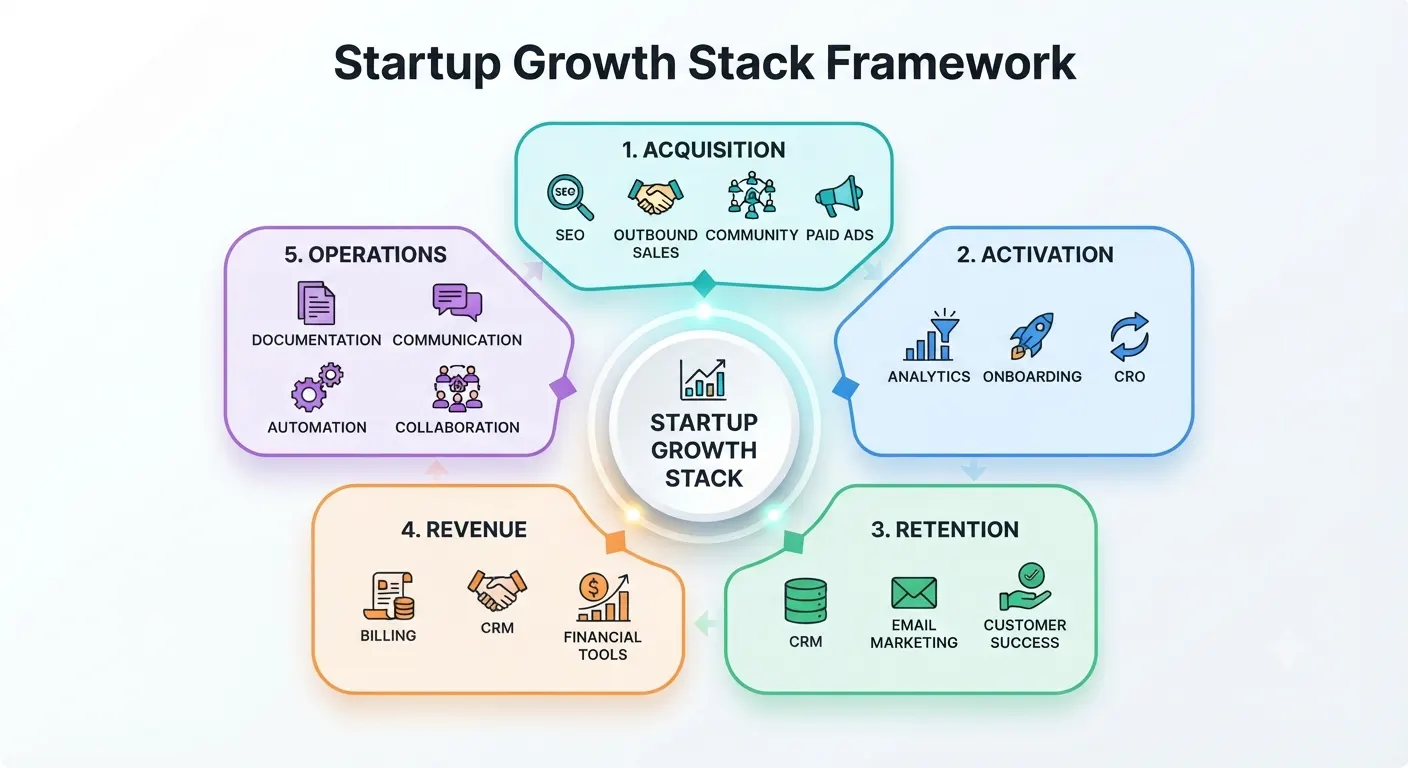
Growth navigate startup tools are the software platforms early-stage companies use to acquire customers, manage operations, and make decisions from data — enabling a small team to execute at a scale that would otherwise require a much larger headcount.
That definition matters because it draws a line most guides blur. Some tools grow your business — they bring in leads, convert them, and retain customers. Others run your business — they keep tasks organized, finances tracked, and teams aligned. Both are essential, but they solve different problems and belong at different stages.
The distinction changes which tool you reach for first — and that order matters more than most founders realize.
The Full Startup Growth Funnel — and Where Tools Fit
The clearest lens for organizing startup tools is the AARRR framework (Acquisition, Activation, Retention, Revenue, Referral), popularized by Dave McClure at 500 Startups. Every tool in your stack should map to one of these stages. If it doesn't, question whether it belongs.
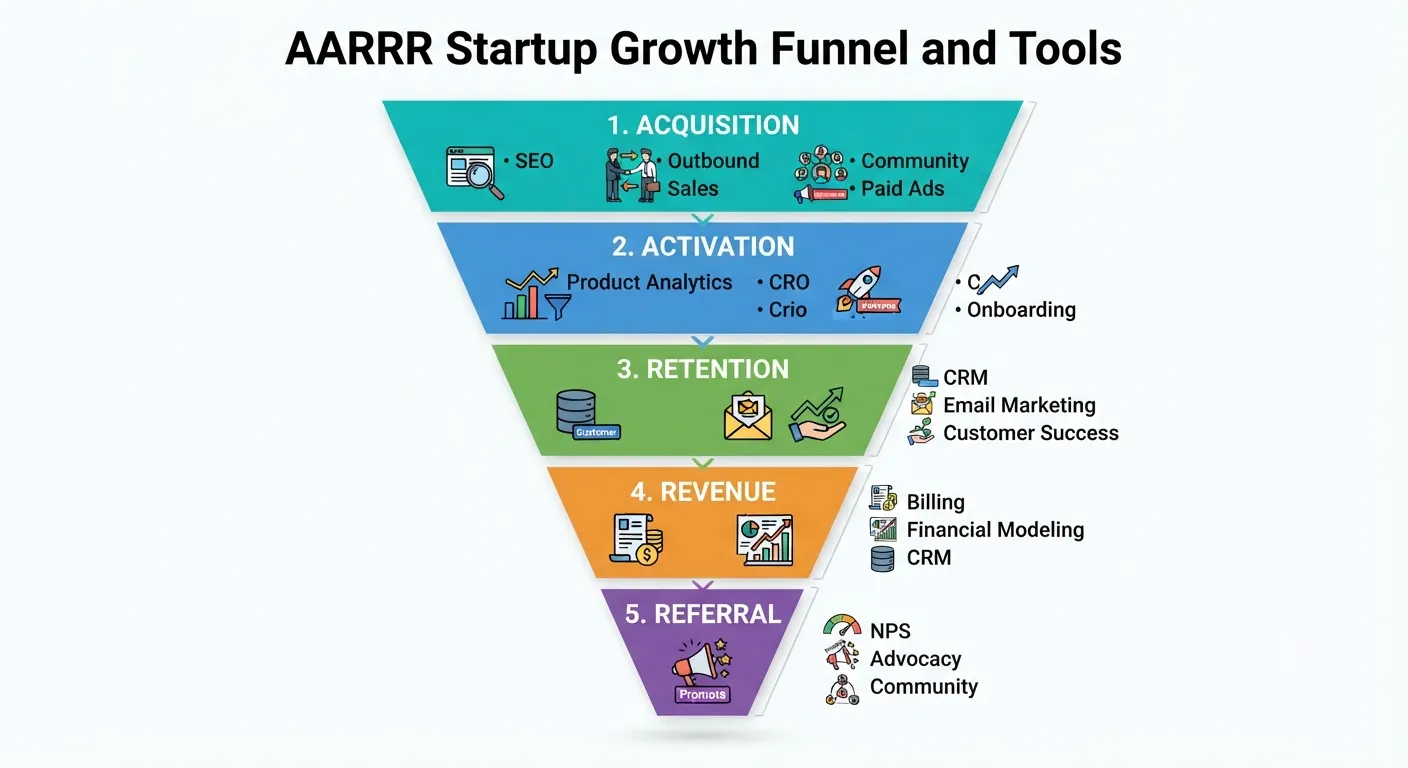
Funnel Stage | The Core Question | Tool Category |
|---|---|---|
Acquisition | How do people find us? | SEO, outbound sales, community marketing, paid ads |
Activation | Do they get value on first contact? | Onboarding flows, product analytics, CRO |
Retention | Do they come back? | CRM, email marketing, customer success |
Revenue | Are they paying, and is it growing? | Billing, CRM, financial modeling |
Referral | Are they telling others? | NPS, advocacy tools, community programs |
Most startup tool lists are heavily weighted toward Retention and Revenue — CRMs, project managers, accounting software. The Acquisition stage, where growth actually starts, often gets a single bullet that says "HubSpot" and nothing more. That's not a growth stack; it's a back-office setup.
The Two Stacks Every Startup Needs
Before diving into specific tools, understand this structural point: you need two mini-stacks, not one undifferentiated list.
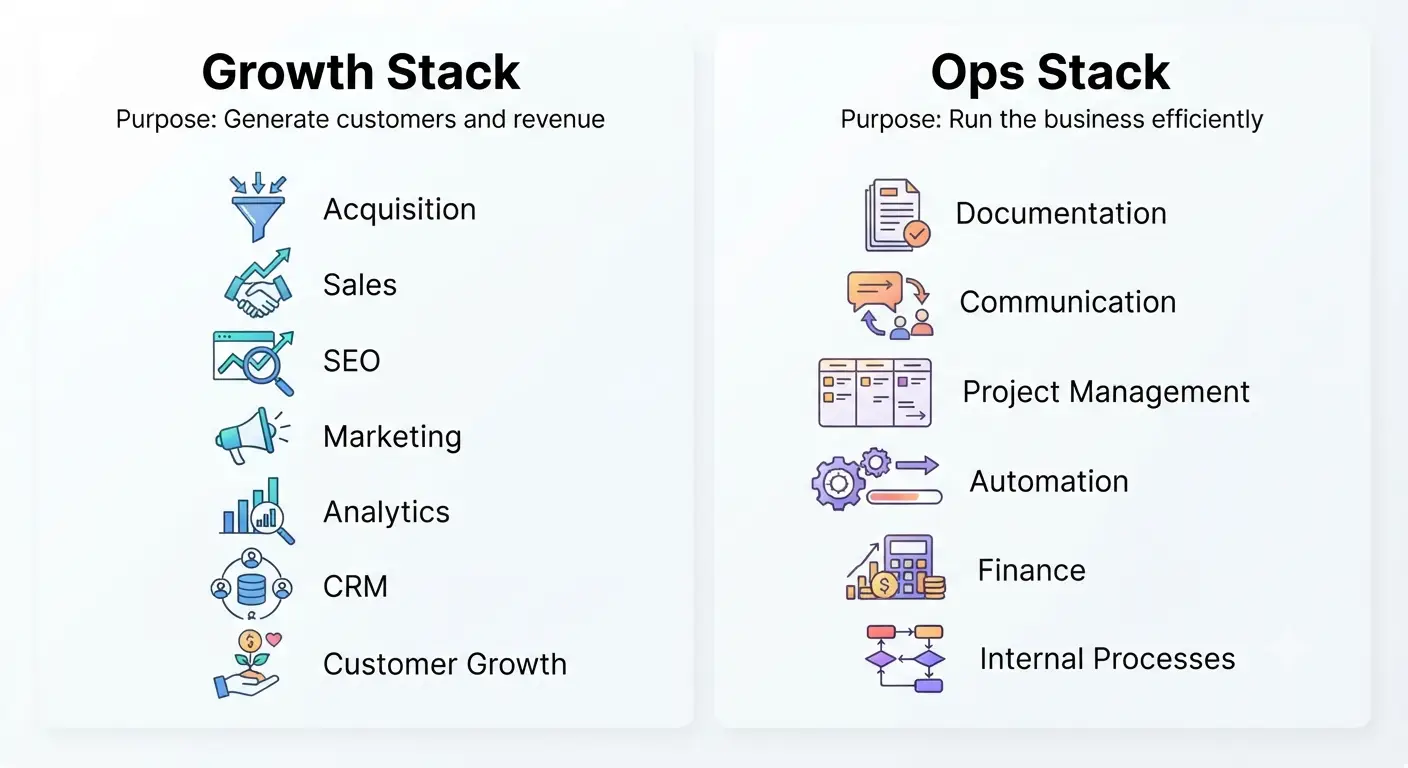
The Growth Stack drives customer acquisition and revenue. These tools are your offense — they bring people in, convert them, and keep them paying.
The Ops Stack keeps everything running. These are your defense — they prevent operational chaos, track money, and keep your team aligned without 40-person Slack threads.
Why separate them? Because founders routinely over-invest in ops tools early — setting up Notion, Asana, Miro, Slack, and Zapier before they've validated that anyone wants their product. The result is a beautifully organized operation with no customers. Build the growth stack first.
Growth Stack: The Tools That Actually Bring In Customers
Outbound Sales: Apollo.io
Before inbound kicks in, most early-stage startups need outbound. Apollo.io is the standard choice for founder-led sales: a database of 275+ million verified contacts, enriched with company data, job changes, and buying signals, built directly into a sequencing engine.
The workflow is tight: build a list by ICP filters (industry, company size, job title, tech stack), enrich those contacts with direct emails and phone numbers, and drop them into an automated multi-touch sequence — all without leaving the platform. The AI-powered intent data layer surfaces leads who are actively in-market based on behavioral signals.
Apollo.io's free tier gives you 50 email credits per month and full access to the sequencing engine — enough to validate outbound as a channel before committing to a paid plan. For a founding team running their own sales, it replaces the need for separate prospecting, enrichment, and sequencing tools.
Free tier: Yes (50 credits/month). Paid plans from $49/user/month. Best for: B2B startups doing founder-led outbound before they have an SDR team.
SEO & Organic Search: Semrush
For startups betting on organic acquisition, Semrush is the research layer that makes the channel actionable. Its core value for early-stage teams is keyword gap analysis — seeing exactly which search terms competitors rank for that you don't, so you can sequence your content investment against opportunities with proven demand.
The Site Audit tool catches technical SEO issues before they suppress ranking potential. The position tracking dashboard shows weekly rank changes for your target keywords, which turns SEO from a quarterly exercise into a real-time signal. Backlink analysis helps identify link-building targets by showing where competitors get their domain authority from.
The free tier is limited; the $129/month Pro plan is the practical entry point. Worth it once content is a documented acquisition channel, not worth it as a speculative add-on.
Free tier: Limited. Pro from $129.95/month. Best for: Startups that have identified organic search as a primary or secondary acquisition channel.
Community-Led Acquisition: Leadmore AI
Reddit has 500+ million monthly active users and hosts some of the most intent-rich conversations on the internet — founders asking for tool recommendations, buyers comparing options, early adopters sharing problems. For many B2B SaaS, AI, and e-commerce startups, relevant subreddits are a direct window into their ICP at the moment of maximum buying intent.
The challenge is execution. Reddit's community norms actively penalize promotional behavior: accounts get banned, posts get removed, and aggressive outreach backfires visibly. Most founders who try it manually either give up after one ban or spend hours per week on a workflow that doesn't scale.
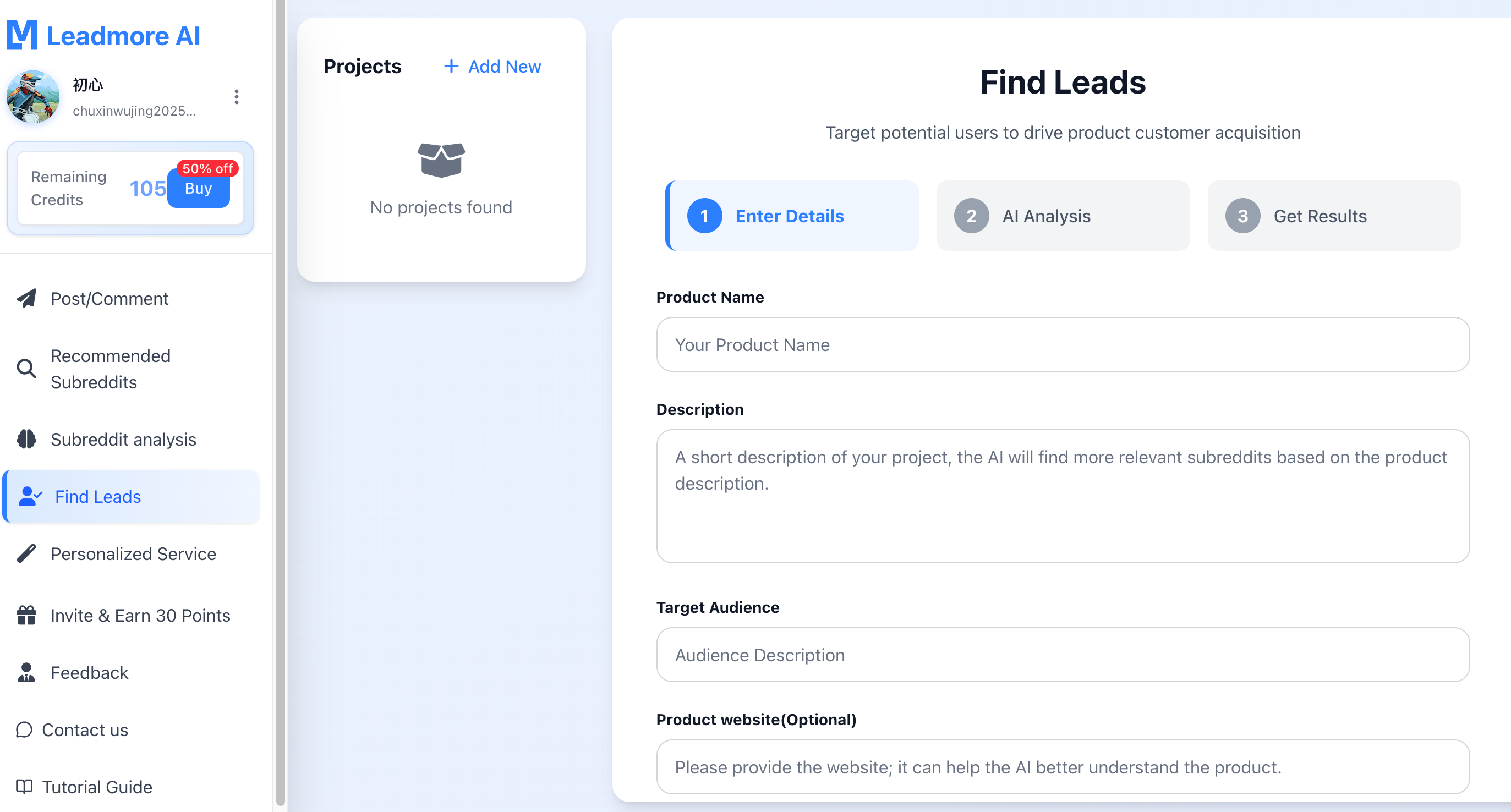
Leadmore AI is designed specifically for this use case. It's a Reddit marketing platform that combines subreddit discovery, content compliance checking, and managed-account publishing — so you can engage on Reddit without risking your personal account or violating community rules.
The key workflow: you input your product details and ICP, and the platform generates subreddit recommendations with community-specific engagement strategies and compliance notes (including whether links are permitted). High-intent leads — people actively describing problems your product solves — are surfaced daily via AI intent scoring, not just keyword matching. Approved content is published through Leadmore's own aged Reddit accounts, keeping your account off the platform entirely.
The compliance layer is what differentiates it from generic automation tools. Every piece of content is checked against subreddit-specific rules before it goes out; failed posts are automatically refunded. For founders who've been burned by Reddit bans before, that's a meaningful guarantee.
Pricing is pay-per-success: $4 per comment, $7 per post. For a startup testing Reddit as an acquisition channel with a modest weekly budget, this is a low-risk way to build systematic presence without the overhead of manual execution.
Best for: B2B SaaS, AI tools, e-commerce, and consumer tech companies with active customer communities on Reddit. Particularly useful for founders who recognize Reddit as a relevant channel but haven't been able to execute it at scale.
CRM & Sales Pipeline: HubSpot
HubSpot remains the default CRM for early-stage startups, largely because the free tier is genuinely functional — not a crippled demo. Contact management, deal pipelines, email sequences, meeting scheduling, and basic reporting are all available before you pay a dollar. For a founder managing their first 50 deals, it covers the full workflow.
One important caveat on pricing: HubSpot escalates sharply between Starter and Professional tiers, and the contact limits on lower tiers compress faster than most founders expect. Map your 12-month growth trajectory before committing to a plan — a surprise upgrade mid-growth can double your monthly cost overnight.
Free tier: Yes. Paid plans from ~$15/user/month. Best for: Startups that need sales and marketing under one roof from day one.
Analytics: Google Analytics 4 + Amplitude
GA4 is the mandatory starting point. It's free, integrates with every advertising platform, and captures behavioral data — scroll depth, click patterns, form completions — that basic page view trackers miss entirely. Install it on day one and configure five to ten events for your key conversion actions. A custom report showing acquisition source → first action → conversion will tell you most of what you need to know about your growth funnel.
Amplitude answers the questions GA4 can't: which features do retained users engage with? Where does onboarding drop off? Which cohort has the best 90-day retention rate? For product-led growth companies, Amplitude's cohort analysis and funnel visualization turn anecdotal feedback into actionable roadmap decisions.
When to add each: GA4 on day one. Amplitude when you have 200+ monthly active users and enough behavioral signal to see meaningful patterns.
Free tiers: Both have generous free tiers.
AI Content at Scale: Jasper
Once you've identified acquisition channels that convert, Jasper helps you scale content output without scaling headcount. Its differentiator from generic AI writers is brand voice training — the platform learns your tone and applies it consistently across blog posts, ad copy, email campaigns, and landing pages.
Honest caveat: human review is still necessary. Jasper accelerates production; it doesn't replace editorial judgment. At ~$39/month for individuals, it only earns its cost if you're publishing at least weekly across multiple channels.
Best for: Growth-stage startups with active content programs needing more output per person.
Ops Stack: The Tools That Keep the Business Running
Workspace & Docs: Notion
Notion replaces three or four tools at once — internal wiki, project tracker, meeting notes, and SOPs library — with a unified workspace that compounds value over time. The AI assistant added in recent versions summarizes meeting notes, drafts recurring documents, and answers questions about internal documentation.
The most common failure mode: teams set up Notion in a hurry without a page hierarchy, and it becomes an unlinked document dump nobody refers to. Invest two hours in the first week on a simple structure — home page, team wikis, project folders, templates — and it becomes the connective tissue of your ops.
Free tier: Yes. Plus plans from $10/user/month.
Team Communication: Slack
Slack's core value isn't just messaging — it's the integration layer that surfaces the right information to the right people automatically. Connect it to your CRM, analytics, and project boards and Slack becomes a live operations feed.
The free plan is sufficient for teams under 10 for the first 12 months. The 90-day message history limit starts to bite as institutional context accumulates; that's the practical trigger for upgrading.
Free tier: Yes. Pro from ~$7.25/user/month.
Project Management: Asana
Asana earns its place when projects are complex enough that Notion's lightweight task views start dropping balls. It handles cross-functional dependencies, capacity management, and accountability at a level that simple kanban boards can't. Notion's project views are usually enough through seed stage; Asana starts paying off around Series A when multiple tracks are running simultaneously.
Free tier: Yes. Starter from $10.99/user/month.
Workflow Automation: Zapier
Zapier is what makes a connected stack actually connected. With 6,000+ app integrations and no-code setup, a non-technical founder can build most core automations — routing leads from HubSpot into Slack notifications, syncing form submissions to spreadsheets, triggering follow-up tasks from CRM events — in an afternoon.
Watch task volume carefully; costs compound quickly if you automate aggressively without reviewing what's actually running.
Free tier: Yes (limited tasks). Professional from ~$19.99/month.
Visual Collaboration: Miro
Some conversations — roadmapping, customer journey mapping, competitive analysis, sprint planning — don't work in text or linear task lists. Miro's infinite canvas and 250+ built-in templates give product and strategy teams a shared visual space that spatial reasoning needs. The AI layer automatically clusters sticky notes into themes and converts rough diagrams into organized structures.
Free tier: Yes (3 boards). Starter from ~$8/member/month.
Customer Success: Intercom
Intercom bridges the gap between acquisition and retention — it's where you talk to customers after they sign up. The core product bundles live chat, a help center, automated onboarding sequences, and in-app messaging into one platform, with AI-powered automation handling the high-volume, low-complexity queries that would otherwise consume support time.
For product-led growth companies, Intercom's in-app messaging is particularly valuable: you can trigger onboarding nudges based on specific user behavior (hasn't used Feature X after 7 days, upgrade prompt at trial limit), turning passive users into activated ones without manual outreach.
Free tier: Limited trial. Paid plans from ~$39/month for small teams. Best for: Startups post-PMF that need to reduce churn and improve activation without hiring a support team.
Finance & Runway: Puzzle
Puzzle converts accounting data into founder-relevant intelligence: live burn rate, runway under different hiring scenarios, investor-ready financial statements. Traditional accounting software generates monthly reports that are stale by the time you read them. Puzzle generates them in real time.
The live financial dashboard pays its cost most visibly during fundraising conversations — when investors ask about runway or burn rate, the answer is on your screen before they finish the question.
Paid plans from: ~$50/month.
Tool Stack by Startup Stage
The most common tooling mistake is adding tools before you have the problem they solve. Here's the honest sequence:
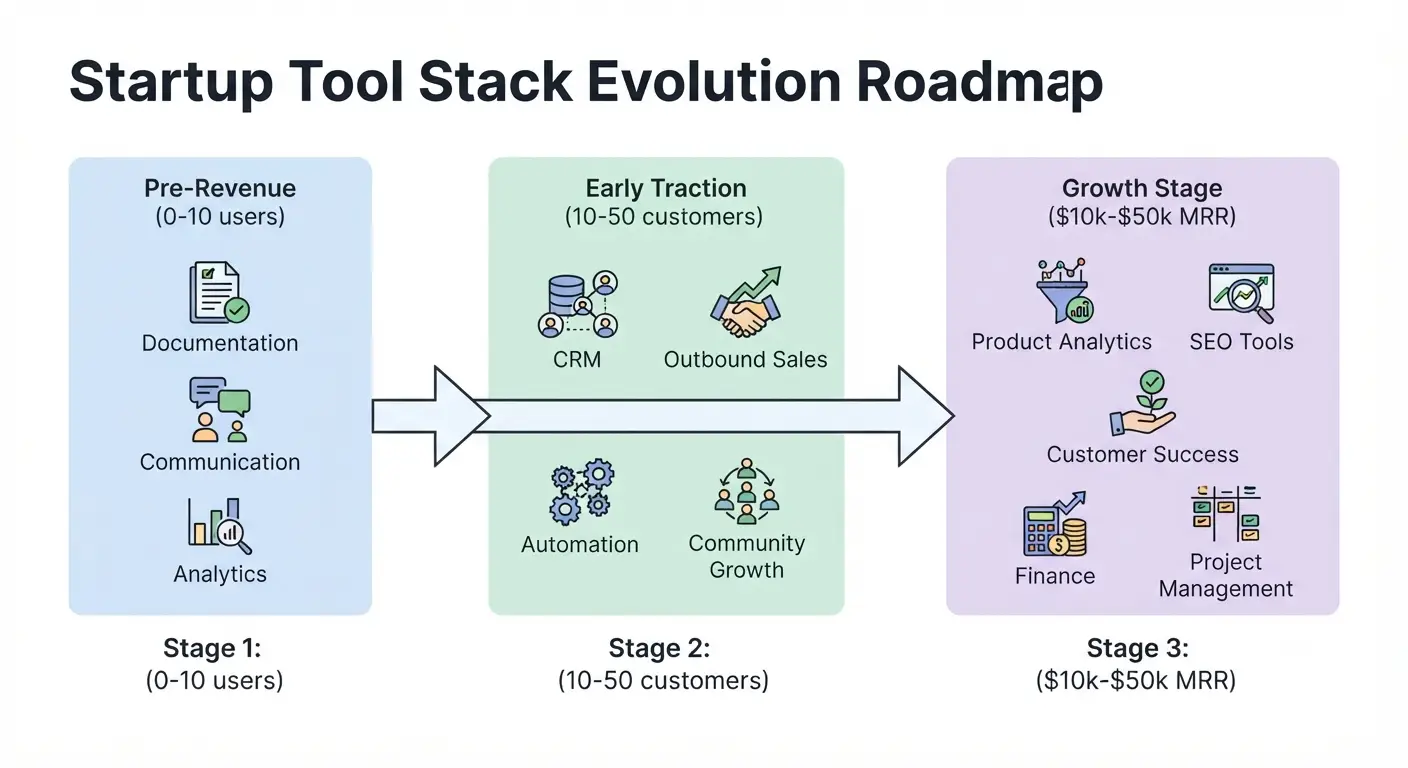
Pre-Revenue (0–10 users): Stay at Zero
You need three tools: Notion for documentation, Slack for communication, and GA4 for tracking. Total cost: $0.
Don't add a CRM, project management tool, outbound platform, or finance software before you have recurring customers. Every subscription before product-market fit is a bet you're making against customer conversations, not with them.
Early Traction (10–50 customers): Build the Growth Layer
Once real customers arrive, add HubSpot (free tier) for the pipeline, Apollo.io (free tier) to test outbound systematically, and Leadmore AI if Reddit engagement is relevant to your ICP. Add Zapier (free tier) to connect your tools without manual data entry.
At this stage, resist the urge to add ops tools. You can manage projects in Notion; you don't need Asana yet.
Growth Stage ($10k–$50k MRR): Add Depth and Measurement
Add Amplitude for product analytics, Semrush if organic is a documented channel, Asana for cross-functional project management, Intercom for customer success, Jasper for content scaling, and Puzzle for financial visibility. Upgrade Slack to Pro.
Before adding anything, audit what you have. Growth-stage startups commonly carry 10–15 SaaS subscriptions, of which 4–6 are genuinely underused. Cut before you add.
Real-World Stack Example: A B2B SaaS Startup in Practice
Here's how a 5-person B2B SaaS startup might realistically evolve their stack across three stages:
Stage 1 — Before PMF (0 customers, $0 MRR)
Notion (wiki + tasks) · Slack · GA4
Monthly cost: $0
Focus: Customer conversations, not infrastructure
Stage 2 — Early traction (50 customers, ~$5k MRR)
HubSpot Free (CRM) · Apollo.io Free (outbound prospecting) · Leadmore AI (Reddit acquisition) · Zapier Free
Monthly cost: ~$100–150 (Leadmore AI pay-per-use)
Focus: Systematic acquisition, pipeline visibility
Stage 3 — Scaling ($50k MRR, 8-person team)
HubSpot Starter · Apollo.io Basic · Amplitude · Semrush Pro · Asana Starter · Intercom Starter · Slack Pro · Jasper · Puzzle · Miro Starter
Monthly cost: ~$600–800
Focus: Depth, measurement, and retention
The jump from Stage 1 to Stage 2 is acquisition-first. The jump from Stage 2 to Stage 3 is measurement and retention. Most advice skips Stage 1 entirely, and that's why most startups over-tool before they've earned it.
Comprehensive Tool Comparison
Tool | Category | Best For | Pricing | Free Tier | Ideal Stage |
|---|---|---|---|---|---|
Apollo.io | Outbound / Sales | B2B lead prospecting + sequencing | From $49/user/mo | Yes (50 credits) | Early traction → Growth |
HubSpot | CRM / Sales | Sales pipeline + email marketing | From $15/user/mo | Yes (generous) | Pre-revenue → Growth |
Leadmore AI | Acquisition / Community | Reddit-based lead generation | $4/comment, $7/post | No (pay-per-success) | Early traction → Growth |
Semrush | SEO / Organic | Keyword research + competitor analysis | From $129.95/mo | Limited | Growth |
Google Analytics 4 | Analytics | Website + acquisition analytics | Free | Yes | Day 1 |
Amplitude | Analytics | Product + retention analytics | Free (Starter) | Yes | Early traction → Growth |
Intercom | Customer Success | Onboarding + in-app messaging + support | From $39/mo | Trial only | Post-PMF → Growth |
Jasper | Content / AI | Brand-consistent content at scale | From $39/mo | No | Growth |
Notion | Ops / Docs | Wiki + projects + knowledge base | From $10/user/mo | Yes | Day 1 |
Slack | Ops / Communication | Team messaging + integrations | From $7.25/user/mo | Yes | Day 1 |
Asana | Ops / Projects | Cross-functional project management | From $10.99/user/mo | Yes | Growth (Series A+) |
Zapier | Ops / Automation | Cross-platform workflow automation | From $19.99/mo | Yes | Early traction → |
Miro | Ops / Visual | Strategy sessions + roadmapping | From $8/member/mo | Yes (3 boards) | Early traction → |
Puzzle | Finance | Real-time runway + financial statements | From $50/mo | No | Post-PMF |
How to Evaluate Any Tool: A 5-Question Framework
Before opening another pricing page, run every candidate tool through these questions:
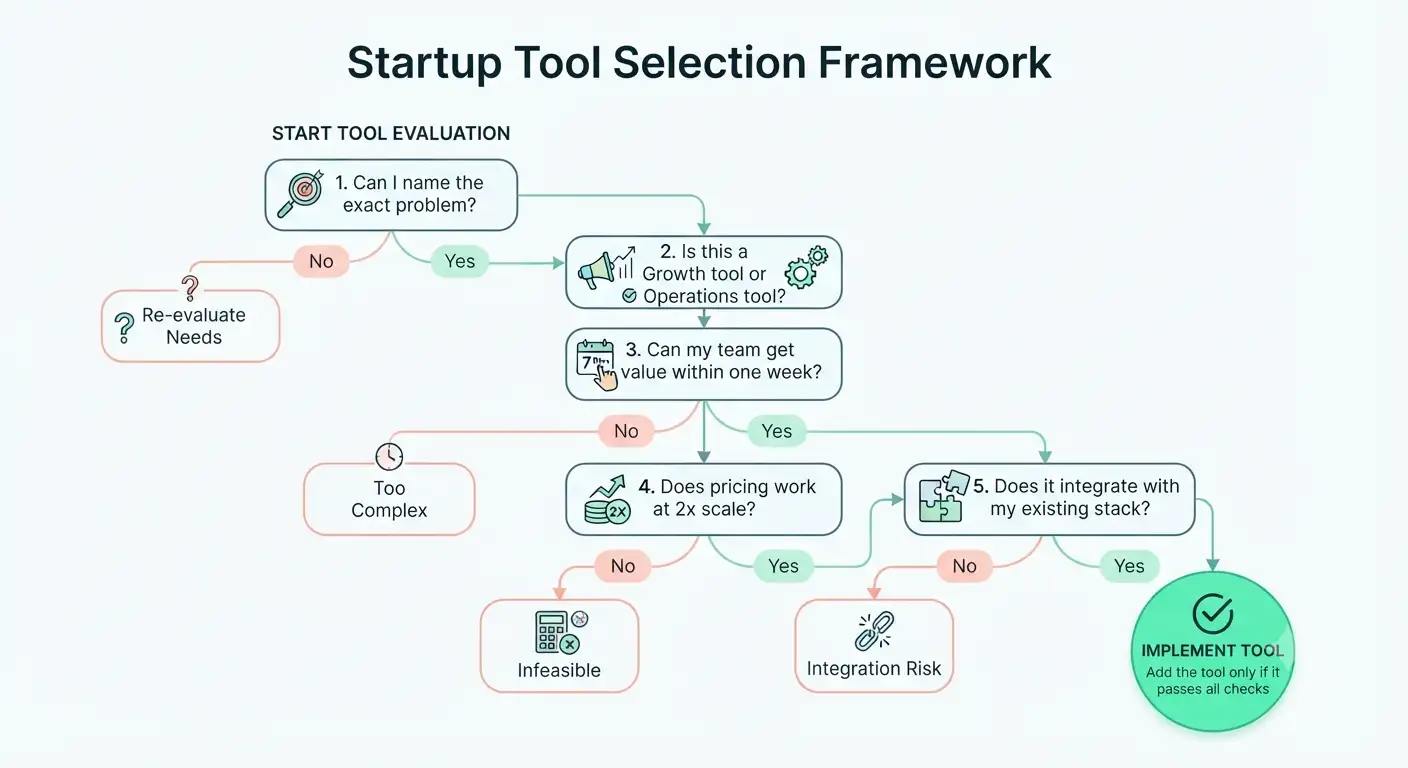
1. Can I name the exact problem in one sentence? Not a theoretical future problem. A documented, recurring problem: "Leads are going cold between week 2 and week 6 of our outbound sequence." If you can't name it precisely, you're not ready for the tool.
2. Does it address Acquisition, or Operations? Know which half of your stack you're building. Founders who conflate these end up with four ops tools and no acquisition tools.
3. Can your team get value from it within the first week? A powerful tool that takes three months to configure and then gets abandoned is not a powerful tool for your startup. Time-to-productive matters more than feature depth.
4. What does the pricing look like at 2× your current scale? Mid-growth migrations — switching CRMs, rebuilding analytics, moving project management — are some of the most disruptive things a startup can do. They burn engineering time at exactly the wrong moment. Choose tools you can grow into.
5. Does it integrate with your existing stack? A tool that doesn't connect to your other platforms creates data silos and manual work. Verify native integration or Zapier support before committing. A slightly less powerful tool that fits your workflow beats a more capable one that sits in isolation.
The Mistakes That Quietly Drain Your Budget
Over-tooling before product-market fit. The most expensive mistake. Building a sophisticated ops stack before you've validated that anyone wants your product is the startup equivalent of buying a commercial kitchen before you've tried your recipe on anyone.
Ignoring integration compatibility. Tools that don't talk to each other force manual data transfer — the opposite of the efficiency you paid for. Always verify before committing.
Skipping adoption. According to Backlinko's analysis of SaaS data, companies don't use 53% of the SaaS licenses they purchase. Even 30 minutes of structured onboarding per tool improves adoption measurably. If a tool isn't in daily use within two weeks of launch, remove it.
Paying for features before you need them. Most leading platforms — HubSpot, Notion, Slack, GA4, Zapier, Amplitude — have free tiers that are genuinely functional for 12–18 months. Upgrade only when a specific limit is blocking growth.
Treating tool cost as fixed overhead. Review subscriptions quarterly. Apply a simple test: which tools does your team open daily? Cut anything that can't pass it. The average startup carries 10–15 active SaaS subscriptions by year two; trimming 3–4 unused ones often funds an upgrade for a tool the team actually relies on.
Frequently Asked Questions
What are growth navigate startup tools?
Growth navigate startup tools are software platforms that help early-stage companies acquire customers, manage operations, and make data-driven decisions — enabling small teams to execute at a scale that would otherwise require much larger headcount. They span two categories: growth tools that drive acquisition and revenue, and ops tools that keep the business running efficiently.
Which tools should an early-stage startup start with?
Start with GA4 (analytics), Notion (documentation), and Slack (communication) — all free. Add HubSpot CRM and Apollo.io (both with strong free tiers) once you're actively generating leads. If Reddit is a relevant channel for your ICP, add Leadmore AI as a systematic acquisition layer. Resist adding project management, marketing automation, or advanced finance tools before you have repeating customers.
How much should a startup spend on tools?
Industry benchmarks vary by stage. Small businesses typically spend 6–12% of revenue on SaaS (Binadox, 2025). For pre-revenue startups, the target is as close to zero as possible — most essential tools have capable free tiers. According to Zylo's 2025 SaaS Management Index, companies lose up to 50% of SaaS spend on unused licenses. Upgrade to paid plans only when a specific feature limit is actively blocking growth, not preemptively.
What is Leadmore AI and is it worth it for startups?
Leadmore AI is an AI-powered Reddit marketing platform that helps startups find high-intent conversations on Reddit, discover relevant subreddits for their product, and publish content safely through managed Reddit accounts. It uses pay-per-success pricing ($4/comment, $7/post), so you only pay when content goes live and stays up. It's worth evaluating for B2B SaaS, AI tools, and consumer tech startups whose customers are active on Reddit — particularly for founders who recognize Reddit as a relevant channel but haven't been able to execute it systematically without account bans.
What's the difference between GA4 and Amplitude?
GA4 is best for acquisition analytics — traffic sources, user behavior on first visit, conversion tracking, and ad attribution. Amplitude is best for product and retention analytics — which features do retained users engage with, where does onboarding drop off, which cohort has the best 90-day LTV. Install GA4 on day one. Add Amplitude when you have 200+ monthly active users with enough behavioral signal to find meaningful patterns.
When should I add a CRM?
Add HubSpot (free tier) when you have more than a handful of active leads or customers — roughly when you can no longer hold your full pipeline in your head. The practical trigger is noticing that leads are slipping through the cracks, or realizing that onboarding a new team member would require you to explain the pipeline from memory.
How do I avoid tool sprawl?
Add a tool only when you can articulate the specific problem it solves in a single sentence. Then audit your stack quarterly — apply the daily-use test to every subscription and remove anything that doesn't pass. The "one-in, one-out" principle helps: before adding a new subscription, identify what it replaces or consolidates. According to Zylo, an average of 7.6 new SaaS apps enter a company's environment each month; without active management, portfolios can grow 33%+ annually.
Do I need both HubSpot and Apollo.io?
They serve different directions. Apollo.io is primarily outbound — prospecting, enriching contact data, and running cold email sequences. HubSpot is primarily inbound and pipeline management — capturing leads from your website, managing deals through stages, and storing customer history. For a startup doing founder-led sales, you might start with Apollo.io for outbound prospecting and route those contacts into HubSpot to manage the pipeline. They integrate natively, so the two tools work together without manual data transfer.
The Bottom Line
The startups that scale efficiently aren't the ones with the most tools — they're the ones who map tools deliberately to the funnel stage they're in, integrate everything so data flows without manual work, and cut what isn't earning its place.
Build the growth stack before the ops stack. Add tools in response to documented, real problems. Use free tiers until you hit actual limits. And don't skip the acquisition layer — community-led growth, outbound sales infrastructure, and SEO foundations are what generate the customers your ops stack exists to serve.
That's the whole framework. Build deliberately, measure honestly, audit quarterly.
About the Author
Daniel Brooks is a SaaS growth analyst who studies startup tools, workflows, and technology stacks. He helps founders identify the right solutions for each growth stage, from customer acquisition and analytics to automation and operations.
Data sources referenced in this article: Zylo 2025 SaaS Management Index · SQ Magazine SaaS Statistics 2026 · Backlinko SaaS Statistics · Binadox SaaS Spend Benchmarks 2025 · Lighter Capital B2B SaaS Benchmarking.