B2B Lead Generation Strategies That Actually Work in 2026
By Clara Bennett, B2B Marketing Consultant & Lead Generation Strategist.
Clara Bennett is an independent B2B marketing consultant specializing in lead generation, account-based marketing, and content-led demand strategies. Clara has advised SaaS, martech, and enterprise software companies on creating pipelines that scale while staying ahead of modern buyer trends.
B2B lead generation differs from B2C in many ways — if you want a full guide on what lead generation really is and how all channels fit together, check out our [What Is Lead Generation? The Complete 2026 Guide].
The uncomfortable truth: 95% of winning vendors were already on the buyer's shortlist before formal evaluation began. If you're not in the consideration set early, you've already lost most deals.
1. What Makes B2B Lead Generation Different
B2B lead generation isn't just B2C with bigger logos. Four structural differences shape every strategic decision:
Long Sales Cycles
The average B2B deal takes 272 days from first impression to closed revenue — nearly nine months. Lead generation isn't just acquisition; it's about staying relevant across a window where the buyer is doing most of their research without you.
B2B Buying Journey: 272-Day Average
Day 0: First Impression → Content & Brand Awareness
Day 60: Active Research → Community Engagement & Intent Signals
Day 150: Vendor Shortlist → ABM & Targeted Outbound
Day 220: Negotiation → ABM + Outbound Follow-up
Day 272: Close → Final Decision
Multiple Decision-Makers
A typical enterprise buying committee involves 6–12 stakeholders, each arriving with 4–5 pieces of independently gathered research. You're building consensus across technical evaluators, financial approvers, end users, and executive sponsors — all with conflicting priorities.
High-Consideration Purchases
B2B buyers read G2 reviews, post in Reddit threads, run internal pilots, and benchmark multiple vendors — mostly before ever contacting sales. The majority of the journey is invisible to you.
Rational + Emotional Buying
Despite the process overhead, B2B purchases aren't purely logical. Champions, finance leads, and end users all respond to social proof, storytelling, and credibility signals. The brand that feels safer wins the tie.
2. The Invisible Buyer Problem
83% of B2B buyers have fully defined their requirements before speaking with sales.
By the time a prospect fills out a form, they've already formed most of their opinions about you. The "lead" you captured is the output of a much longer journey you weren't present for.
51% of buyers now start their research in an AI chatbot — not a search engine. They're asking ChatGPT and Perplexity to compare tools, summarize categories, and recommend vendors. The Reddit thread where someone praised your product three years ago may be influencing your pipeline today.
Where B2B Buyers Start Research in 2026
AI Chatbots (ChatGPT, Perplexity) ████████████████░░░░ 51%
Search Engines (Google) ███████████░░░░░░░░░ 38%
Peer Networks / Community ████░░░░░░░░░░░░░░░░ 11%
The strategic implication: Build for shortlist presence, not just demand capture. You need to show up wherever your buyers research — before they ever visit your website.
3. Strategy 1: ICP Definition & Buying Committee Mapping
Every other strategy on this list performs better with a tight ICP. This is the single highest-leverage variable in B2B lead generation.
What a Complete 2026 ICP Includes
Dimension | What to Define |
|---|---|
Firmographics | Company size (headcount + revenue band), industry vertical, geography, funding stage |
Technographics | Current tool stack — predicts buying behavior and integration requirements |
Trigger Events | New funding, exec hires, product launches, acquisitions, headcount spikes |
Negative ICP | Companies that look right but consistently churn or underperform |
Buying Committee Map (by Role)
Role | Their Priority | Content That Wins Them |
|---|---|---|
Champion | Career outcome, internal win | ROI case studies, quick wins |
Economic Buyer | Cost, risk, strategic fit | TCO analysis, executive summaries |
Technical Evaluator | Security, integration, scalability | Technical docs, compliance sheets |
End Users | Ease of use, time savings | Product demos, UX walkthroughs |
Legal / Compliance | Risk exposure, data handling | Security reviews, SLA terms |
Key insight: The top deal bottlenecks in 2026 are budget approval (34%), internal alignment (22%), and security concerns (20%). All three map to roles most marketing programs under-reach.
✅ Quick Wins: ICP in 3 Steps
Audit your last 20 closed-won deals. Find the firmographic and technographic patterns. That's your real ICP, not the theoretical one.
Interview 5 champions who advocated for you internally. Ask who almost killed the deal and why.
Build a "negative ICP" list of company types that consistently churn within 6 months. Add these as disqualifiers to your lead scoring model.
4. Strategy 2: Content-Led Demand Generation
Content marketing generates 3x more leads at 62% lower cost compared with outbound. The compounding effect is real — a well-optimized post published today will still generate qualified pipeline in 2028.
Why Gating Is Losing Effectiveness
The 2026 trend is toward ungated, high-value content that builds brand authority and captures company-level intent data (who visits your site) rather than individual form fills that go cold before follow-up.
Original Research & Data Studies
Proprietary data that nobody else can publish. These become citations in others' content, earn backlinks, get picked up by AI models, and build category authority faster than any other format.
Real-world example: Drift published its annual "State of Conversational Marketing" report each year. It became a go-to citation across dozens of industry blogs, earning hundreds of inbound links and positioning the brand as a category authority — without a single paid ad.
3-Step Action Plan:
Survey 200–500 people in your ICP (use Typeform + LinkedIn outreach).
Publish raw findings with your own analysis and named benchmark numbers.
Pitch the data to 10 industry newsletters and 3 journalists who cover your category.
Comparison & Alternative Pages
"Best [Competitor] alternatives in 2026" and "[Your Product] vs [Competitor]" pages capture high-intent buyers deep in evaluation. 41% of B2B buyers already have a preferred vendor before formal evaluation begins — these pages influence who makes the shortlist.
Real-world example: ClickUp built an entire library of "[Competitor] alternative" pages early in its growth phase. These pages consistently ranked for bottom-of-funnel queries and drove a significant portion of their self-serve pipeline, with conversion rates 3–5x higher than blog content.
3-Step Action Plan:
List your top 5 competitors and build one comparison page per competitor.
Be honest about trade-offs — buyers trust nuance more than pure boosterism.
Include a comparison table with neutral criteria, then link to G2 for third-party validation.
Interactive Tools
Format | Conversion Lift | Best Use Case |
|---|---|---|
ROI Calculators | 2x vs static | CFO and economic buyer |
Assessments / Audits | 3x lead quality | Consultative sales motion |
Configurators | Higher ACV deals | Complex product with options |
Interactive content generates 2x more conversions and 5x more pageviews than static content.
Video
88% of marketers report video helps bring in new opportunities
84% say video directly increases sales
Short-form explainers, customer story videos, and product walkthroughs perform best at the consideration stage
3-Step Action Plan:
Film a 90-second "who this is for" explainer and embed it above the fold on your homepage.
Create a 3-minute customer story video per ICP vertical.
Repurpose each video into a blog post, LinkedIn native upload, and email sequence.
Distribution Discipline
Publishing without distributing is the most common reason good content underperforms. Every piece needs an active promotion plan:
Post in communities where your ICP already spends time
Share in relevant subreddits (before you pitch anything)
Email your existing subscriber base within 24 hours of publish
Repurpose across LinkedIn, Twitter/X, and short-form video
Pitch to 5 industry newsletters per quarter
5. Strategy 3: SEO for B2B Intent
B2B SEO in 2026 runs on two tracks simultaneously.
Track 1: Bottom-of-Funnel, High-Intent Keywords
These searches indicate active evaluation — lower volume, dramatically higher conversion:
Keyword Type | Example | Intent Level |
|---|---|---|
Category + tools | “best outbound email tools 2026” | High |
Competitor alternatives | “Apollo.io alternatives” | Very High |
Product reviews | “[Your brand] reviews G2” | Very High |
Solution for segment | “lead gen software for SaaS startups” | High |
Track 2: AI Search Presence
With 51% of buyers starting in AI tools, appearing in AI-generated answers now matters as much as Google rankings. Content cited by AI models tends to be:
Authoritative: Written by or citing recognized experts
Data-rich: Contains specific numbers and benchmarks
Clearly structured: Uses headers, tables, and lists AI can parse
From trusted domains: High DA, low spam signals
2026 wrinkle: Google AI Overviews are reducing click-through on broad informational queries. The response is to go deeper — long-form, highly specific content that answers questions AI summaries can't fully address, plus bottom-of-funnel content where searchers want more than a summary.
✅ Quick Wins: SEO in 3 Steps
Audit your competitor comparison gap. Use Ahrefs or Semrush to find "[Competitor] alternative" keywords where you don't rank but competitors do.
Publish one data-rich study with proprietary stats — this is your fastest path to AI citation.
Add FAQ schema to your bottom-of-funnel pages to capture featured snippets and People Also Ask boxes.
6. Strategy 4: Account-Based Marketing (ABM)
ABM flips the traditional model: identify high-value accounts first, then run coordinated campaigns to reach multiple stakeholders simultaneously.
ABM vs. Traditional Lead Gen
Dimension | Traditional Lead Gen | ABM |
|---|---|---|
Targeting | Broad, filtered down | Account-specific, upfront |
Metrics | MQLs, form fills | Account engagement, pipeline |
Deal size | Variable | 47% larger on average |
Close rate | Baseline | 68% higher |
Best for | High-volume, lower ACV | Enterprise, high-ACV |
The 3-Tier ABM Model
ABM Tier Structure
Tier 1: Bespoke (10–50 accounts)
└── Custom landing pages, direct mail, 1:1 outreach, exec gifting
Tier 2: Lightly Personalized (50–500 accounts)
└── Industry-specific messaging, persona content, LinkedIn targeting
Tier 3: Programmatic (500+ accounts)
└── Company-list ad targeting, intent triggers, automated nurture
Real-world example: Terminus (an ABM platform) ran a Tier 1 campaign targeting 20 enterprise accounts with personalized microsites, direct mail gifts, and coordinated LinkedIn + email sequences. The campaign generated a 5x pipeline lift compared with traditional outbound targeting equivalent accounts — with zero cold inbound activity.
✅ Quick Wins: ABM in 3 Steps
Build your Tier 1 list. Pull your top 20 dream accounts from sales, score them by ICP fit and intent signals, and commit a dedicated budget.
Map one buying committee end-to-end for a Tier 1 account — find everyone on LinkedIn, understand their priorities, and assign outreach ownership.
Launch one personalized landing page per Tier 1 account using their logo, use case, and industry-specific copy. Even basic personalization lifts conversion 2–3x.
7. Strategy 5: Outbound Email & LinkedIn (Done Right)
Outbound has a PR problem in 2026. Inboxes are saturated, reply rates are declining. But outbound that leads with relevant value still works — it's just harder to execute.
The Shift That Separates Effective from Ineffective
❌ Old approach:
Hi [First Name], I noticed you work at [Company]. We help companies like yours with [generic value prop]. Are you free for a 30-minute call?
✅ New approach:
Saw your post in r/SaaS last week about evaluating outbound tools. We built [specific feature] for exactly that problem. Worth 15 minutes?
The second works because it demonstrates you've been paying attention. It's personalized, timely, and relevant to something the prospect actually raised.
High-Reply Email Template (2026)
Subject: [Specific trigger] → [One relevant outcome]
Hi [Name],
[1 sentence showing you've done your homework — reference something
real: their post, their company news, a shared connection's mention.]
[1 sentence connecting that to a specific problem you solve —
no generic value props.]
[1 sentence of social proof — company name or quantified result,
not a list of logos.]
Worth a 15-minute call to see if it's relevant?
[Your name]
The Mechanics That Matter
Factor | What to Do |
|---|---|
Deliverability | Warmed sending domains, SPF/DKIM/DMARC, ≤50 emails/domain/day |
List quality | Small, high-fit lists beat large spray-and-pray every time |
Trigger timing | Reach out within 48h of a relevant trigger event |
LinkedIn warm-up | Like and comment on their posts before the cold email arrives |
Real-world example: Cognism shifted from volume-based cold outreach to trigger-based sequencing — reaching prospects within 72 hours of a job change, funding round, or relevant LinkedIn post. Reply rates increased from ~3% to ~11%, and the cost per booked meeting dropped by 40%.
✅ Quick Wins: Outbound in 3 Steps
Set up one trigger alert (e.g., new CMO hires at ICP companies via LinkedIn Sales Navigator) and write a dedicated sequence for that trigger only.
Cut your list in half. Take your current outreach list and remove everyone with a fit score below 7/10. Measure reply rates for 30 days.
Engage on LinkedIn first. Comment genuinely on 5 prospects' posts before emailing. Track whether those prospects reply at a higher rate.
8. Strategy 6: Community & Forum-Based Lead Generation
This is the most underutilized strategy in B2B lead generation — and the gap between teams doing it well and those ignoring it is widening fast.
Why Communities Matter More Than Ever
Online communities — subreddits, Slack groups, Discord servers, Hacker News, niche forums — are where B2B buyers ask each other for honest opinions. When a procurement manager posts in r/sysadmin: "What's everyone using for identity management?" — that's an intent-qualified lead announcing themselves publicly.
Reddit's Scale in 2026
Daily Active Users: 121.4 million
Projected MAU (2026): 1.5 billion
YoY Growth: +19.3%
Google Citation Rank: Top source
ChatGPT Source Rank: #2 (after Wikipedia)
Because Reddit is one of Google's most-cited sources and ChatGPT's second-largest training source, showing up helpfully in Reddit threads has compounding value far beyond any single conversation.
Where to Find B2B Intent Signals by Category
Product Category | Key Communities |
|---|---|
SaaS / Software | r/SaaS, r/startups, r/entrepreneur |
Developer Tools | r/programming, Hacker News, Discord servers |
MarTech | r/marketing, r/digital_marketing |
Sales Tech | r/sales, r/saleshackers |
IT / Infra | r/sysadmin, r/devops, r/netsec |
The Right Way to Engage (Without Getting Banned)
Lead with value, not pitch. Answer the question thoroughly before mentioning your product — or don't mention it at all.
Read subreddit rules before every post. Rules vary dramatically; what's fine in r/entrepreneur will get you banned in r/SaaS.
Build history first. Accounts with posting history and karma are trusted; brand-new accounts that immediately promote are flagged instantly.
Real-world example: Notion's early growth was substantially driven by power users and founders organically recommending it in productivity-focused subreddits and Slack communities. The team monitored mentions and engaged in threads — not with sales pitches, but with genuinely helpful responses that happened to demonstrate Notion's philosophy. This community presence seeded word-of-mouth that no paid channel could replicate at the same trust level.
Scaling Community Lead Gen Without Burning Reputation
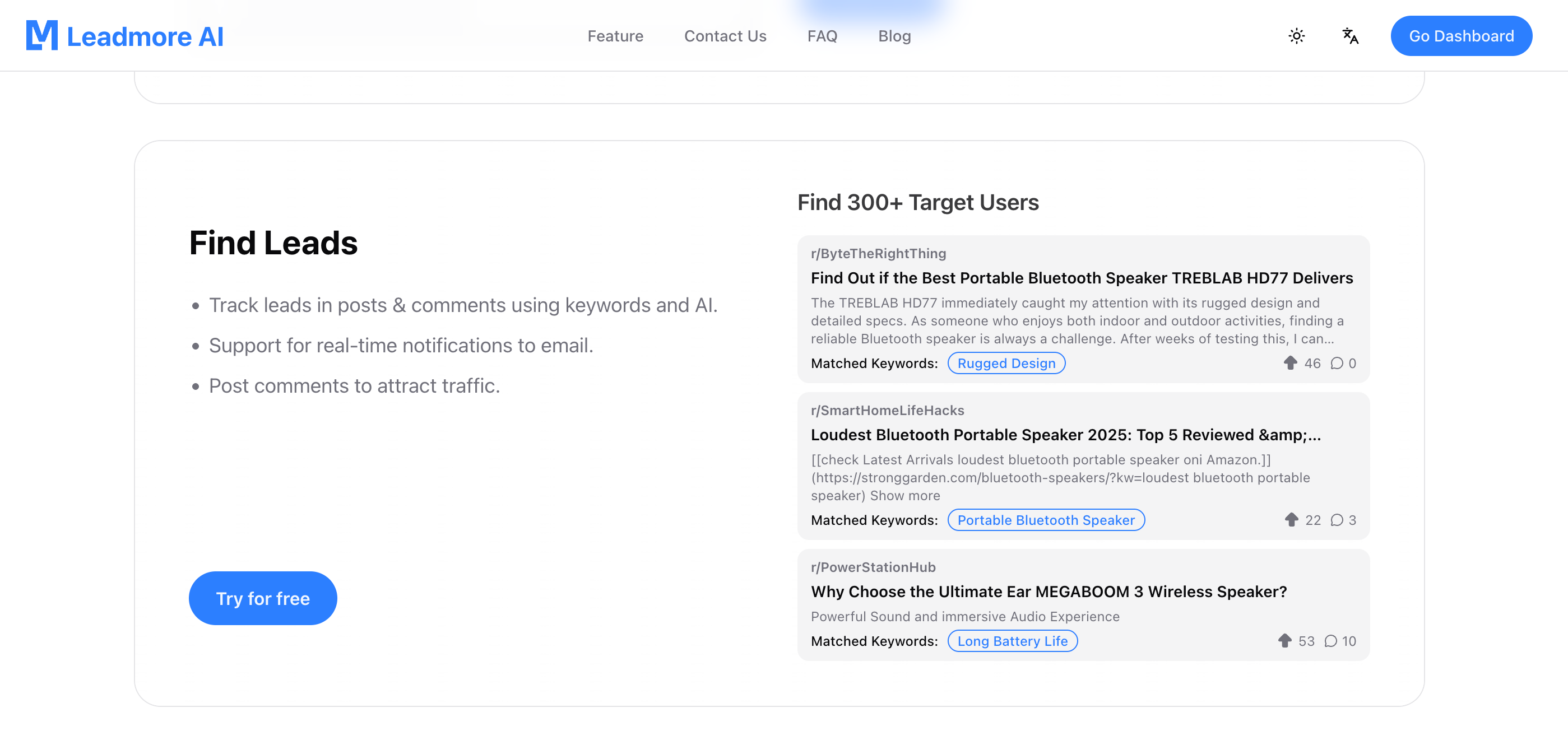
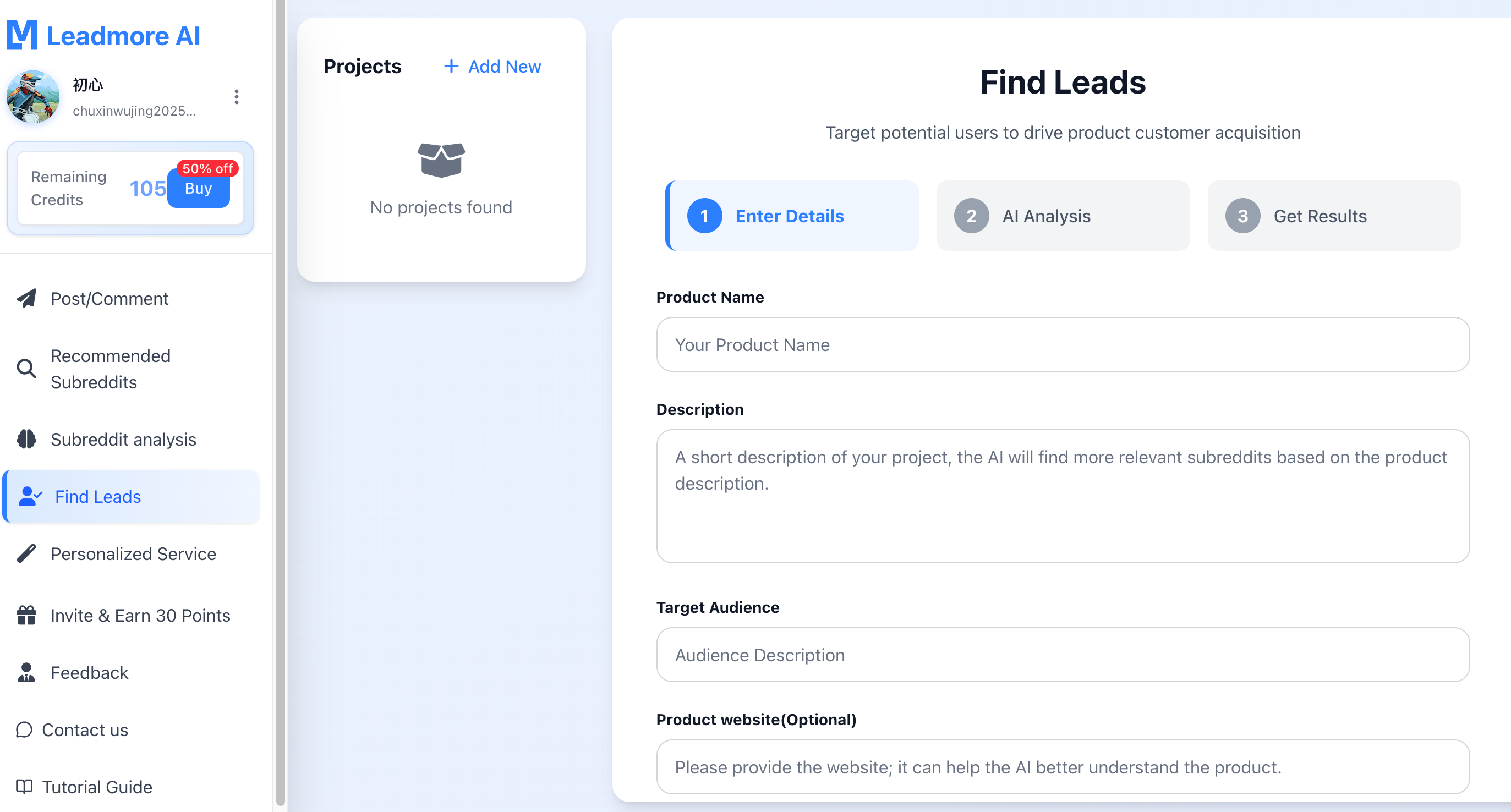
Manual community monitoring is unsustainable at scale. Leadmore AI monitors Reddit posts and comments in real time using your defined keywords, filters signal from noise using AI, and alerts you the moment a high-intent conversation appears — while also analyzing subreddit-specific rules before you post, reducing account risk and keeping your presence sustainable.
✅ Quick Wins: Community Lead Gen in 3 Steps
List 10 subreddits where your ICP asks questions. Search "[your product category] reddit" to find them.
Set up keyword monitoring for your category, competitors, and key pain points. Review alerts daily for the first month.
Post one genuinely helpful answer per day in a relevant community — no pitch, no link. Build credibility for 30 days before mentioning your product.
「Turn community discussions into B2B leads. Leadmore AI alerts you instantly when high-intent conversations happen. Boost your lead generation with Leadmore AI」
9. Strategy 7: Intent Signal Monitoring
Intent data has matured from a nice-to-have into a core infrastructure layer for any outbound-heavy B2B team.
Three Layers of Intent Data
Level | Source | Example Signals |
|---|---|---|
Third-Party Intent | Aggregated web signals | Bombora, G2, 6sense, category-level research patterns |
Second-Party Intent | Platform-specific signals | LinkedIn engagement, G2 profile views, review site activity |
First-Party Intent | Your own website | Pricing page visits, competitor comparisons, documentation downloads |
The 98% Problem
Only 2% of B2B website traffic converts into a lead. The remaining 98% — including companies actively researching your product — disappears without a trace. Intent data tools identify the companies behind that anonymous traffic, so you can initiate outreach when their interest is highest.
Intent-Triggered Outreach vs. Cold Lists
Approach | Avg. Reply Rate | Cost per Meeting |
|---|---|---|
Cold list, no intent signal | 2–4% | High |
Intent-triggered outreach | 8–15% | 40–60% lower |
Community intent (live threads) | 15–25%+ | Very low |
Real-world example: G2 Buyer Intent alerts allowed a mid-market SaaS company to reach out to accounts actively viewing competitor profiles on G2. By sequencing these accounts with targeted messaging ("We noticed you may be evaluating [category] tools..."), they achieved a 3x lift in booked meetings compared with their standard cold outbound — with no increase in send volume.
✅ Quick Wins: Intent Monitoring in 3 Steps
Install a visitor identification tool (e.g., Clearbit Reveal, Leadfeeder) on your pricing and comparison pages immediately.
Create a Slack alert that fires every time a company from your ICP visits your pricing page. Assign outreach ownership within 24 hours.
Layer in G2 buyer intent if you have a G2 profile — accounts viewing your profile or competitors' profiles are warm by definition.
10. Strategy 8: Referral & Partner Programs
Referral leads convert 70% faster than cold leads. The trust transfer is the entire mechanism — when an existing customer recommends you to a peer with the same problem, they've done the awareness and credibility work that would otherwise take months of nurturing.
Why Most B2B Referral Programs Underperform
Most programs fail because they're passive: "let us know if you know anyone." Referrals need to be systematic and explicit.
The Referral System That Works
Element | What to Do |
|---|---|
Define the ask | Be specific: refer ICP-fit companies, leave a G2 review, join a case study |
Make it explicit | Customers don't automatically think to refer unless directly prompted |
Remove friction | Dedicated form, one-click LinkedIn share, pre-written email template |
Close the loop | Reward that's meaningful (not a $25 Amazon card for a $50k deal referral) |
Technology Partner Programs
Integrating with adjacent tools in your customer's stack creates warm introductions through:
Co-marketing (joint content, shared email to partner's list)
Joint webinars (shared audience, shared credibility)
Marketplace listings (Salesforce AppExchange, HubSpot Marketplace, Zapier)
Real-world example: HubSpot's partner program (Solutions Partners) became one of its primary growth engines — not just by generating referrals, but by creating an ecosystem of agencies financially motivated to recommend and implement HubSpot. At its peak, the partner channel accounted for a substantial portion of new customer acquisition, with partners naturally qualifying leads through the implementation process.
✅ Quick Wins: Referral Programs in 3 Steps
Email your top 20 happiest customers this week. Ask directly: "Do you know two or three founders/CMOs who'd benefit from [your product]?" Give them a referral link.
Create a one-page referral kit — a pre-written LinkedIn message and email they can send with one click.
Identify your top 3 integration partners and propose a co-marketing exchange: one joint webinar, one swap in each other's onboarding email sequence.
11. Building Your B2B Lead Gen Stack
The Minimal Viable Stack (by Stage)
Stage | Must-Have Tools | Optional Additions |
|---|---|---|
0–10 employees | CRM (HubSpot free), LinkedIn Sales Nav, 1 content channel | — |
10–50 employees | + Email outreach tool (Apollo, Instantly), SEO tool (Ahrefs) | Intent monitoring |
50–200 employees | + ABM platform (Demandbase, 6sense), community monitoring | Data enrichment |
200+ employees | Full stack + dedicated RevOps, attribution tooling | AI SDR layer |
The Most Common Stack Mistake
Overbuilding before validating. Most early-stage teams buy 6 tools before any single channel is working. Start with CRM + one outreach channel + one content channel. Add tools only when you've identified the specific bottleneck a new tool would remove.
The 2026 Channel Mix by ACV
Recommended Channel Emphasis by Deal Size
ACV Range | Channel | Emphasis (%) |
|---|---|---|
< $10k/year | Content / SEO | 40% |
< $10k/year | Outbound | 20% |
< $10k/year | Community | 20% |
< $10k/year | Referral | 20% |
$10k–$100k/year | ABM | 30% |
$10k–$100k/year | Outbound | 30% |
$10k–$100k/year | Content / SEO | 20% |
$10k–$100k/year | Community | 20% |
> $100k/year | ABM | 50% |
> $100k/year | Outbound | 30% |
> $100k/year | Partner / Referral | 20% |
12. 2026 Benchmarks at a Glance
Core B2B Buying Benchmarks
Metric | 2026 Benchmark |
|---|---|
Average B2B buying cycle | 272 days |
Buying committee size (enterprise) | 8–13 stakeholders |
Buyers with preferred vendor before formal evaluation | 41% |
Buyers starting research in AI chatbots | 51% |
Buyers who define requirements before talking to sales | 83% |
Channel Performance Benchmarks
Channel | Key Metric | Benchmark |
|---|---|---|
Content vs. outbound | Lead cost advantage | 3× more leads at 62% lower cost |
ABM vs. traditional | Deal size lift | +47% |
ABM vs. traditional | Close rate lift | +68% |
Referral vs. cold | Conversion speed | 70% faster |
Interactive content vs. static | Conversion rate | 2× higher |
Video | Marketers reporting new opportunities | 88% |
Funnel Benchmarks
Metric | 2026 Median |
|---|---|
MQL-to-SQL conversion rate | 9.8% |
Median B2B cost-per-lead | $213 |
Website visitor-to-lead conversion | 2% |
Cold outbound reply rate (no trigger) | 2–4% |
Intent-triggered outreach reply rate | 8–15% |
FAQs
Q1: What is B2B lead generation?
B2B lead generation is the process of identifying and attracting potential business customers — distinct from B2C in that it involves longer sales cycles, multiple decision-makers, and significantly higher deal values.
Q2: What is the most effective B2B lead generation strategy in 2026?
There's no universal answer — the right mix depends on your ACV, sales cycle, and ICP. That said, the highest-ROI combination for most B2B companies is: tight ICP targeting + content-driven SEO + community engagement for intent signals, with outbound layered in for accounts showing active buying intent. ABM adds leverage specifically for high-ACV enterprise deals.
Q3: How long does B2B lead generation take to show results?
Outbound: First conversations in 2–4 weeks
Community / Reddit: Results within days once you're monitoring the right threads
SEO / Content: Meaningful organic traffic in 6–12 months
ABM: Pipeline impact in 3–6 months, depending on deal cycle length
Q4: What's the difference between demand generation and lead generation?
Demand gen creates awareness and interest among people who may not yet know they have a problem. Lead gen captures and qualifies people who already have the problem and are actively looking for solutions. Healthy B2B programs run both simultaneously — demand gen feeds the top, lead gen converts intent into pipeline.
Q5: How does Reddit fit into a B2B lead generation strategy?
Reddit is where B2B buyers seek peer recommendations before committing to a vendor evaluation. Monitoring the right subreddits for keywords related to your product category surfaces intent-qualified conversations you can engage in organically. The compounding effect — Reddit is cited heavily by both Google and ChatGPT — means one well-placed helpful answer can influence buyers for years. Tools like Leadmore AI automate this monitoring and manage the compliance risk of marketing on Reddit.
Q6: What B2B lead generation keywords should I target in 2026?
Beyond "B2B lead generation," prioritize long-tail keywords with clear commercial intent:
B2B lead generation strategies 2026
B2B demand generation AI
Reddit lead generation B2B
[Your category] lead generation software
B2B buying committee mapping
Ready to capture hidden B2B leads before your competitors do? See how Leadmore AI uncovers intent signals across Reddit. Start boosting your pipeline today!
→ Next: B2B Lead Generation Companies: How to Choose the Right Partner → → Related: Outbound Lead Generation · Lead Generation SEO · SaaS Lead Generation
Want a broader view of lead generation, including the channels most marketers overlook? Read our comprehensive guide here: [What Is Lead Generation? The Complete 2026 Guide].