Why Is Content Marketing Important? The 2026 Answer

Content marketing is important because it's the only channel that turns spend into an asset you own instead of attention you rent. A single good page keeps pulling in traffic, leads, and trust for years after it's published — while an ad stops the instant you stop paying. That's why content generates roughly 3x the leads of outbound at 62% lower cost (Demand Metric). And in 2026, a second shift is raising the stakes: the engines people search with are starting to answer instead of list, and they answer by citing whoever explained something best.
If you're deciding whether content deserves real budget, skip the platitudes. Below is the version that respects your time: what content actually does, how the game changed this year, fresh proof, and a blunt test for whether it's even the right bet for you.
What is content marketing, briefly
Content marketing means creating genuinely useful content — guides, videos, original research, newsletters — to earn an audience instead of interrupting one. You give value first. Trust follows. Leads and sales follow that. The whole model runs on being more helpful than the alternatives, which is exactly why it's gotten harder to fake and more valuable to do well.
The benefits, at a glance
Benefit | The number | Source |
|---|---|---|
Leads vs. cost | ~3x more leads than outbound, ~62% cheaper | Demand Metric |
Return per dollar | ~$3 back per $1 spent, vs. ~$1.80 for paid ads | industry ROI benchmarks |
B2B SaaS SEO ROI | ~702% over a three-year average | First Page Sage |
Cost per customer | ~$205 organic vs. ~$341 paid | First Page Sage |
Adoption | 97% of B2B marketers use it | Content Marketing Institute (2026) |
Buyer behavior | buyers finish ~⅔ of the journey before contacting sales | Content Marketing Institute (2026) |
Useful as a snapshot. But the numbers don't explain why content beats the alternatives — and that's the actual question. It comes down to one thing.
The real reason: you're buying an asset, not renting a crowd
Every marketing dollar you spend does one of two things. It either rents attention or builds an asset.
Paid ads, sponsored posts, cold outreach — that's rent. Stop paying and the traffic vanishes the same afternoon. You never stop paying, and the rent only goes up as auctions get more crowded.
A strong piece of content is the opposite. Once it ranks and earns links, it keeps working with no new spend. Industry estimates put the productive life of a good blog post at three to four years, and its returns don't stay flat — they compound as it accumulates authority and citations.
Here's the shape of it, and it's the whole argument in one picture:
The content payback curve (a model, not a promise). Costs land up front — you pay to produce the thing. For the first few months, returns hover near zero while the page earns its ranking. Most programs cross breakeven somewhere around month six or seven. After that, the same asset keeps producing without new spend, so returns bend upward as the library grows. Paid media draws the opposite curve: instant return, dead flat, and a hard stop at zero the moment the budget does.
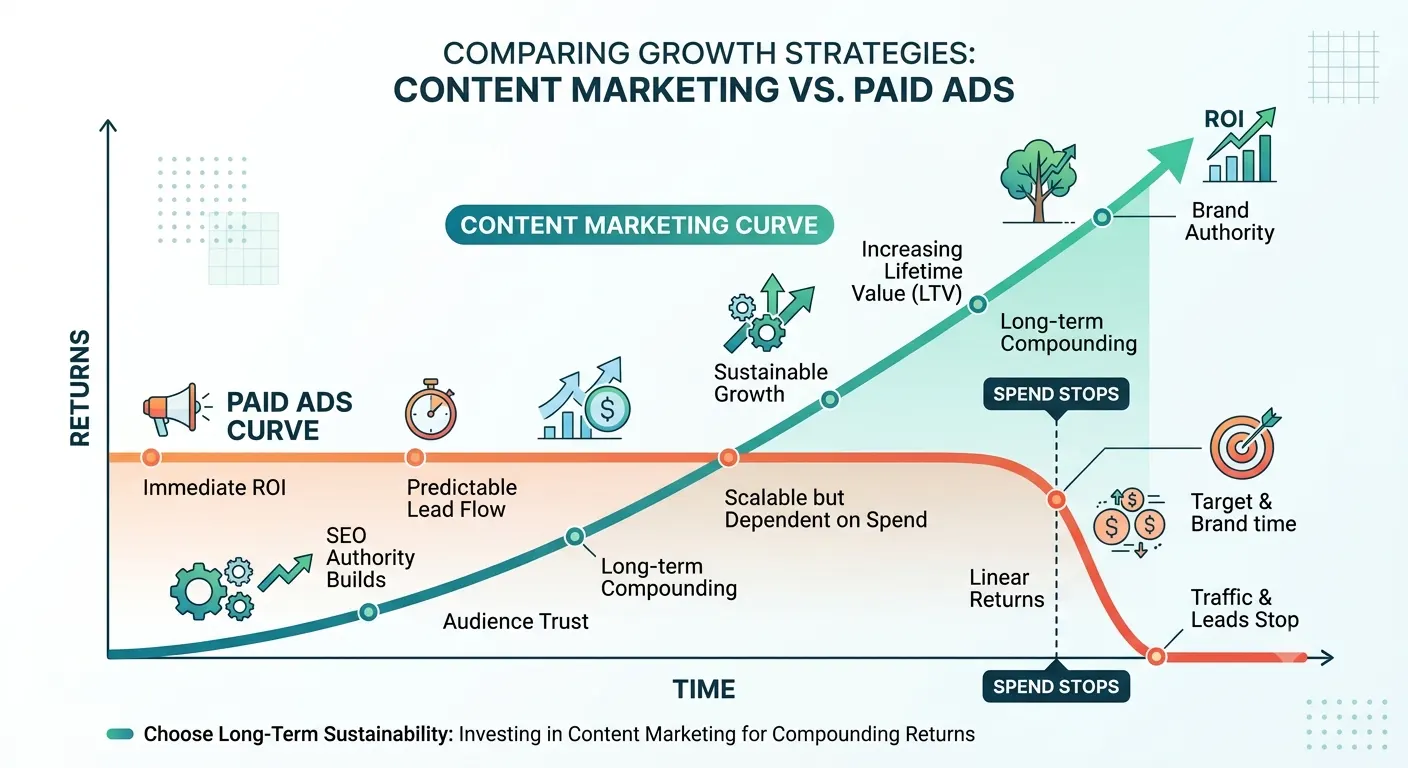
That asymmetry is the entire case for content. Paid gives you a faucet; content builds a well. The faucet is faster. The well is cheaper every year it exists — which is why content is now the single largest line item in most marketing budgets, and why the "3x leads at 62% less cost" benchmark has held for over a decade.
GEO vs. SEO: why the 2026 answer isn't the 2022 answer
Most articles on this topic were written for a world that's dissolving — one where "get found" meant "rank on a page of blue links and earn the click." That's still real, but it's now only half the board.
The other half is GEO (Generative Engine Optimization), sometimes called AEO (Answer Engine Optimization): being the source an AI cites when someone asks ChatGPT, Perplexity, or Google's AI Overviews a question. Buyers increasingly start there, and roughly a third of software buyers now also vet products on Reddit — which is why Reddit threads keep surfacing inside AI answers. The destination changed. The click is optional now.
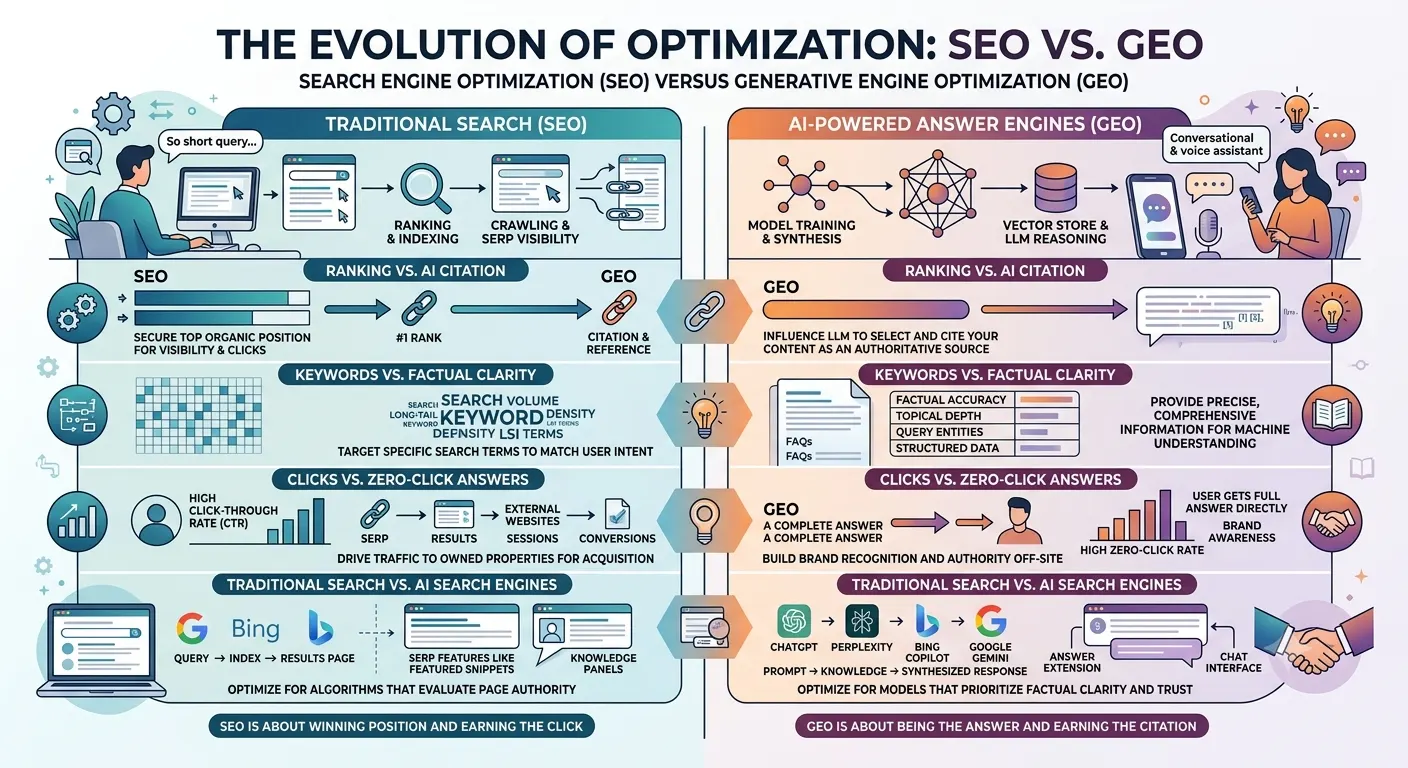
Here's how the two disciplines actually differ — and why it matters for whether content is "important":
SEO (classic search) | GEO / AEO (AI answers) | |
|---|---|---|
The goal | Rank high, win the click | Get cited inside the generated answer |
Unit of visibility | Position on the results page | Inclusion + mention in the AI's synthesis |
What wins | Keyword coverage, backlinks, on-page craft | Clear factual claims, original data, third-party validation, being the consensus answer |
Traffic pattern | Clicks to your site | Often zero-click awareness, plus fewer-but-higher-intent referrals (the AI pre-vetted you) |
How you measure | Rankings, organic sessions, CTR | Citation share across models, AI-referral traffic |
Can you buy your way in? | Partly (ads, sometimes links) | Not really — you earn it by being the best-explained, most-corroborated answer |
Notice the punchline. Both columns reward the same underlying thing: being the most genuinely useful, credible, quotable source on a topic. But GEO removes the shortcuts. You can't keyword-stuff your way into an AI's recommendation or buy the citation. The only durable way in is to publish something worth citing — original data, real expertise, a clearer explanation than anyone else.
So "why is content marketing important?" has a sharper 2026 answer than it did three years ago: because content is now the only asset that works in both worlds — and increasingly the only currency the AI layer accepts. Skip it, and you don't just lose rankings. You become invisible to the systems your buyers now ask first.
What content actually does for a business
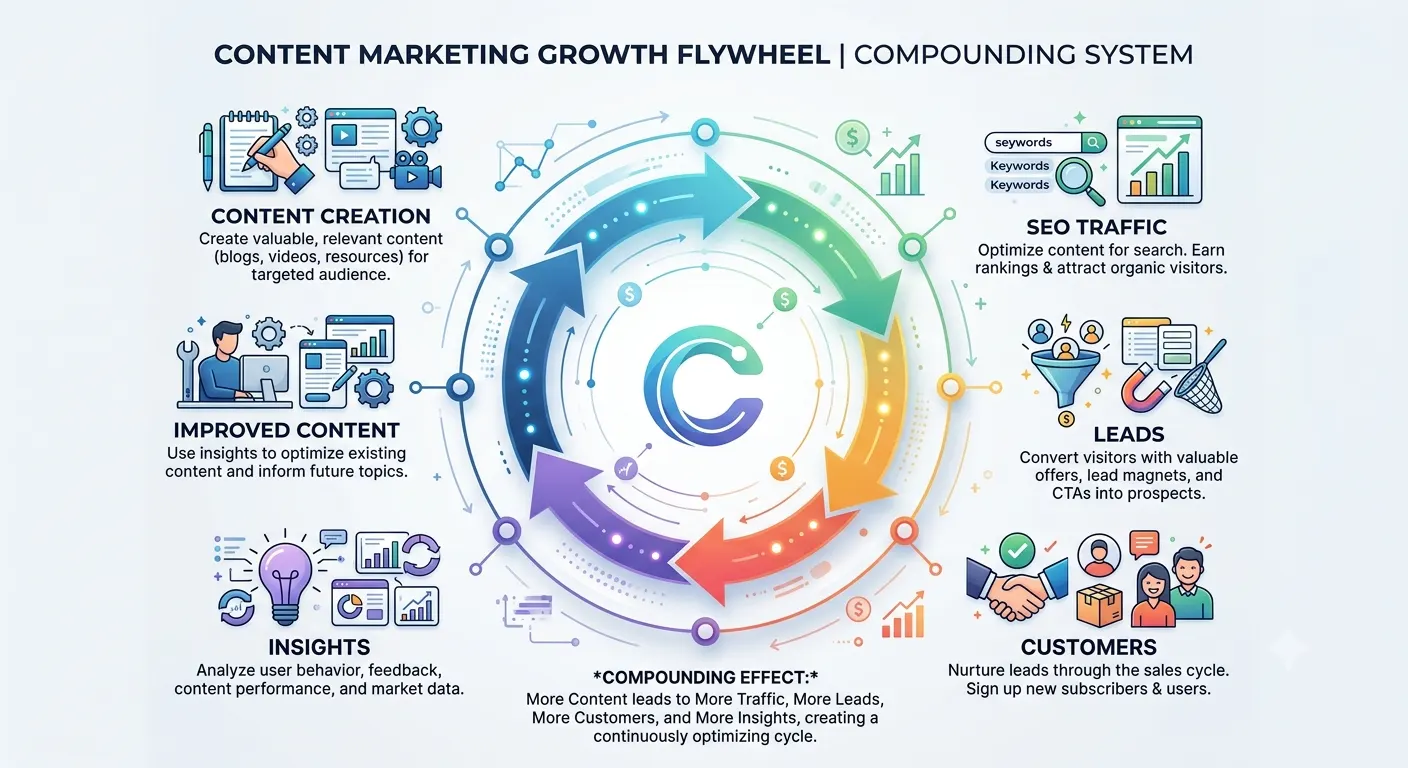
Strip away the listicle padding and content earns its budget through a few distinct mechanisms.
It compounds. Volume, done well, multiplies rather than adds — HubSpot's data shows heavy, consistent publishers pull several times the traffic and leads of occasional ones. It builds authority you can't buy: expertise is what Google's E-E-A-T framework rewards and what AI engines cite, and no ad budget manufactures it. It meets buyers mid-decision, when they're searching an informational question and forming an opinion — the moment that actually decides deals. And it feeds everything else you do: the newsletter, the sales deck, the paid landing page, the social feed all run on content you already made. Cut it, and you quietly starve every downstream channel at once.
None of these are "nice to have." Each is a mechanism a competitor is using against you right now if you're not.
Fresh proof (not the case studies you've read a hundred times)
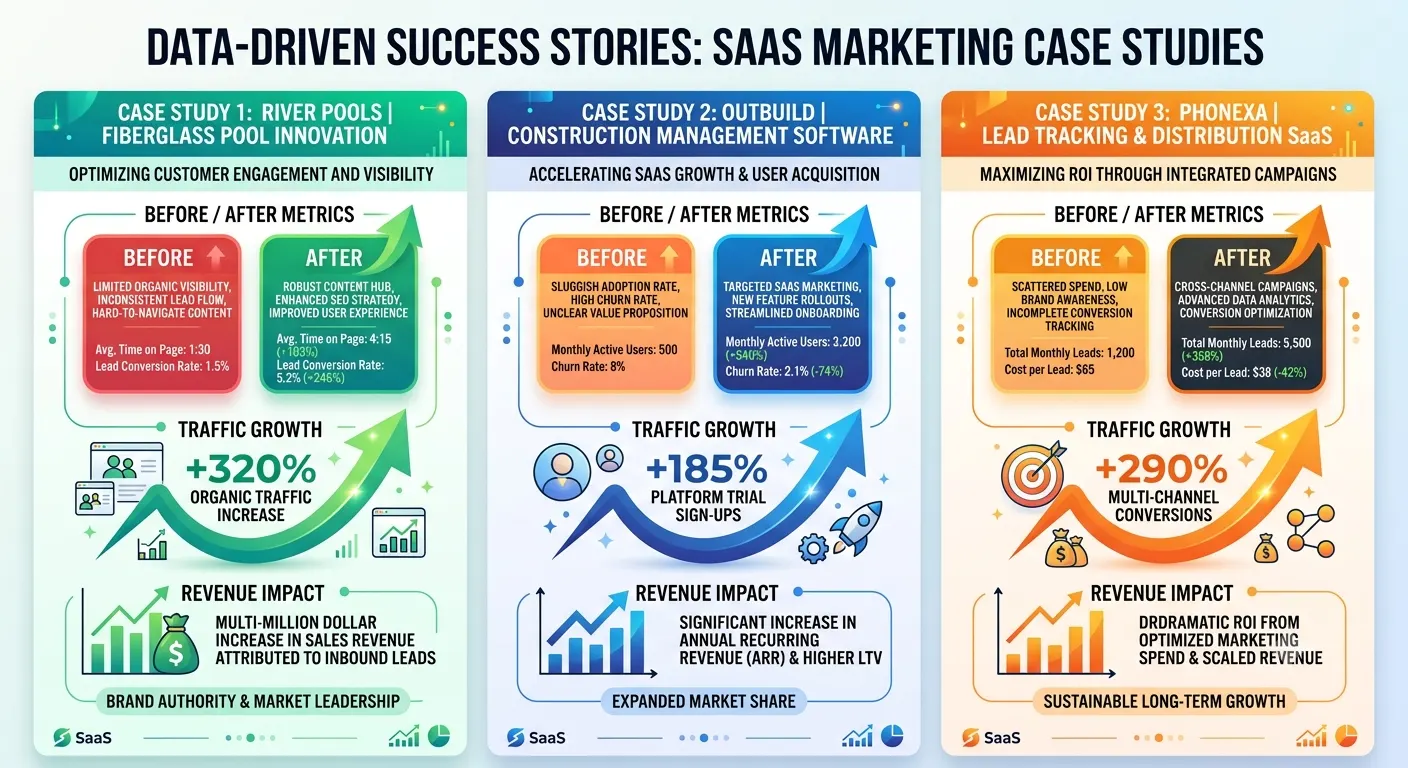
Outbuild — win by talking like your customer, not your category. This construction-scheduling SaaS roughly tripled organic traffic in a year (3,653 to 10,853 monthly, March 2025 to March 2026, per Position Digital). The lever wasn't volume. Their marketing lead noted that construction pros don't search "project management software" — they search lookahead planning, pull planning, Last Planner System. Outbuild built content around how the job actually works, so the traffic it earned was pre-qualified. Content's edge here wasn't reach; it was relevance no generalist competitor could match.
Phonexa — the counterintuitive 2026 lesson. After AI Overviews ate into search, Phonexa watched organic traffic fall 13% — and demo conversions rise 34%. Their SEO director found bloated pages were burying the decision. They cut up to 70% of the content on key pages, leaving only what a buyer needed to act. Less traffic, more revenue. In the AI era, the win isn't always more clicks; it's being the clearest answer for the right person (per Position Digital).
River Pools — still the cleanest small-business proof. A Virginia pool company, nearly bankrupt in 2009, decided to simply answer every customer question online. One article — "How much does a fiberglass pool cost?" — has driven more than $3.5M in revenue by the owner's own lead tracking (Social Media Examiner). The site became the most-visited pool website on earth. No ad budget. Just answering the questions competitors were too cautious to touch.
The through-line across all three: none won on spend. They won on being more useful, more specific, or more honest than everyone else competing for the same buyer.
The content marketing fit test (be honest with yourself)
Content is powerful, not universal. Before you commit budget, score these five. Mostly "yes" means content should be a core bet. Two or more "no"s means fix those first or put the money elsewhere — and no honest guide should pretend otherwise.
Is there demand to capture? Are buyers already searching or asking questions about your problem space? If nobody's looking yet, you may need to create awareness through other channels first, then use content to catch the demand you generated.
Can you commit for 12+ months? Four posts and a shrug produces nothing. Compounding needs sustained, consistent output. No stomach for a year? Spend elsewhere.
Do you have something original? Data, hard-won expertise, a real point of view. In a feed flooded with AI-generated sameness, "more content" is a liability and "new content" is the moat. If everything you'd publish already exists ten times over, you'll lose.
Is your payback window survivable? Most programs take three to seven months to break even. If you need pipeline in 30 days, that's a paid-ads job. Use content to lower costs over time, not to hit an urgent number.
Is the deal worth trust-building? Longer sales cycles and higher LTV make content's slow trust-building pay off handsomely. Impulse-buy, low-margin products may see faster returns from performance channels.
This test is the honest version of "why content marketing is important" — because knowing when it isn't the answer is what separates operators from cheerleaders.
How to start: a loop, and the tools for each stage
You don't need a big team. You need one repeatable loop, run consistently.
Research what buyers actually ask — Semrush and Ahrefs surface the real questions and what competitors already rank for. Create answers better than anything ranking now; AI assistants like ChatGPT or Claude accelerate drafting, while Clearscope or Surfer help you cover a topic thoroughly enough to get cited. Distribute on purpose, because publishing isn't distribution — Buffer or Hootsuite handle owned social, and for community reach, Leadmore AI is an AI-powered Reddit marketing tool that finds relevant subreddits, publishes safely through managed accounts to avoid bans, and tracks leads in real time, which matters now that Reddit threads feed straight into AI answers. Measure with Google Analytics 4 tied to your CRM so you can connect content to actual revenue. Then refresh and repeat — update your winners, repurpose across formats, let the library compound.
No tool "does content marketing" for you. Each owns one stage; the results come from running the loop, not from any app.
Run your own 20-minute study (this is what wins Top 3)
Everything above is synthesized from public data — the same public data your competitors are summarizing. The page that outranks them will have something they can't copy: your first-party numbers. Here's the fastest way to get one original stat worth citing.
Pull your own attribution. In GA4 + your CRM, find one honest figure: cost-per-lead from content vs. paid, or how long your top post has been generating leads, or your organic-vs-paid conversion rate. One real number, clearly sourced to your own data, beats a dozen borrowed benchmarks.
Ask five customers one question. "What did you read or watch before you bought?" Five short answers become a quotable insight about how your buyers actually research — the kind of thing AI engines cite and journalists link to.
Publish the method, not just the result. Say how you measured it. Transparency is an E-E-A-T signal and makes the stat credible enough to earn links.
Do this once and you convert this page from "a good summary" into "a source." That's the difference the rankings actually reward.
FAQ
Is content marketing still worth it in 2026?
More than before. As AI-generated filler floods every channel, original and credible content stands out further — and it's what AI answer engines cite when they recommend a solution. The bar is higher; the payoff for clearing it is bigger.
What's the difference between GEO and SEO?
SEO gets you ranked and clicked in traditional search. GEO (or AEO) gets you cited inside an AI-generated answer. SEO rewards keywords and links; GEO rewards clear claims, original data, and third-party corroboration you can't buy. Strong content serves both.
How long does content marketing take to work?
Usually three to seven months to break even, then compounding returns beyond that. It's a medium-to-long-term investment, not a quick win.
Is content marketing better than paid ads?
Different jobs. Paid is a fast faucet that stops when spend stops; content is a well that gets cheaper every year. The best programs use paid for speed and content for durable, low-cost growth — and use content to make the paid campaigns convert.
Does content marketing work for small businesses?
Yes, and the economics often favor them. You can't out-spend a big competitor on ads, but you can out-teach them in a niche — which is exactly how River Pools outranked national manufacturers.
What are the main benefits of content marketing?
More leads at lower cost, compounding organic visibility, authority and trust you can't buy, full-funnel nurturing, falling acquisition costs over time, and fuel for every other channel.
Is content marketing dead because of AI?
No — inverted. AI raises the value of original, expert content because that's what it cites. What's dying is generic content that adds nothing new.
How do I measure content marketing ROI?
Connect content-attributed traffic and leads to revenue in analytics plus your CRM, and count full costs (creation, tools, salaries). Proper attribution is where most teams fall short — and where your advantage hides.
About the author
Michael Bennett is a B2B content strategist and growth consultant specializing in SEO, GEO (Generative Engine Optimization), and revenue-driven content systems. He helps SaaS and B2B companies build organic growth engines that compound over time instead of relying on paid acquisition.
Over the past decade, he has led content and SEO programs across fintech, SaaS, and martech companies, building editorial systems that scaled from zero to 100K+ monthly organic visits and improving end-to-end attribution from content to pipeline and revenue.
His work focuses on making content perform in both traditional search and AI answer engines—helping teams structure information so it ranks, gets cited, and converts.
Sources
Demand Metric — content generates ~3x more leads than outbound at ~62% lower cost.
First Page Sage — B2B SaaS SEO ROI (~702%, 3-yr avg); organic vs. paid customer acquisition cost.
Content Marketing Institute — B2B Content Marketing Benchmarks, 2026: adoption, buyer self-education, benefits.
HubSpot — publishing-cadence traffic/lead benchmarks; State of Marketing.
Position Digital — Outbuild and Phonexa case data (2025–2026), with named practitioner quotes.
Social Media Examiner / Marcus Sheridan — River Pools & Spas ($3.5M-from-one-article figure, per the owner's lead tracking).
Industry analyses (2025–2026) of content-asset longevity, Reddit's role in buyer research, and AI-search referral trends.
.jpg?width=3840&quality=90&format=auto)