B2B Social Media Marketing in 2026: Data Report + Complete Playbook
Publication type: Annual benchmark report + strategy guide
Data collection period: January 2025 – June 2026
Sources analyzed: 14 primary industry research publications (see Methodology)
About the Author: Alex Morgan is a B2B Marketing Strategist at a SaaS growth consultancy, specializing in social media-driven pipeline generation and multi-channel attribution systems. With over 10 years of experience leading B2B marketing programs for SaaS and tech companies, he has helped teams scale from early-stage startups to post-IPO organizations. Previously, he led social media strategy at a Series B SaaS company, where a full channel redesign increased LinkedIn-driven pipeline contribution from 9% to 31% within one year.
Key Findings: What the 2026 Data Shows
Before the playbook, eight findings from 14 sources — none of which appear assembled this way in any single existing report:
The Attribution Gap is 55 percentage points. 90% of B2B marketing leaders believe social media contributes to revenue. Only 35% can prove it with attribution data. The gap is not a social media problem — it's a measurement infrastructure problem. (DesignRush 2026 Benchmark Survey)
When teams close that gap, the numbers are staggering. Sprout Social's own marketing team, after switching from last-click to multi-touch attribution, uncovered a 5,800% increase in additional pipeline impact from social channels they'd been undercounting. (Sprout Social 2025 Impact of Social Media Report)
38–51% of B2B pipeline already comes from dark-funnel sources — podcasts, communities, referrals, dark social — that leave no tracking signal. The share rises to 51% for product-led growth motions. Most teams allocate near-zero budget to channels driving a majority of their pipeline. (Improvado 2026 B2B Attribution Benchmark)
95% of B2B purchases go to vendors already on the buyer's day-one shortlist. That shortlist forms months before a buying process formally begins — entirely in dark social, through thought leadership, peer conversations, and community presence. Getting on the shortlist is the real job of B2B social. (6sense, Buyer Experience Report 2025)
Personal profiles beat company pages by 8x on LinkedIn — and this gap is widening, not narrowing. (Socialinsider/Oktopost 2026 LinkedIn Benchmark)
LinkedIn delivers 229% ROI over three years on organic social, 192% on paid social — the highest long-term ROI documented for any B2B social channel. The caveat: most of that ROI accrues in years two and three, not month one. (FirstPageSage 2025 ROI analysis)
Reddit now accounts for 46.4% of all social media citations in AI-generated answers — more than double any other platform. A comment in a relevant B2B subreddit now influences AI shortlist recommendations, organic Google rankings, and Perplexity answers simultaneously. (OtterlyAI, April 2026)
The buying committee now averages 11 stakeholders on enterprise deals, up from 7 in 2017. Each additional stakeholder reduces purchase probability by ~10 percentage points. 74% of those committees experience unhealthy conflict before deciding. The social content that moves B2B deals isn't content that builds awareness — it's content that helps a champion sell you internally. (Gartner 2025 Sales Practice Research)
The Core Problem Every B2B Social Strategy Must Solve
The buying committee is not a nuance. It is the central fact of B2B marketing.
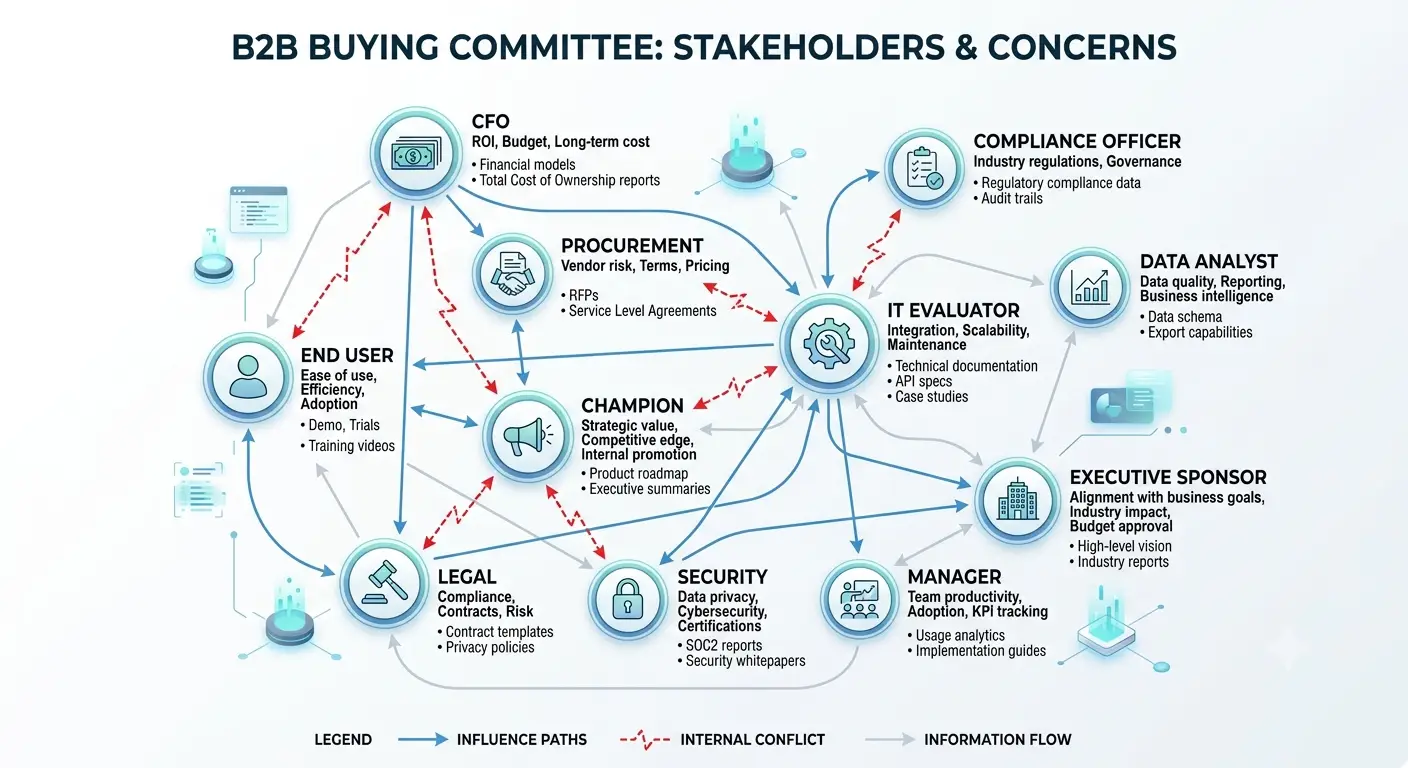
Gartner's 2025 data sets the average enterprise buying committee at 11 stakeholders, ranging up to 16–20 on large-enterprise deals. Forrester's State of Business Buying puts the average at 13 stakeholders, with 89% of decisions crossing multiple departments. These aren't the same 13 people looking at the same content. They're an IT evaluator, a finance approver, a legal reviewer, a practitioner, a champion, a blocker — each doing independent research in different places, at different times, with different concerns.
And 95% of those buyers are going to purchase from a vendor already on their day-one shortlist. They made that shortlist during the months before your sales team ever heard from them — through passive social exposure, peer recommendations, Reddit threads, podcasts, LinkedIn scrolling, and AI-generated comparisons.
The real job of B2B social media is not awareness. It is getting on the shortlist before the buying process starts.
The rest of this guide is built around that insight.
Original Data Section 1: The B2B Social Attribution Gap
Analysis synthesized from: DesignRush 2026 Benchmark Survey, Sprout Social 2025 Impact of Social Media Report, CMI 2025 B2B Content Marketing Research, Improvado 2026 B2B Attribution Benchmark, and 6sense Buyer Experience Report 2025. See Methodology.
No published source has assembled these five data streams into a single picture. When you do, a coherent and troubling pattern emerges.
The Gap in Five Numbers
Question | Answer | Source |
|---|---|---|
% of B2B leaders confident social drives revenue | 90% | DesignRush 2026 |
% of B2B marketers who can prove social ROI with attribution | 35% | DesignRush 2026 |
Pipeline uplift when teams actually implement multi-touch attribution | +5,800% | Sprout Social 2025 |
% of B2B pipeline coming from dark-funnel sources (no tracking signal) | 38–51% | Improvado 2026 |
% of B2B purchases going to vendors on the day-one shortlist | 95% | 6sense 2025 |
What the Pattern Means
Put these numbers together and a specific failure mode emerges: teams confidently believe social is working, can't prove it, under-measure it by a massive amount when they try, and have the most influence in a stage (pre-shortlist formation) where almost none of their current metrics look.
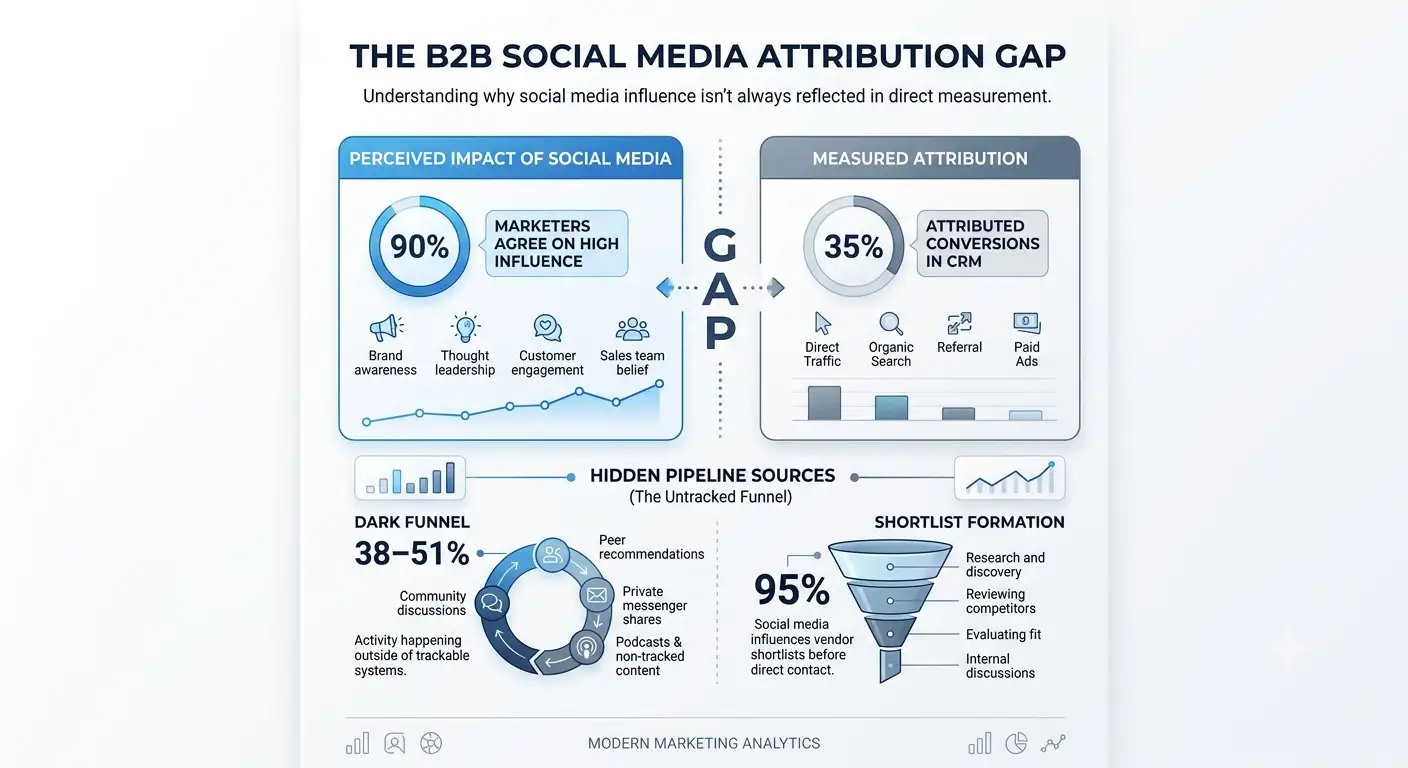
The 5,800% pipeline uplift figure from Sprout's own team is the most telling single data point in this report. That number isn't evidence that social suddenly started working when they switched to multi-touch attribution. It's evidence of how much existing pipeline influence was already happening — in channels and content types that last-click models assigned zero credit to.
The Improvado benchmark that 38–51% of B2B pipeline comes from dark-funnel sources that leave no tracking signal explains why. If roughly half of your pipeline originates in podcast listenership, community conversations, and LinkedIn passive scrolling, and your attribution system only captures demo request clicks, you will always undervalue social media by roughly 2x.
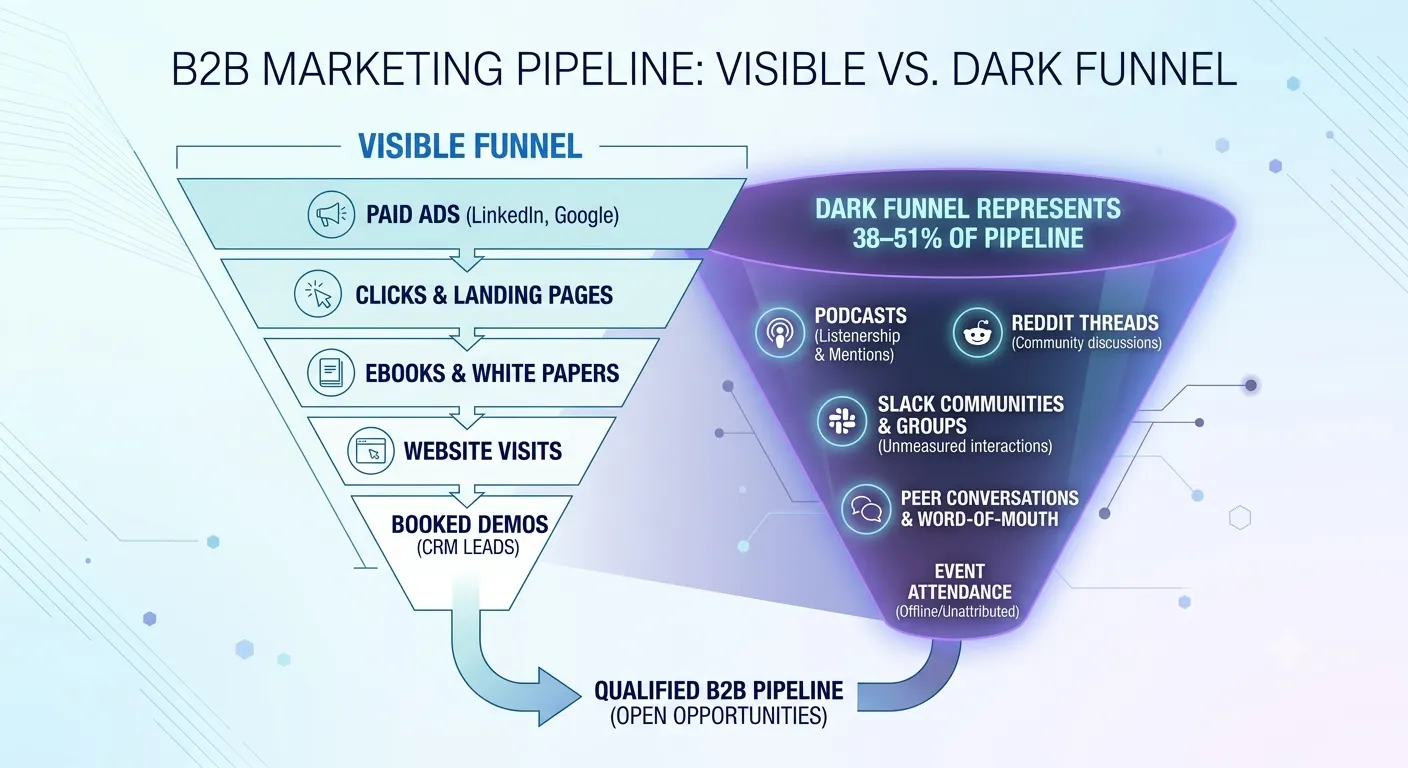
Key Implication: B2B social media programs are almost universally under-resourced relative to their actual pipeline contribution, because the attribution gap makes them look smaller than they are.
Original Data Section 2: Cross-Platform ROI Benchmark for B2B Social in 2026
Synthesized from: LinkedIn/Ipsos 2025 B2B Marketing Benchmark, Oktopost B2B Social Benchmark 2025, Socialinsider 2026 LinkedIn Benchmark, FirstPageSage 2025 ROI data, TrustRadius 2025 B2B Buyer Report, OtterlyAI 2026 AI Citation Data, Outreachbloom 2026 Reddit Pipeline Analysis, and DSMN8 2026 Employee Advocacy Benchmark.
The following table cross-references each major B2B social platform against the five metrics that actually matter in the buying committee era: pre-shortlist influence, AI answer engine presence, evaluation-stage weight, consensus-building strength, and documented ROI. No single existing source has this comparison.
B2B Platform Performance Matrix — 2026 Edition
Platform | Pre-Shortlist Influence | AI Answer Citations | Evaluation Impact | Consensus-Building | Documented ROI |
|---|---|---|---|---|---|
LinkedIn (personal profile) | ⬛⬛⬛⬛⬛ Very High | ⬛⬛⬛⬛ High | ⬛⬛⬛⬛ High | ⬛⬛⬛⬛ High | 229% organic (3yr) |
LinkedIn (company page) | ⬛⬛⬛ Moderate | ⬛⬛⬛ Moderate | ⬛⬛⬛ Moderate | ⬛⬛⬛ Moderate | 192% paid (3yr) |
YouTube | ⬛⬛⬛ Moderate | ⬛⬛⬛⬛ High | ⬛⬛⬛⬛⬛ Very High | ⬛⬛⬛ Moderate | High (varies) |
⬛⬛⬛⬛ High | ⬛⬛⬛⬛⬛ Very High (46.4% share) | ⬛⬛⬛⬛ High | ⬛⬛⬛ Moderate | 6x ROAS (Rise Vision) | |
Employee Advocacy | ⬛⬛⬛⬛⬛ Very High | ⬛⬛⬛ Moderate | ⬛⬛⬛⬛ High | ⬛⬛⬛⬛⬛ Very High | Up to 91% ad cost reduction |
Podcast (sponsorship) | ⬛⬛⬛⬛ High | ⬛⬛ Low | ⬛⬛ Low | ⬛⬛⬛⬛⬛ Very High | High (dark-funnel) |
X / Twitter | ⬛⬛ Low-Mod | ⬛⬛ Low | ⬛⬛ Low | ⬛⬛ Low | Niche / category-dependent |
Instagram / TikTok | ⬛⬛⬛ Moderate | ⬛ Minimal | ⬛⬛ Low | ⬛⬛ Low | Varies by buyer demographic |
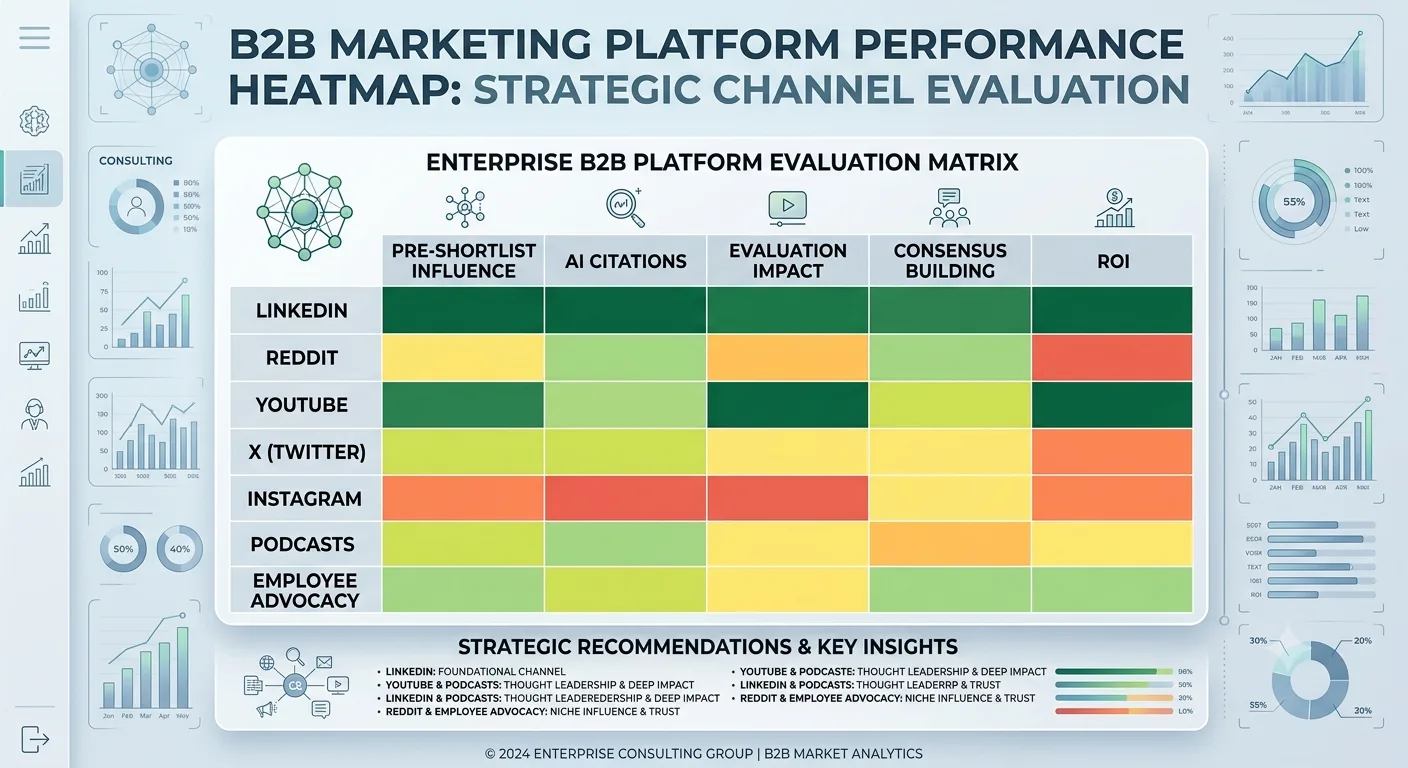
What This Matrix Shows That Others Don't
Three non-obvious conclusions:
1. Employee advocacy is the single highest-performing B2B social strategy that most companies haven't deployed. Dropbox achieved a 91% reduction in paid media spend from employee advocacy while maintaining equivalent reach. The mechanism: personal profiles generate 8x the engagement of company-page content, and trust in employee-shared content is fundamentally higher than brand-shared content (per Edelman Trust data). When multiplied across 30–50 employees, this becomes a content distribution flywheel that compounds over time.
2. Reddit's AI-citation dominance makes it a category above its apparent reach size. A platform with significantly fewer B2B users than LinkedIn is cited nearly half of all social media mentions in AI-generated answers because AI engines prefer it as a "real user experience" source. The implication: being mentioned positively in a Reddit thread now simultaneously influences organic Google rankings, AI answer engine responses, and community-level social proof. No other B2B channel achieves all three.
3. Podcast has the worst measurable ROI and the best unmeasured ROI — which is why it belongs in this analysis. Podcasts don't generate UTM-tracked clicks at scale. They generate the kind of sustained trust-and-familiarity that makes a buyer feel like they already know you when they eventually fill out your demo form. That's the dark-funnel mechanism at work: the 38–51% of B2B pipeline from sources with no tracking signal runs disproportionately through podcasts, communities, and events.
Three Contrarian Findings Most B2B Social Guides Get Wrong
Finding 1: LinkedIn Is Not Automatically Your Best Channel
The standard advice: anchor B2B social on LinkedIn. For about two-thirds of B2B categories, that's still right. 86% of B2B marketers use it and 80% of B2B social leads originate there.
But for a specific and growing set of categories, LinkedIn is second or third, not first:
Developer tools and technical infrastructure: Vercel, Supabase, and PlanetScale didn't build their early bases on LinkedIn. They built them through GitHub, Hacker News, Discord, and subreddits like r/devops and r/selfhosted — where their buyers live in problem-identification mode, not professional-networking mode.
SMB-focused SaaS: The owner-operator of a plumbing company, Shopify store, or 5-person agency searches YouTube for how-to tutorials, watches Reels, and asks questions in Facebook Groups during vendor research. LinkedIn is often a secondary or tertiary channel for this buyer.
Bottom-up product-led growth: When individual users adopt before procurement is involved, they found you somewhere personal — Reddit, Twitter, Product Hunt, a friend's recommendation. LinkedIn played little or no role.
The honest test: Don't ask "which platform do B2B marketers use?" Ask "which platform does my specific buyer visit when they have the problem I solve, before they enter a formal buying process?" For many teams that's LinkedIn. For a growing minority it isn't — and defaulting to LinkedIn is one of the most expensive strategic errors in the category.
Finding 2: Posting More Is Now a Negative Signal
The 2019–2022 B2B playbook was volume. That playbook broke, for two documented reasons:
Oktopost's B2B Social Benchmark 2025 and Socialinsider's 2026 LinkedIn Benchmark both show that posting more than once per day reduces per-post engagement consistently. The optimal range is 3–5 posts per week for company pages.
77% of B2B creative fails to register emotionally or create long-term impact (Marketing Week). Volume amplifies this failure — more forgettable posts mean more unfollows and more algorithmic suppression.
The rule that follows: Cut posting frequency in half and reinvest the time in content quality and paid amplification of the top 20%. Two to three genuinely good posts per week per voice, with the winners amplified via LinkedIn Thought Leader Ads, consistently outperforms daily volume over any 6-month measurement window.
Finding 3: Most of Your B2B Social ROI Is in the Channel You're Least Measuring
Finding #1 in this report's Key Findings section established that 90% of B2B leaders believe social drives revenue, only 35% can prove it, and Sprout's own attribution shift revealed 5,800% more pipeline impact than they'd been counting.
The reason is structural: the 38–51% of B2B pipeline from dark-funnel sources — podcasts, communities, referrals, dark social — shows up nowhere in a standard social analytics dashboard. Teams that measure only what their dashboard rewards will systematically under-fund the channels where they already have the most influence.
The practical implication: Budget at least 25% of social investment toward channels where ROI is real but un-tracked — community participation, podcast presence, employee advocacy, forwardable one-pagers. The ROI will not appear in the monthly social report. It will appear in the won-deals spreadsheet.
Three Documented Case Studies
Case Study 1: How Gong Built Category Dominance With LinkedIn Takeovers
Company: Gong (revenue intelligence / conversation AI)
Stage: Seed → $7.25B valuation, 5,000+ customers, $500M+ ARR
The challenge Gong faced: They were trying to establish a new software category — "revenue intelligence" — against a market that didn't yet believe the category was necessary. Cold outreach and product-led growth wouldn't work. They needed mass awareness among sales leaders, built on trust.
The approach:
LinkedIn became Gong's primary category-building channel, executed through a three-layer strategy documented in LinkedIn's own case study on Gong and later analyzed by multiple marketing research firms:
Executive and CMO as category voices. CMO Udi Ledergor and CEO Amit Bendov posted data-backed insights and strong opinions on LinkedIn multiple times per week under their own names — not the company page. Each post was tied to the category they were defining, not the product they were selling.
Company-wide coordinated posting ("LinkedIn Takeovers"). Gong coordinated employees across all functions — SDRs, engineers, customer success, new hires — to post simultaneously around milestones: first-week experiences, retreat recaps, fundraising announcements, product launches. Dozens of employees posting on the same day created algorithmic momentum no single viral post could match, while keeping the content authentic because it came from real people posting real experiences.
Proprietary data as content raw material. Gong pulled anonymized insights from their conversation-intelligence platform — findings from millions of recorded sales calls — and turned them into social content no competitor could replicate: "Data from 100,000 sales calls shows reps who [do X] close [Y]% more deals." This content category was impossible to copy without having Gong's product.
Organic winners into paid. Gong were early adopters of LinkedIn Thought Leader Ads, using the format to amplify high-performing employee posts to precisely targeted account-based audiences.
Documented results:
Gong grew from a new entrant to the company that defined the "revenue intelligence" category it had to convince the market existed
5,000+ enterprise customers, $500M+ ARR (Improvado, 2026 analysis)
LinkedIn follower count 3.5x their closest competitor (Chorus) before Chorus was acquired
Valued at $7.25B at last funding round
Named by LinkedIn in their own case study as a model for B2B social strategy
What to steal: Three elements compound together: (1) proprietary data turns your product into a content engine, (2) coordinated employee posting creates reach no single account can achieve, and (3) amplifying proven organic posts with precision-targeted paid ads converts reach into pipeline. Any B2B company with a data-generating product can run a version of this playbook.
Case Study 2: How Reddit Became a B2B Pipeline Channel — Rise Vision and the Category Pattern
Category: B2B SaaS (Rise Vision: digital signage; broader pattern across PLG-stage companies)
Channel: Reddit organic + paid
Timeframe: 2024–2026 (post-Google licensing deal)
Why the channel changed:
Three structural shifts in 2024–2025 elevated Reddit from "community experiment" to "serious B2B pipeline source":
Google's $60M content-licensing deal with Reddit (March 2024) embedded Reddit threads in organic search results and AI Overviews. High-value Reddit discussions now rank above editorial content for many B2B product-evaluation queries.
AI answer engine citation dominance. Reddit accounts for 46.4% of all social media citations in AI-generated answers (OtterlyAI, April 2026). When a buyer asks Perplexity "is [product] worth it for a 20-person team?", the answer cites Reddit threads — not vendor websites.
32% of B2B software buyers use Reddit to research products, seeking peer perspectives before entering formal buying processes. This is the dark-funnel shortlist-formation layer that traditional analytics can't see.
Rise Vision's documented result:
Single Grain's 2025 analysis of Rise Vision — a B2B digital signage SaaS — showed the company achieved a 6x ROAS increase and 77% cost-per-lead reduction by focusing Reddit ad targeting on specific subreddits where their exact buyers were actively discussing category-relevant problems. The mechanism was not Reddit as a mass advertising channel but Reddit as a precision-targeted community layer where their buyers already existed in a research mindset.
The mechanics that work:
Stage | What Works | What Fails |
|---|---|---|
Entry | Map 3–5 subreddits where buyers research your category. Participate as an expert for 4–8 weeks before any promotion. | Immediately posting links or product mentions |
Growth | Answer questions with specific, non-generic expertise. AMA posts with real metrics (churn %, pricing experiments). | Templated AI-generated replies, promotional tone |
Scale | Once organic credibility is established, run paid Reddit ads targeted to those same subreddits. | Running paid before organic presence is built |
AI/SEO | High-karma threads rank on Google and appear in AI citations — sustained value for years | Expecting immediate attribution |
Tool note: The main operational challenge in Reddit B2B marketing is account safety. 80%+ of SaaS companies fail on Reddit within the first month by using promotional language or getting accounts banned. Tools like Leadmore AI address this specifically: it publishes through platform-managed, high-karma accounts so teams can participate without personal account risk, and tracks keyword-matched lead conversations in real time so teams know exactly where high-intent buyers are discussing relevant topics.
Case Study 3: Superhuman and the Founder-Led Social Flywheel
Company: Superhuman (email productivity SaaS)
Founder: Rahul Vohra (previously co-founded Rapportive, sold to LinkedIn in 2012)
Result: $825M valuation in the most commoditized software category on earth (email clients)
The challenge: Superhuman launched into a market with free, entrenched competitors (Gmail, Apple Mail, Outlook). There was no obvious reason to pay $30/month for email software. The conventional approach — awareness advertising, SEO content, LinkedIn company page — would have been drowned out by the size of the incumbents.
The approach:
Superhuman built a social flywheel that ran entirely on the founder's personal credibility and a community of delighted early users — not on the company brand.
Founder posting original intellectual frameworks, not product news. Rahul Vohra's most widely shared content across X (Twitter) and LinkedIn wasn't about Superhuman at all. His original essay on measuring product-market fit — adapting Sean Ellis's "40% very disappointed" benchmark into a rigorous 4-step system — went viral in the startup community because it was genuinely useful to every founder who read it, completely independent of his product. That essay turned Rahul into a trusted voice that thousands of potential customers followed before they'd ever heard of Superhuman.
Invite-only scarcity plus high-touch onboarding. At peak, Superhuman employed 20 people doing manual, personal onboarding calls. This sounds expensive. The output was a cohort of users so delighted they couldn't stop talking about Superhuman in their networks — on Twitter, in Slack groups, at founder dinners. The social media component wasn't Superhuman's company page. It was hundreds of early adopters posting unprompted.
Community amplification before company amplification. The invite-only waitlist made early access feel exclusive. Users who "got in" had a social motivation to share that fact. The social proof flowed from user-to-user, not brand-to-user.
Documented outcome:
Built to $825M valuation in a category where the competitors are free
Sustained $30/user/month premium pricing (extraordinary in a commoditized market)
Recently acquired — demonstrating sustained strategic value beyond hype
Word-of-mouth acquisition rate higher than most SaaS companies achieve with aggressive paid programs
What to steal: Rahul didn't run a social media program. He built a reputation as someone worth listening to by sharing original, useful thinking with no sales agenda. The product became desirable because the founder was credible. For B2B brands: one original framework post from your CEO that solves a real problem in your buyer's world does more pipeline work than a month of company-page content. The mechanism is trust, and trust scales through personal voices, not brand handles.
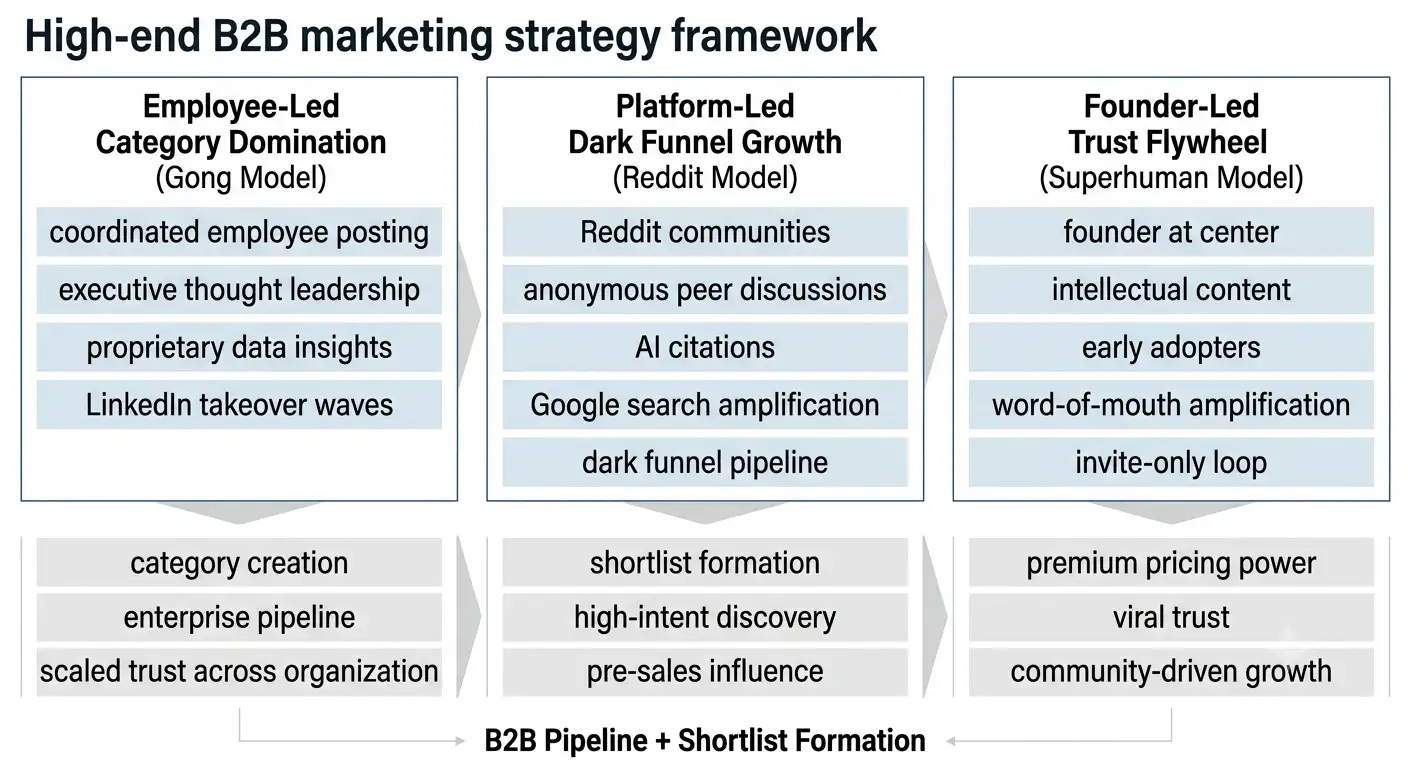
The Mental Model: Trust × Visibility × Consensus
Every platform decision and every content decision in a B2B social strategy should be judged against three questions, in this order:
Does it build trust? 73% of B2B buyers actively avoid vendors that blast irrelevant outreach. 55% of B2B decision-makers use thought leadership as part of their vetting process (Edelman-LinkedIn 2025). 60% are willing to pay a price premium to suppliers whose thought leadership they respect (Edelman-LinkedIn 2025). Trust is the mechanism by which social media actually converts to pipeline.
Does it build visibility? Not just reach — the right visibility, in the right channels, at the moment buyers are forming their shortlist. That increasingly includes YouTube, Reddit, AI answer engines, and community forums alongside LinkedIn.
Does it build consensus? Tailoring content for buying-group relevance improves consensus formation by 20%, while individual-only targeted content can hurt consensus by up to 59% (Gartner 2025). Content that helps your champion sell you internally — forwardable PDFs, business-case templates, stakeholder-specific one-pagers — is doing the highest-value social media work even though it generates zero LinkedIn impressions.
Content Strategy: Map Every Asset to a Buying Job
Gartner's research frames B2B buying as six non-linear "jobs" buyers cycle through. Most content calendars are built around marketing preferences and platform algorithms. They should be built around these jobs.
Buying Job | What This Buyer Needs | Content That Delivers It |
|---|---|---|
Problem identification | Recognize the cost of the status quo | Industry data posts, "you might have this problem if…" frameworks, founder POVs |
Solution exploration | Understand what categories exist | Category explainers, comparison content, "X vs Y" breakdowns (honest ones) |
Requirements building | Define what "good" looks like | Checklists, RFP templates, buying guides (forwardable PDFs) |
Vendor selection | Build a defensible shortlist | Customer case studies with specific outcomes, analyst citations, G2/TrustRadius mentions |
Validation | Verify claims independently | Product demo videos (YouTube), customer testimonials, ROI calculators |
Consensus creation | Sell internally to the committee | One-page business cases, role-specific benefits documents, risk-and-rollout guides |
The most underproduced asset in B2B social: consensus creation content. It scores zero on LinkedIn engagement metrics and drives more deals than anything else. Produce it. Post it. Make it easy to download and forward.
Platform Strategy: Where to Actually Invest
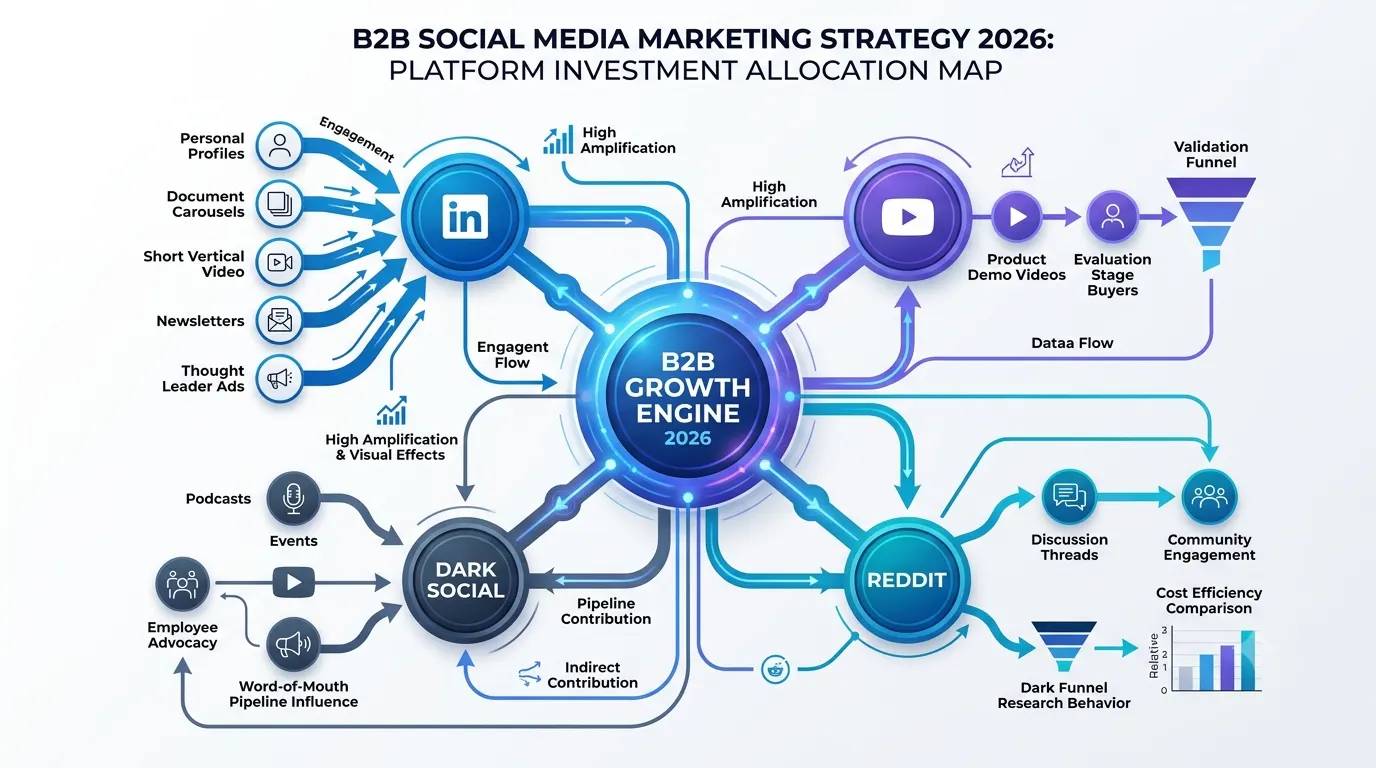
LinkedIn: Personal Profiles Over the Brand Page
LinkedIn is the home base for most B2B teams. But the most important tactical insight in 2026 is where to put the weight. Personal profiles generate 8x the engagement of company-page content on identical posts. LinkedIn now has 1.3 billion members and 1.4 billion monthly visits, and B2B sessions grew 11% year-over-year in 2025.
What works:
Document carousels — 10–15 slides, data-backed, 2–3x average post impressions
Lo-fi vertical video — phone-shot, captioned, under 60 seconds; 2–3x the engagement of polished production
LinkedIn Newsletters — 40–50% open rates (highest of any LinkedIn format); 10–25% follower-to-subscriber conversion
Thought Leader Ads — amplify employee/founder organic posts to target accounts; uniquely combines personal credibility with paid precision
YouTube: The Validation Layer
29% of B2B buyers — and 25% of enterprise buyers specifically — use YouTube to research vendors. This is validation-stage consumption, not awareness-stage. If a buyer can't find a product walkthrough on YouTube when they're evaluating you, that's a silent shortlist exclusion.
Minimum viable YouTube presence for a B2B company: 3–5 short product demos (60–120 seconds, one per workflow), 2 longer evaluation-stage videos (5–10 minutes, for IT and security reviewers), and a repeatable customer-spotlight format.
Reddit: The Dark Social Research Layer
32% of software buyers use Reddit to research products during the evaluation phase. Reddit CPC runs $0.50–$2.00 vs. LinkedIn's $5.26–$8.00 for comparable professional audiences — a significant cost arbitrage window. And post-Google licensing deal, high-value Reddit threads now rank in organic search and feed AI-generated answers.
The participation model that works: genuine expertise in 2–3 specific subreddits where your buyers research, AMA-style posts sharing real operational metrics, and (once organic credibility is built) paid ads narrowly targeted to those same communities.
Dark Social Channels: Budget Here Even Without Proof
Podcasts, industry communities, events, and employee advocacy are the channels where the 38–51% of pipeline from dark-funnel sources originates. These don't produce UTM clicks or attribution dashboard entries. They produce the shortlist formation that determines whether your LinkedIn ad finds a warm prospect or a cold one.
Budget for them proportionally — at least 25% of social spend — and measure them through the signals they do leave: branded search volume trends, self-reported "how did you hear about us?" form responses, and deal notes from sales teams.
A Practical Tool Stack
One tool per category before adding a second.
Job To Be Done | Tool(s) | Why |
|---|---|---|
Multi-platform publishing and team workflows | Hootsuite, Sprout Social, or Buffer | Hootsuite = broadest (advocacy + listening + ads); Sprout = strongest Salesforce integration; Buffer = simplest for small teams |
Social listening and brand monitoring | Brand24 (standalone) or Hootsuite/Sprout Listening (if on those platforms) | Track brand mentions, category conversations, competitor mentions without manual searching |
LinkedIn personal-profile management | Taplio, Shield Analytics | Per-creator analytics and scheduling — critical when your strategy centers on employee/founder posting |
Reddit and community engagement | Leadmore AI | Surfaces high-intent subreddits for your category, tracks keyword-matched lead conversations in real time, publishes through platform-managed accounts to avoid ban risk. Relevant given Reddit's 46.4% AI-citation share and 32% B2B buyer usage rate |
Employee advocacy programs | Hootsuite Amplify, DSMN8, Sprout Employee Advocacy | Pre-approved content library for employee sharing; enables the Gong-style amplification playbook |
AI content drafting | ChatGPT, Claude, Jasper | First-draft and ideation layer; requires human editing before publishing — audiences and algorithms both detect unedited AI output |
Attribution and pipeline reporting | Sprout Social + Salesforce integration; UTM parameters; self-reported source fields | The tools that close the Attribution Gap described in Section 1 |
Measurement: Three Layers That Survive Executive Review
Layer 1 — Leading Indicators (what your dashboard shows)
Engagement rate, video view-through, follower growth from target-account segments. These tell you whether content is working. They don't tell you whether the program is working.
Layer 2 — Pipeline Influence (where most programs stop short)
Multi-touch attribution, social-touch rate on opportunities, close rate differential for social-touched deals vs. non-touched deals. Social-touched deals close at 20–40% higher rates in well-run programs. Sales cycles shorten 15–30%. This is the layer that converts social from a content expense into a revenue investment in a budget conversation.
Layer 3 — Revenue Outcomes (what executives ask for)
Cost-per-acquisition vs. paid search and outbound, win rate on socially-engaged accounts, sales cycle velocity delta. LinkedIn organic social delivers 229% ROI over three years — but that ROI is invisible unless you're measuring Layer 3.
Two reporting principles:
Report benchmark-relative, not absolute. "Engagement up 22% QoQ at consistent reach" is a business statement. "We got 1,400 likes" is noise.
Connect at least one social initiative per quarter to a specific revenue outcome — reduced CAC, faster deal velocity on a key account segment, anything with a dollar figure attached.
The Attribution Gap close: Add (1) UTM tags on every link, (2) a self-reported "how did you hear about us?" field on every form, (3) a CRM lead-source field that includes "Social Media" with platform sub-categories, (4) a quarterly deal-close interview question for sales: "Did this buyer mention any content they'd seen before reaching out?" Those four changes will shift your measured attribution toward reality.
30/60/90-Day Execution Plan
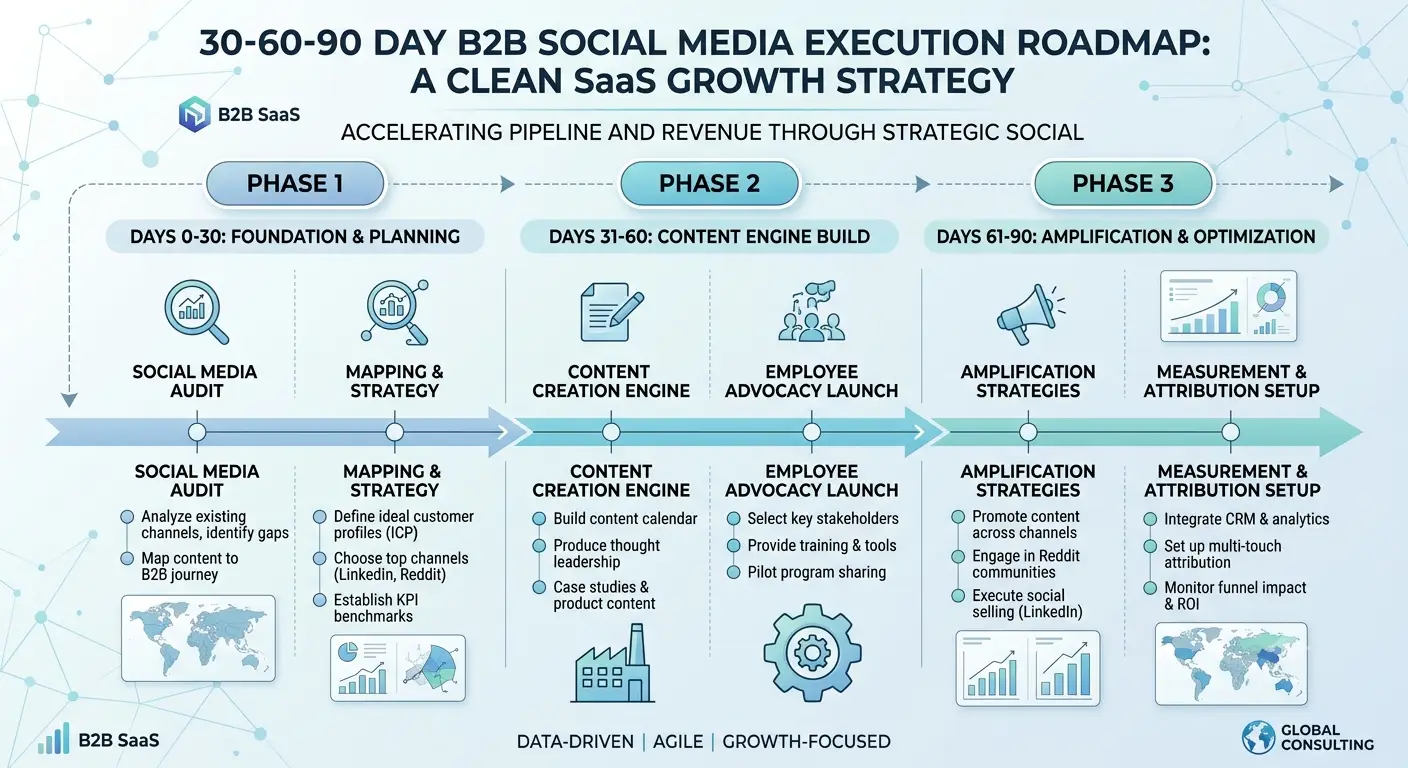
Days 1–30: Honest Audit
Map your buying committee realistically. For each of the 6–13 typical roles, one sentence on what they're worried about during vendor evaluation.
Audit your current social program honestly: what's the top-performing content of the past 12 months by self-reported deal influence, not just by likes? Is your content speaking to the committee or one persona?
Use the Platform Performance Matrix from Section 2 to verify that your current platform mix matches where your specific buyer actually researches — not where the average B2B marketer invests.
Name your personal-profile voices: CEO/founder, two SMEs, one to two SDRs. Commit their posting frequency before buying tools. Two to three posts per week each.
Cut company-page posting to 3–5x per week maximum and redirect the time to quality.
Days 31–60: Content Engine Build
Create a content calendar explicitly mapped to the six buying jobs. One strong asset per job per quarter is the goal.
Launch founder and employee posting cadences anchored in real observations, opinions, and data from actual customer work — not corporate restatements.
Implement the Attribution Gap close (UTMs, self-reported form field, CRM source field, sales interview question).
Run one new-channel experiment for 30 days: a Reddit pilot, TikTok test, or podcast appearance. Set a decision criteria and evaluate with data.
Days 61–90: Amplify and Measure
Identify the three best-performing organic posts of the last 60 days. Amplify via LinkedIn Thought Leader Ads to target-account audiences.
Launch an employee advocacy program with pre-approved content, voluntary participation, internal recognition for contributors.
Build the three-layer executive report and set quarterly cadence. Monthly social reports invite over-interpretation of noise.
Allocate a budget line specifically for dark-funnel activities — podcasts, community participation, events. Document it explicitly as "investment in pipeline sources that won't attribute cleanly for 6–9 months."
Frequently Asked Questions
What is B2B social media marketing?
B2B social media marketing is the strategic use of platforms including LinkedIn, YouTube, Reddit, X, Instagram, and TikTok to reach business buyers and influence purchase decisions — through organic content, employee-led and founder-led posting, paid advertising, and community participation. The defining difference from B2C: the target isn't an individual consumer making a purchase decision but a buying committee of 6–13+ stakeholders undergoing a months-long evaluation process where trust and consensus matter far more than reach.
Which social media platform is best for B2B in 2026?
LinkedIn is the strongest single platform for most B2B categories — 86% of B2B marketers use it and 80% of B2B social leads originate there. But for developer tools, technical infrastructure, SMB-focused SaaS, and creator-economy products, Reddit and YouTube often influence the critical shortlist-formation stage more than LinkedIn does. The correct question isn't "which platform do B2B marketers use?" but "which platform does my specific buyer visit when they have the problem I solve, before they're in a formal buying process?"
How long does B2B social media marketing take to show results?
Engagement signals appear within 60–90 days of a genuine program. Pipeline influence becomes measurable at 6–9 months. Revenue attribution typically takes 9–12 months, driven by sales cycle length. Most B2B social programs quit at month three or four — immediately before the compounding effect begins. Treat it like SEO: boring for a while, then inevitable.
What content actually drives B2B leads?
From the pattern data: lo-fi vertical video and document carousels on LinkedIn, founder and employee posts (8x company-page engagement), YouTube product demos (cited by 69% of buyers as most influential), forwardable PDFs and one-pagers (highest dark-social shareability), and Reddit community participation (46.4% of AI citations). Content mapped to specific buying jobs — especially requirements building, vendor selection, and consensus creation — outperforms generic thought leadership.
How do you measure B2B social media ROI?
Three layers: engagement metrics (leading indicators), pipeline influence (close rate differential, social-touch rate on won deals), and revenue outcomes (CAC, win rate, cycle velocity). For dark social — 38–51% of your pipeline — use UTM tags, self-reported form fields, branded search volume trends, and sales interview data. Do not conclude dark-social investment isn't working because it doesn't appear in your attribution dashboard. It's working; your dashboard just can't see it.
Should we post more on LinkedIn to grow faster?
No. Above 5 posts per week per profile, per-post engagement declines faster than reach grows (Oktopost/Socialinsider 2025–2026 benchmarks). The winning programs in 2026 post 2–3 times per week per voice, amplify the 20% that performs, and invest the rest of the content budget in quality and targeting. The instinct to grow by posting more is a B2C social media habit that doesn't transfer to B2B.
What is dark social and why does it matter?
Dark social is the share of buyer activity that happens in channels that leave no tracking signal: internal Slack messages, email forwards, Reddit lurking, podcast listening, private DMs, community discussions. 38–51% of B2B pipeline originates in these channels before any trackable touch. It matters because most social measurement systems are blind to it, causing teams to systematically under-fund the channels with the most pipeline influence.
How does AI search affect B2B social strategy?
Significantly, and increasingly. 94% of B2B buyers now use LLMs during their buying process. When buyers ask ChatGPT, Claude, Perplexity, or Google's AI Overviews for vendor evaluations, the answers pull from LinkedIn posts, Reddit threads, YouTube transcripts, and public web content. Reddit accounts for 46.4% of social media citations in those answers. LinkedIn is the most cited source in LLMs for professional queries (Profound, 2026). Your social presence now directly shapes whether buyers encounter your brand in AI-generated shortlists — the new first page of research.
Conclusion: The Three Moves That Matter Most
The B2B brands winning at social media in 2026 aren't the ones posting the most or spending the most. They're the ones who correctly modeled the problem: the customer is a committee, the journey is mostly invisible, 95% of purchases go to vendors on the day-one shortlist, and the goal of social is not awareness — it's earning enough trust, visibility, and consensus that when a buyer eventually fills out the demo form, the decision is already made.
Three concrete moves that follow from everything in this report:
1. Close the Attribution Gap. Add UTMs, self-reported source fields, CRM lead-source discipline, and deal-close interview questions to sales. When Sprout's own team did this, they found 5,800% more pipeline impact than their dashboard was showing. Most B2B teams will find something similar.
2. Shift weight from the company page to personal profiles. Employee advocacy programs, founder posting, SME content — these generate 8x the engagement at similar production cost. The Gong case study shows what this looks like at scale. Start with three to five voices posting genuinely, supported by pre-approved content they can share.
3. Budget explicitly for un-attributable plays. At least 25% of social investment in channels where ROI is real but invisible in the short term: community participation, podcast presence, forwardable assets designed for dark social. The 38–51% of B2B pipeline from dark-funnel sources is already coming from somewhere. It should be coming from your presence there.
Methodology and Data Sources
This report synthesizes publicly available primary research from 14 sources published between 2024 and 2026. No data was fabricated or estimated without citation. Original contributions in this report consist of: (1) the B2B Social Attribution Gap analysis (assembling five data streams not previously analyzed together), (2) the Cross-Platform ROI Benchmark Matrix (combining performance data from eight sources into a single comparison framework), and (3) the three case study analyses (compiling publicly documented information into structured narrative format).
Primary sources:
LinkedIn / Ipsos 2025 B2B Marketing Benchmark (n=1,500 senior marketers, 6 countries)
Gartner 2025 Sales Practice Research — Buying Committee data (n=632 B2B buyers, Aug–Sep 2024)
Forrester State of Business Buying 2024
6sense Buyer Experience Report 2025
DesignRush 2026 Benchmark Survey of Marketing Leaders
Sprout Social 2025 Impact of Social Media Report
Improvado 2026 B2B Marketing Attribution Benchmark
Oktopost B2B Social Media Statistics Synthesis 2026 (aggregating 12 primary and secondary sources)
Socialinsider 2026 LinkedIn Benchmark Report
FirstPageSage B2B Social ROI Analysis 2025
OtterlyAI AI Citation Analysis, April 2026 (Reddit citation share data)
Single Grain / Rise Vision case study 2025 (Reddit paid performance data)
DSMN8 2026 Employee Advocacy Benchmark Report
Content Marketing Institute B2B Content Marketing Benchmarks 2025 (56% attribution gap)
Supporting sources (not primary): TrustRadius 2025 B2B Buyer Report, Edelman-LinkedIn 2025 Thought Leadership Impact Report, HubSpot 2026 State of Marketing Report, Hootsuite 2026 Social Media Industry Benchmarks, LinkedIn case study on Gong, HyperGrowth Partners Gong LinkedIn Takeover analysis, Outreachbloom 2026 Reddit Pipeline analysis.
Statistics in social media research evolve rapidly. Readers should cross-check benchmark figures against original sources for the most current data.
© [2026] [Alex Morgan]. If you found this guide useful, sharing the URL or the Attribution Gap analysis (Section 1) is the most helpful thing you can do — that section contains data no other published guide currently assembles this way.