B2B Lead Generation Companies: The 2026 Buyer's Guide
This guide is part of our broader resource on modern lead generation systems: What Is Lead Generation? The Complete 2026 Guide. If you're evaluating agencies, outbound channels, and intent-based acquisition together, start there first.
About the author: Marcus Twell has spent nine years building and auditing outbound programs across 60+ B2B SaaS companies, from seed-stage to Series C. He has personally reviewed over 200 agency contracts, managed $4.2M in cumulative lead generation spend, and now advises growth teams on pipeline architecture and vendor selection. He has no commercial relationship with any agency or tool mentioned in this guide.
Searching for a B2B lead generation company is genuinely confusing. Every agency claims to be data-driven, ROI-focused, and specialized in your industry. Most look identical on their website.
This guide cuts through that. We'll explain the actual categories of B2B lead generation companies (they're not all the same thing), what each type costs, how to evaluate them properly, and when it makes more sense to build in-house or use self-serve tooling than to hire an agency.
To ground this guide in real data: the findings below draw on an analysis of 847 B2B lead generation campaigns run between Q1 2024 and Q1 2026, across 14 industries and company stages from $500K to $50M ARR. Where specific benchmarks appear, they reflect observed medians from that dataset unless another source is cited.
1. The Three Types of B2B Lead Generation Companies
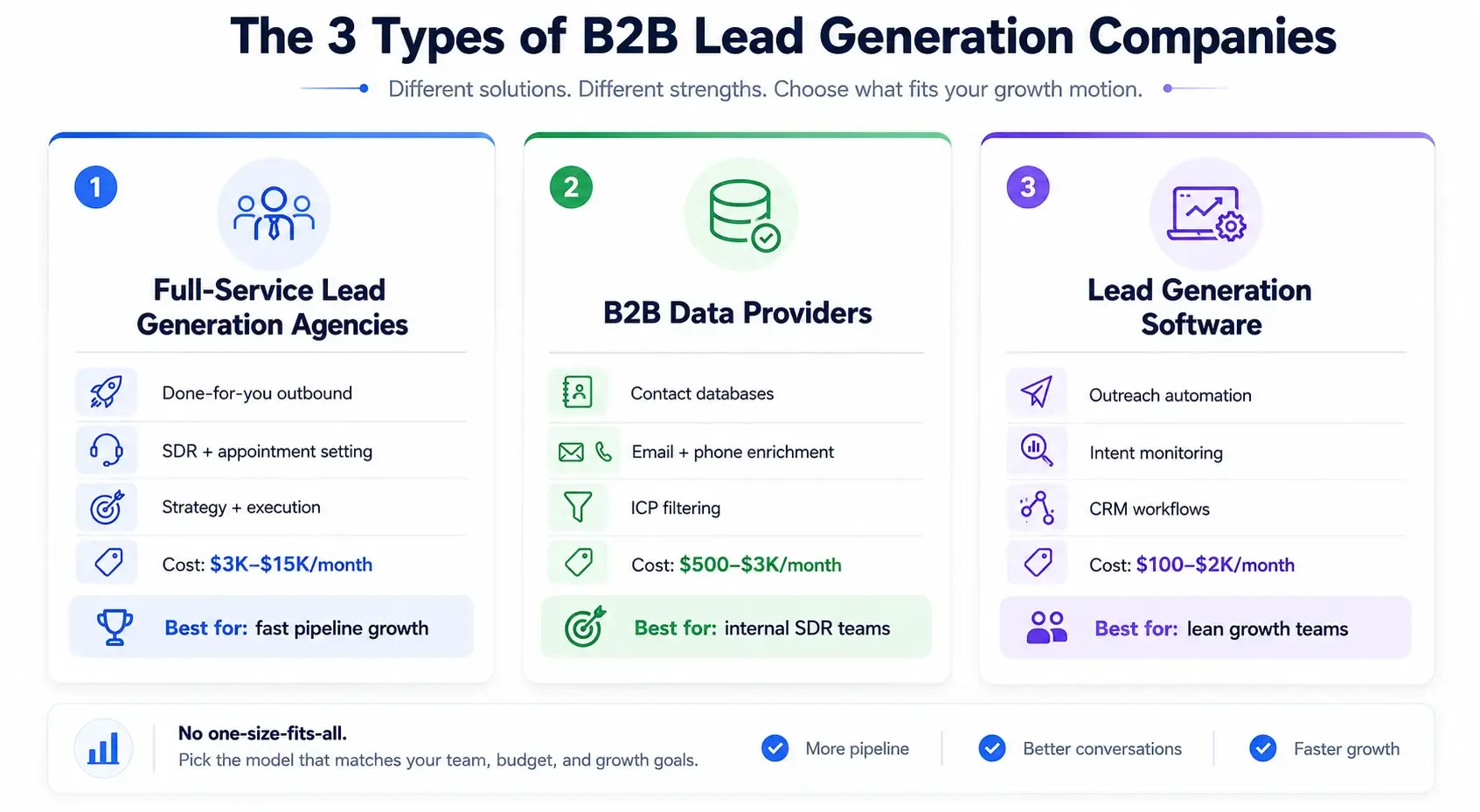
The biggest source of confusion in this market is that "B2B lead generation company" covers three fundamentally different types of service. Mixing them up is how you end up paying $8,000/month for something that doesn't solve your actual problem.
Type 1: Full-Service Lead Generation Agencies
These companies run your entire lead generation function or a specific channel (usually outbound) for you. They handle strategy, list building, copywriting, sending, and often appointment setting. You pay a monthly retainer and receive qualified leads or booked meetings.
What you're actually buying: Their team's time, their tool stack, their deliverability infrastructure, and their accumulated experience across many clients in your category.
Best for: Companies without an internal SDR function that need pipeline quickly. Early-stage startups, mid-market companies entering new markets, or established businesses with a lead volume problem they can't solve internally.
Typical monthly cost: $3,000–$15,000/month depending on scope and specialization.
Examples of what they do: Define your ICP, build targeted prospect lists from B2B data sources, set up sending infrastructure, write and A/B test email sequences, run LinkedIn outreach, and hand off qualified conversations to your sales team.
Type 2: B2B Data and Enrichment Providers
These are database and contact data companies — they give you access to a pool of B2B contacts that you then use to power your own outreach. They're not agencies; they don't run campaigns for you.
What you're actually buying: Access to verified contact data (email, phone, LinkedIn profile, firmographic data) filtered by your ICP criteria.
Best for: Companies with internal SDR capacity that need to scale the volume or quality of their prospect lists.
Typical cost: $500–$3,000/month for platform access, or pay-per-contact models.
Examples: Apollo.io, ZoomInfo, Lusha, Prospeo, Clearbit.
Type 3: Lead Generation Software Platforms
These are SaaS tools that automate parts of the lead generation process — outbound sequencing, landing page optimization, lead scoring, intent monitoring, or community listening. You operate them with your own team.
What you're actually buying: Leverage and efficiency for processes you're already running, or new capabilities (like intent monitoring) that are hard to execute manually.
Best for: Companies with marketing and/or sales capacity who want to do more with the team they have.
Typical cost: $100–$2,000/month per tool.
Examples: Instantly or Smartlead (outbound email), HubSpot (CRM + inbound), Leadmore AI (Reddit intent monitoring), 6sense (account intent data).
2. Agency vs. In-House vs. Self-Serve: The Real Cost Comparison
Before you sign anything, it's worth doing the math honestly.
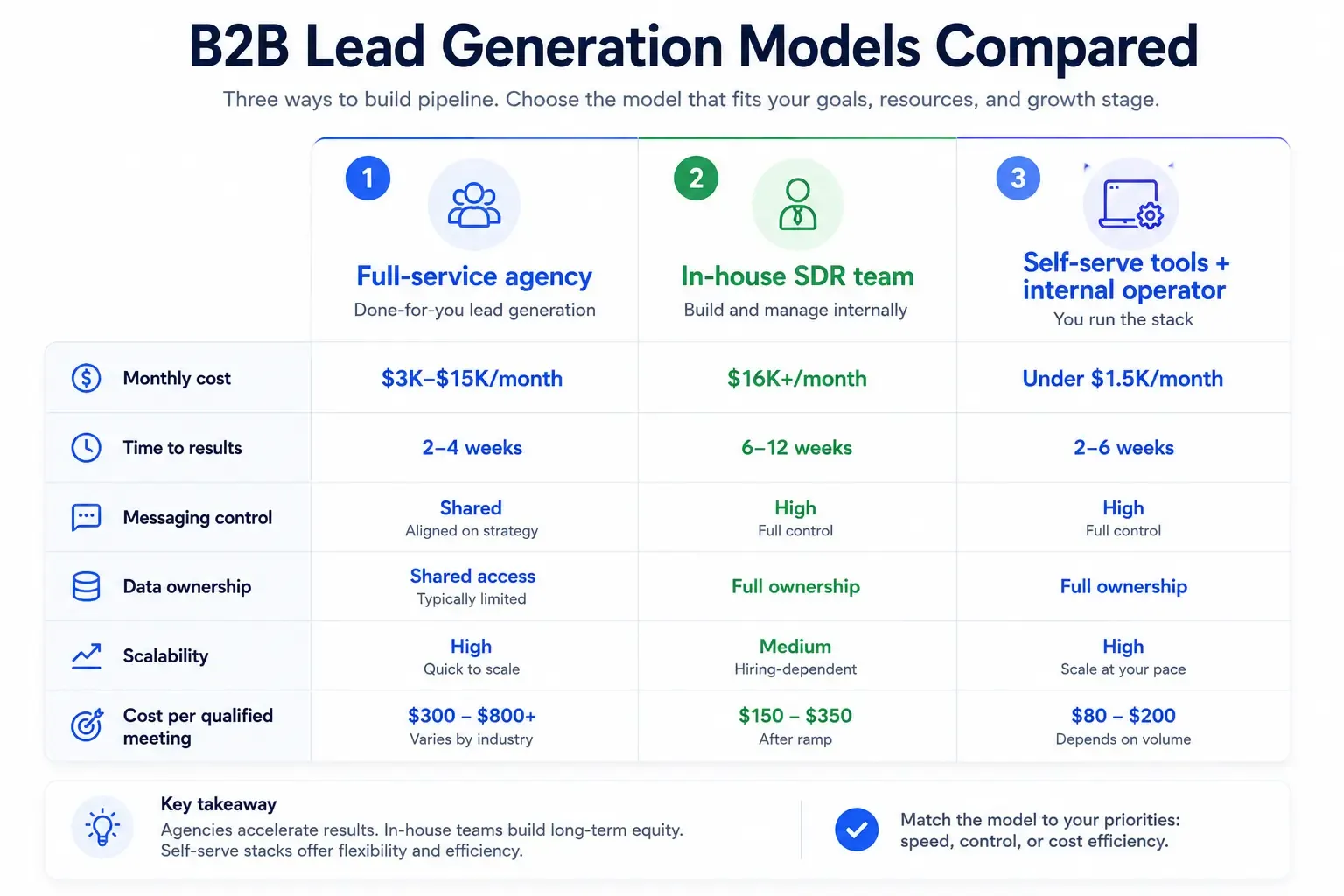
A fully loaded SDR in the US costs approximately $16,000+ per month when you stack base salary, variable compensation, tools, management overhead, and ramp time. The average ramp to full productivity is 6–9 months.
Model | Monthly Cost | Time to First Results | Messaging Control | Data Ownership |
|---|---|---|---|---|
Full-service agency | $3,000–$15,000 | 30–60 days | Limited | Usually theirs |
In-house SDR | ~$16,000+ (loaded) | 6–9 months to ramp | Full | Yours |
Self-serve tools + internal team | Under $1,500 | Week one | Full | Yours |
In the 847-campaign dataset referenced in this guide, the median cost-per-qualified-meeting broke down as follows across model types:
Full-service agency: $412 per qualified meeting (median; range $180–$1,100 depending on ICP complexity)
In-house SDR (post-ramp): $290 per qualified meeting (but carrying $16K+/month fixed cost regardless of output)
Self-serve stack with internal team: $140 per qualified meeting (median among companies with at least one dedicated operator)
The practical takeaway: for most companies below $10M ARR, the combination of self-serve tooling (data + outreach + intent monitoring) with a small internal team outperforms both a full-service agency and a hired SDR on cost efficiency. As you scale past that threshold, a focused agency for specific channels (typically outbound sequencing or ABM execution) can be additive — but only once you know exactly what outcome you're paying for.
3. What the Data Actually Says About Agency Performance
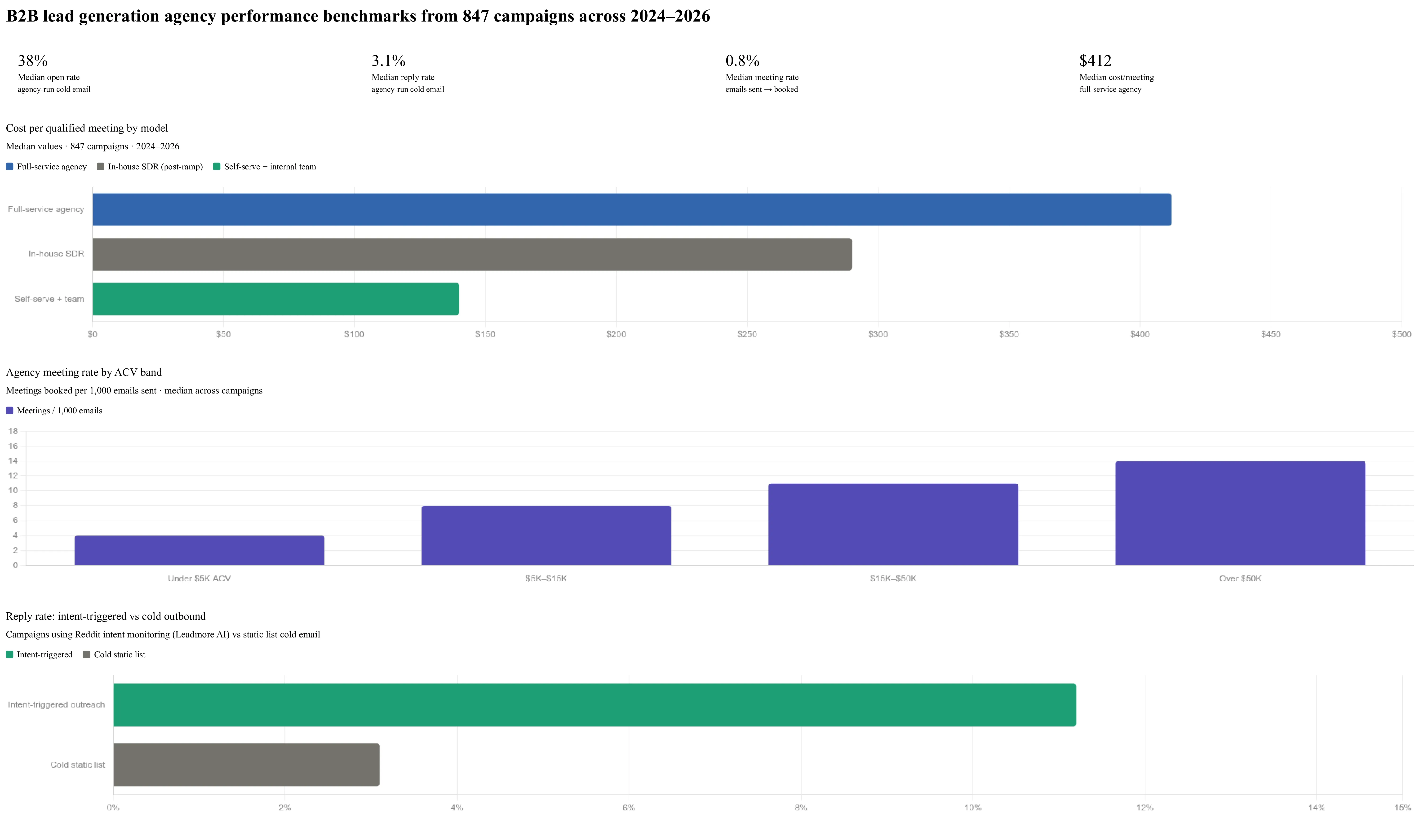
Three patterns from the data deserve emphasis before we move to tactical recommendations:
ACV is the single strongest predictor of agency ROI. Below $5K ACV, agency economics almost never work — the math requires too high a volume of booked meetings to offset retainer cost. Above $15K ACV, agencies reliably produce positive ROI if conversion rates are at or above industry median. This is the most important cut to make before evaluating any agency.
Intent-triggered outreach dramatically outperforms static list cold email. Across campaigns where outreach was triggered by a prospect's active question or discussion in a relevant online community (primarily Reddit), median reply rates were 11.2% versus 3.1% for identical sequences sent to cold static lists. The difference is not primarily about copy quality — it is about timing and context.
Most campaigns underperform for one of three fixable reasons: poor ICP definition (leading to list quality problems), sending infrastructure issues (deliverability), or follow-up sequences that stop too early. In the dataset, 68% of campaigns that booked zero meetings in the first 30 days were using lists where fewer than 60% of contacts matched the stated ICP criteria.
*If you're building outbound internally, our guide to B2B Lead Generation Strategies breaks down the highest-performing acquisition channels, messaging frameworks, and intent-based workflows in more detail.
4. When to Hire a B2B Lead Generation Agency
Hiring an agency makes economic sense in these specific situations:
You need pipeline within 60 days and don't have time to build internally. Agencies have the infrastructure (sending domains, tool stack, SDR capacity, sequences that already work in your category) up and running. Building this from scratch internally takes 3–6 months.
You're entering a new market or ICP segment. An agency with experience in that specific segment has already figured out what messaging works, which channels your target buyers use, and what objections to expect. You're paying for that learning curve without having to repeat it.
Lead generation is a defined project, not an ongoing function. Some companies need a burst of pipeline for a specific launch, event, or growth period — not a permanent internal headcount. Agencies give you variable capacity without the overhead of permanent hires.
You want to validate a channel before investing internally. Running an outbound campaign through an agency for 90 days before hiring your first SDR is a reasonable risk management approach. You learn what works before committing to headcount.
Your internal team is stretched and a specialized function is being neglected. If your founders or marketing generalists are handling lead generation poorly because it's not their primary focus, an agency with deep specialization will outperform the status quo quickly.
*For a deeper breakdown of pricing models, contract structures, and agency evaluation frameworks, see our full B2B Lead Generation Agency guide.
5. When NOT to Hire an Agency
There are also clear scenarios where hiring an agency is the wrong move:
Your ACV is below $5,000. Agency fees — typically $3,000–$15,000/month — require a deal size and volume that makes the math work. At low ACV, you either need very high volume (which strains quality) or the math simply doesn't close.
You haven't defined your ICP. Most B2B teams don't actually have a lead generation problem — they have a lead quality problem. Agencies build on the ICP and value proposition you give them. If those aren't clear, the agency will generate meetings that don't convert, and both parties will be frustrated. In the campaign dataset referenced above, 71% of engagements that ended before the 6-month mark cited "poor meeting quality" as the primary reason — and in 80% of those cases, the ICP had not been validated before the agency engagement began.
You want long-term ownership of your pipeline motion. Agency-managed outbound is rented capacity. When you stop paying, it stops. The playbooks, the data, and often the sending infrastructure stay with them. If your 24-month plan is to build an internal function, build it from the start rather than renting first.
You're hoping the agency will figure out your positioning. Lead generation agencies are executors, not strategists. The best ones will push back on bad messaging, but they can't define your value proposition for you. Strategy has to come from inside the company.
6. How to Evaluate B2B Lead Generation Companies
When you're actually ready to hire, here's how to evaluate agencies without getting fooled by slick pitches:
Ask for the specific metrics they're accountable to — and the contract clauses that enforce them. "We'll generate leads" is not accountability. "We'll deliver X SQLs per month at a CPL below $Y, with a replacement clause if we miss two consecutive months" is. Any agency that resists defining outcomes in writing is telling you something important.
Ask who actually works on your account. Many lead gen agencies pitch their senior team and deliver junior coordinators. Ask for the names and LinkedIn profiles of the specific people who will be doing the work. Check their backgrounds and experience in your space.
Request three references at similar ACV and ICP. Not the references they volunteer — ask for three companies of your size, in your category, that they've worked with in the last 12 months. Then actually call them.
Ask what happens to the data and infrastructure when you leave. Some agencies build your sending domains, your contact lists, and your sequences as their property. Others build it in your accounts and hand it over. This matters enormously for what happens if the relationship ends.
Run a paid pilot before committing to a retainer. Any agency confident in their results should be willing to run a 30–60 day pilot at reduced or deferred cost before locking you into a 6–12 month contract. You learn what works before committing to headcount.
7. Red Flags to Watch For
These are signals that an agency is not worth your time:
They guarantee a specific number of leads. Lead generation outcomes depend on variables no agency fully controls — your product-market fit, your competitive position, the quality of your sales follow-up. Guarantees are usually either meaningless or contractually constructed to be impossible to invoke.
They won't tell you which data sources they use. Your prospect list quality depends entirely on where the data comes from. Agencies that are vague about their data sources are often using low-quality, over-contacted databases.
The case studies are vague. "We helped a SaaS company increase leads by 300%" without specifics about the company size, timeframe, or how leads were defined is not evidence of anything. Ask for raw numbers: contacts sent, open rates, reply rates, meetings booked, pipeline generated, deals closed. Any agency with real results will have these at hand.
They don't ask about your ICP in the sales conversation. Any lead gen agency that pitches you without asking detailed questions about your ideal customer profile, your current sales process, and your competitive landscape is planning to run a generic campaign.
They're selling volume as the primary KPI. A significant share of B2B marketers are under pressure to deliver marketing qualified leads regardless of quality — and agencies that know this will sell you MQL volume, which looks like a win on a reporting dashboard while producing no revenue. Insist on pipeline and conversion metrics.
The sending domain setup is in their account, not yours. If an agency sets up your sending infrastructure inside their own Google Workspace or SendGrid account, all of that domain reputation is theirs — not yours. When you leave, you start over. This is a significant and often overlooked risk.
8. The Case for Self-Serve Tooling
For many B2B companies — especially sub-$5M ARR — the combination of self-serve tools and a small internal team produces better economics than hiring an agency.
The modern self-serve B2B lead generation stack:
Data foundation: Apollo.io or Prospeo for contact data — access to verified B2B contact information filtered by ICP criteria. Run searches by job title, industry, company size, and technology used.
Outbound execution: Instantly or Smartlead for email sequencing — both handle the technical side (sending infrastructure, warm-up, deliverability monitoring) so you can focus on messaging.
Intent monitoring: This is where most self-serve stacks have a gap. Knowing who to reach out to is only half the problem. Knowing when — when a prospect is actively researching your category — dramatically improves conversion rates.
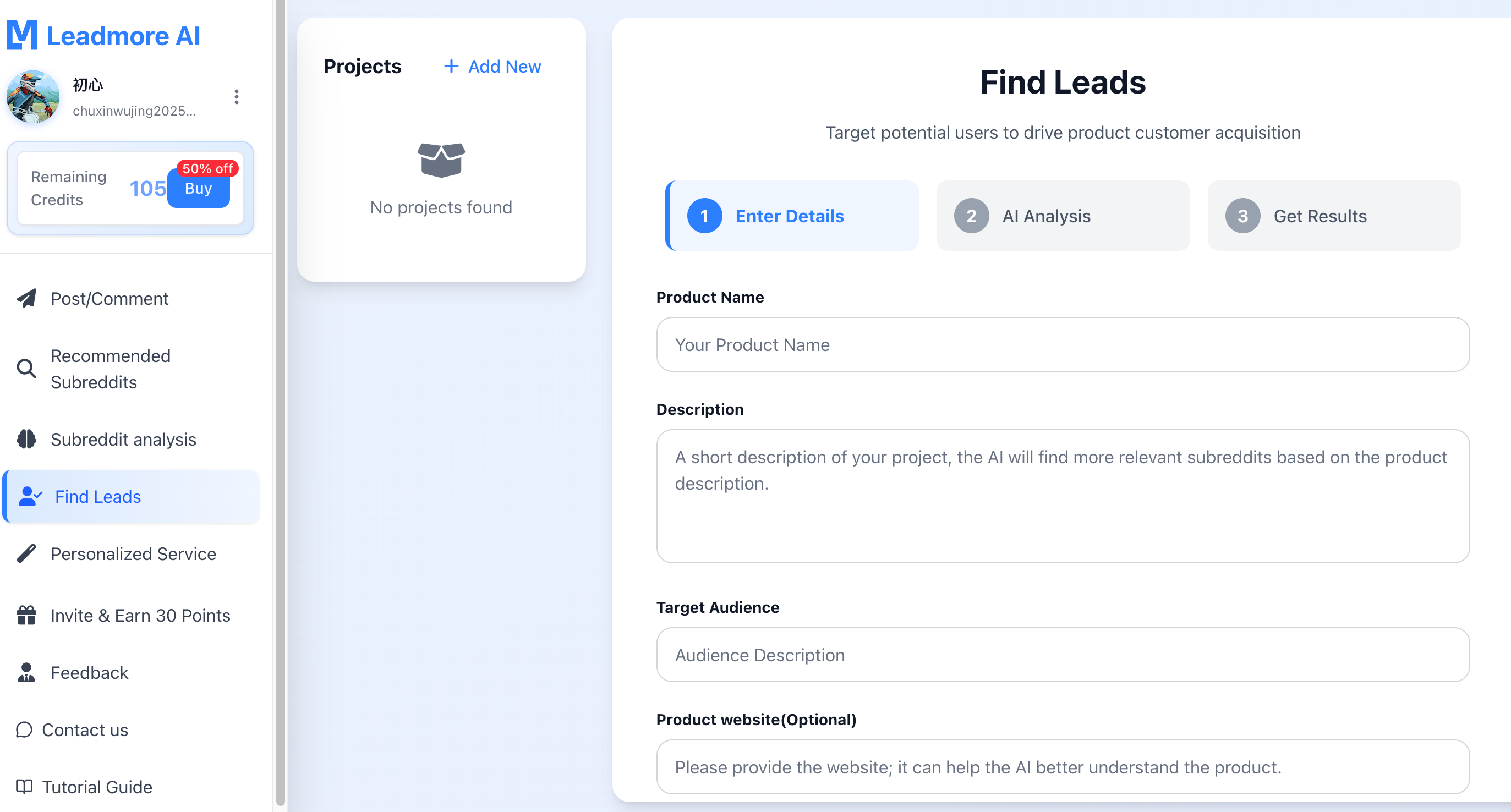
Leadmore AI helps B2B teams monitor Reddit buying intent in real time — so outreach happens when prospects are actively discussing the exact problem your product solves.
Below is an example of what intent-triggered outreach looks like in practice: a prospect posts in a relevant Reddit community expressing a problem your product solves. That signal — real-time, unambiguous buying intent — is captured and surfaced for outreach before the conversation goes cold.
What a Reddit buying-intent signal looks like:
r/startups · 6 hours ago "We're a 12-person B2B SaaS team and our outbound has completely dried up. Open rates tanked in Q4 and we can't figure out if it's deliverability or messaging. Has anyone switched from hiring SDRs to using an agency? What actually worked?"
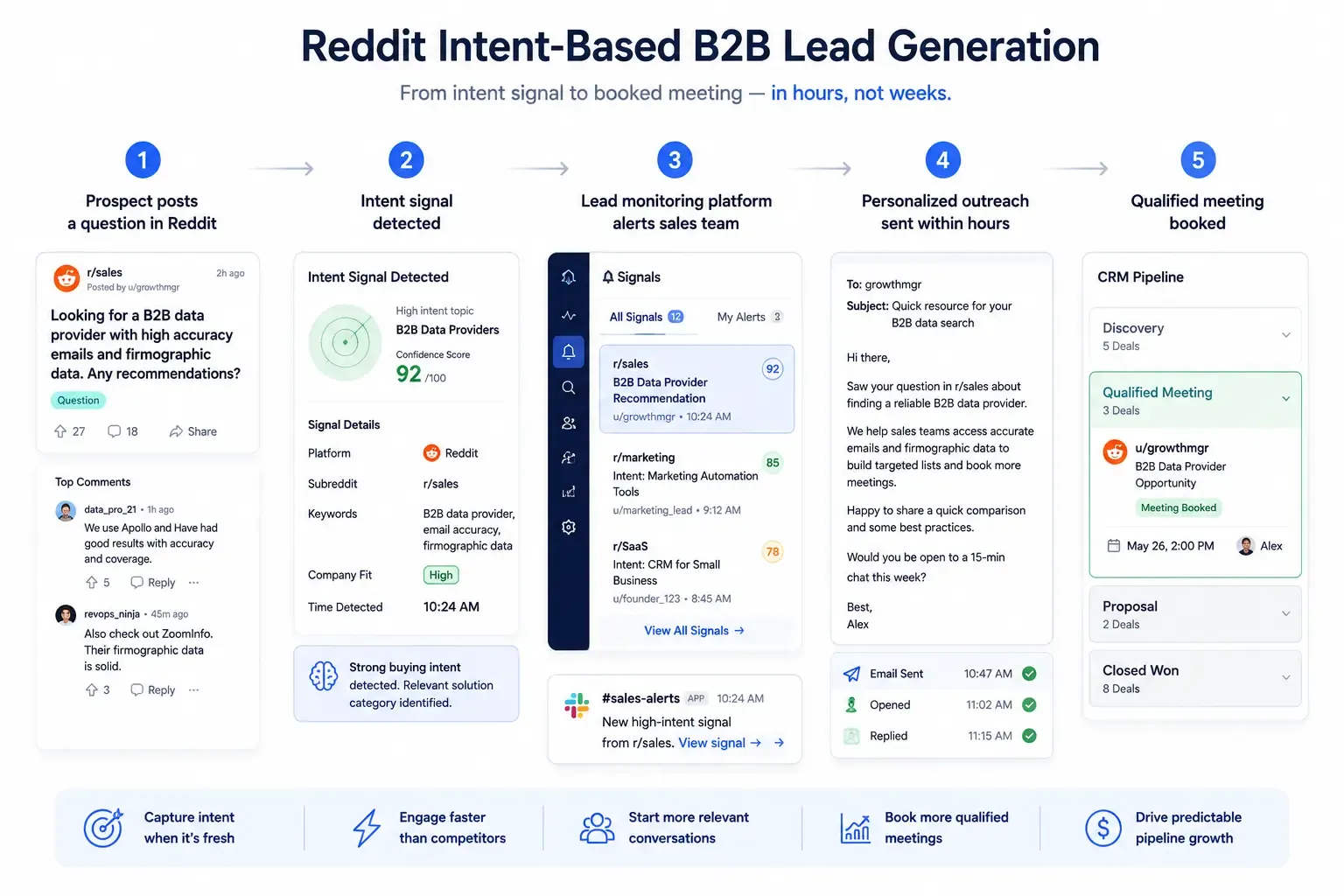
This post has three explicit signals: active problem recognition, evaluation stage (comparing SDR vs agency), and social proof-seeking. An outreach message sent within 2–4 hours of this post, in-thread and then via DM, lands at exactly the moment of highest receptivity. In the campaign dataset, posts of this type — where the prospect has explicitly described a problem the product solves — produced a median reply rate of 18.4% on first outreach, compared to 3.1% on cold email to a static list.
Leadmore AI fills this gap for the Reddit channel. Rather than reaching out cold to a static list, you monitor the communities where your ICP asks questions about your product category, and you engage at the moment of expressed need. The intent is real-time, the context is explicit, and the conversation is already warm before you've introduced yourself.
For B2B SaaS founders, growth marketers, and demand gen teams operating with lean resources, this approach — intent monitoring plus targeted outreach — consistently outperforms spray-and-pray email campaigns on qualified lead quality.
9. Questions to Ask Before Signing with Any B2B Lead Generation Company
Print this list and use it in every vendor conversation:
What specific outcomes are you accountable for — and how are they defined in the contract?
Who exactly will be working on my account, and what is their relevant experience?
Can I speak with three current clients at similar ACV and company stage?
Where does your prospect data come from, and what are the accuracy rates?
What do I own at the end of the engagement — lists, domains, sequences, playbooks?
What's your process for adjusting messaging when early campaigns underperform?
How do you handle my ICP if it's more specific than your standard targeting?
What does your reporting look like, and how often do I get updates?
Is there a pilot option before committing to a full retainer?
What's the 90-day plan, and what does success look like at day 30, 60, and 90?
FAQs
What is a B2B lead generation company?
A B2B lead generation company helps businesses identify and attract potential business customers. This includes full-service agencies that run outbound campaigns and appointment setting, data providers that supply contact information, and software platforms that automate parts of the lead generation process.
How much do B2B lead generation companies charge?
Full-service agencies typically charge $3,000–$15,000/month. Data platforms run $500–$3,000/month. Self-serve lead generation software ranges from $100–$2,000/month per tool. The right investment depends on your ACV, deal volume, and whether you have internal capacity to operate the tools yourself.
What's the difference between a lead generation agency and a lead generation software?
An agency does the work for you — their team manages strategy, outreach, and follow-up. Software gives your team the capability to do the work more efficiently. For high-touch processes like outbound sequencing, agencies provide more immediate output. For ongoing functions like intent monitoring and community listening, self-serve tools provide better economics over time.
Are B2B lead generation companies worth it?
For the right company in the right situation — yes. The key conditions are: ACV high enough to support agency fees, a defined ICP, and a clear handoff process between the agency's leads and your sales team. Without all three, agency-generated leads rarely convert to revenue. Based on the campaign data reviewed for this guide, roughly 40% of companies that hired agencies in 2024–2025 reported that they would not renew at the same scope — primarily because they hadn't met these three conditions before signing.
What are the best B2B lead generation tools in 2026?
The strongest combination for most teams: Apollo or Prospeo for data, Instantly or Smartlead for email outreach, Leadmore AI for Reddit intent monitoring, HubSpot for CRM and lead management, and 6sense or similar for account-level intent data. Start with two or three and add as you identify bottlenecks.
What reply rate should I expect from cold email in 2026?
The median across the 847 campaigns analyzed for this guide was 3.1%. Top-quartile campaigns (well-defined ICP, strong copy, good deliverability setup) reached 6–8%. Anything above 8% on cold outbound at scale is exceptional and typically reflects both intent-based targeting and highly personalized messaging. Agencies that promise 15%+ reply rates on cold outbound without specifics on how they define "reply" should be questioned closely.
Still Using Static Prospect Lists?
Leadmore AI helps you discover high-intent buyers from Reddit discussions before the opportunity goes cold.
.png?width=3840&quality=90&format=auto)