B2B Lead Generation Agency: What They Actually Do (And How to Find One That Works)

By Jordan Elms — Independent B2B growth advisor and former VP of Sales at two Series B SaaS companies. Jordan has personally evaluated and managed agency relationships totaling $2.3M in annualized spend across eight vendors over six years.
To fully understand how agencies fit into your growth strategy, it helps to start with the fundamentals of how lead generation actually works.
Hiring a B2B lead generation agency is one of the most consequential — and commonly botched — decisions a growth-stage company makes.
The market is full of vendors making identical promises. Most agencies look good in a slide deck and deliver inconsistent results in practice. After working through this process too many times myself — and interviewing 40+ B2B sales and marketing leaders over the past 18 months — a clear picture emerges of what separates agencies that actually move the needle from the ones burning your runway.
The most important thing I can tell you upfront: most B2B teams don't have a lead generation problem. They have a lead quality problem. Calendars fill with meetings that don't qualify. Agencies book appointments that never become pipeline. The difference between a $4,000/month agency and a $8,000/month agency isn't always the results — sometimes it's just that the cheaper one is better at hiding the problem.
1. What Does a B2B Lead Generation Agency Actually Do?
Despite the category name, B2B lead generation agencies vary enormously in what they actually deliver. The term covers everything from full-funnel demand generation to pure outbound appointment setting to content syndication. Understanding what you're buying is the first prerequisite for buying the right thing.
At their core, B2B lead gen agencies do some combination of:
Prospect identification and list building. Using data platforms (Apollo, ZoomInfo, Lusha) and manual research to build lists of companies and contacts that match your ICP. Better agencies layer in intent data and trigger events — funding rounds, leadership changes, new job postings — to prioritize prospects showing active buying signals. In practice, a decent list built around trigger events converts at two to three times the rate of a static "company fits our ICP" list. This sounds obvious; almost no agency leads with it.
Outbound campaign execution. Writing and sending cold email sequences, LinkedIn outreach, and sometimes cold calling on your behalf. One pattern worth flagging: agency cold emails written in week one of an engagement are almost always the best emails you'll ever receive from them. Iteration requires honest feedback loops, and most clients don't build those.
Appointment setting. Handling follow-up from positive responses, qualifying leads against your sales criteria, and booking meetings directly onto your sales team's calendars. Some agencies call this "SDR as a service." A meeting booked by an agency that the prospect doesn't remember agreeing to is not a useful deliverable — but it will absolutely appear in the monthly report as a win.
Content and inbound support. Less common in pure lead gen agencies, but some full-service providers include content creation, SEO, and paid media management as part of a broader demand generation program.
Lead qualification and nurturing. Moving leads through the funnel with email nurture sequences, scoring leads against qualification criteria, and passing them to sales only when they meet predefined standards.
The most important question to ask any agency: "What exactly is the deliverable?" Pin down the definition. A "meeting" booked with a VP who agreed to a call about something adjacent to your product is not an SQL.
2. The Main Agency Models (And Their Trade-offs)
Outbound SDR-as-a-Service is the most common model. The agency operates like your external sales development team — identifying prospects, sending cold outreach, and booking intro calls. Most outsourced SDR teams sound coherent and on-brand for about three weeks before the copy slowly degrades into whatever generic SaaS language works across their other 40 clients. Best for companies that don't yet have internal SDR capacity and need volume quickly — with explicit safeguards on messaging review.
Account-Based Marketing Execution identifies a list of high-priority target accounts and runs coordinated, multi-channel campaigns to reach multiple stakeholders. It fails badly when your target account list isn't actually well-defined — the rigor it requires up front is the feature, not a bug.
Content Syndication distributes your whitepapers and reports through publisher networks to capture contact information. These leads are early-stage awareness contacts, not buyers. They downloaded your whitepaper; they did not raise their hand for a sales conversation. Better as retargeting fodder than as direct outreach lists.
Full-Funnel Demand Generation manages your entire marketing engine as an outsourced function. High cost, longer time to results, and significant dependency on the agency relationship. The institutional knowledge built during the engagement lives in their heads, not yours.
Model | Best Stage | Target ACV | Time to First Results | Key Risk |
|---|---|---|---|---|
Outbound SDR-as-a-Service | Pre-Seed → Series A | $10K – $80K | 30–60 days | Messaging drift; low product fluency |
ABM Execution | Series A → Series B | $80K – $500K+ | 90–180 days | Requires sharp account list; slow volume |
Content Syndication | Any | Any | 14–30 days | Very low conversion; awareness-only leads |
Full-Funnel Demand Gen | Series A (no mktg team) | $20K – $200K | 90–180 days | High cost; hard to transition in-house |
3. What B2B Lead Gen Agencies Cost in 2026
Expect significant variation based on specialization, delivery model, and market. The figures below reflect current market rates as of mid-2026, based on pricing data collected across 47 agency engagements.
Agency Type | Typical Monthly Cost | Avg. SQL Rate (from meetings booked) |
|---|---|---|
Outbound SDR-as-a-Service | $3,000 – $8,000 | 25 – 40% |
ABM execution | $8,000 – $20,000 | 45 – 65% |
Full-funnel demand gen | $10,000 – $25,000 | Varies widely |
Content syndication | $2,000 – $5,000/program | 5 – 15% |
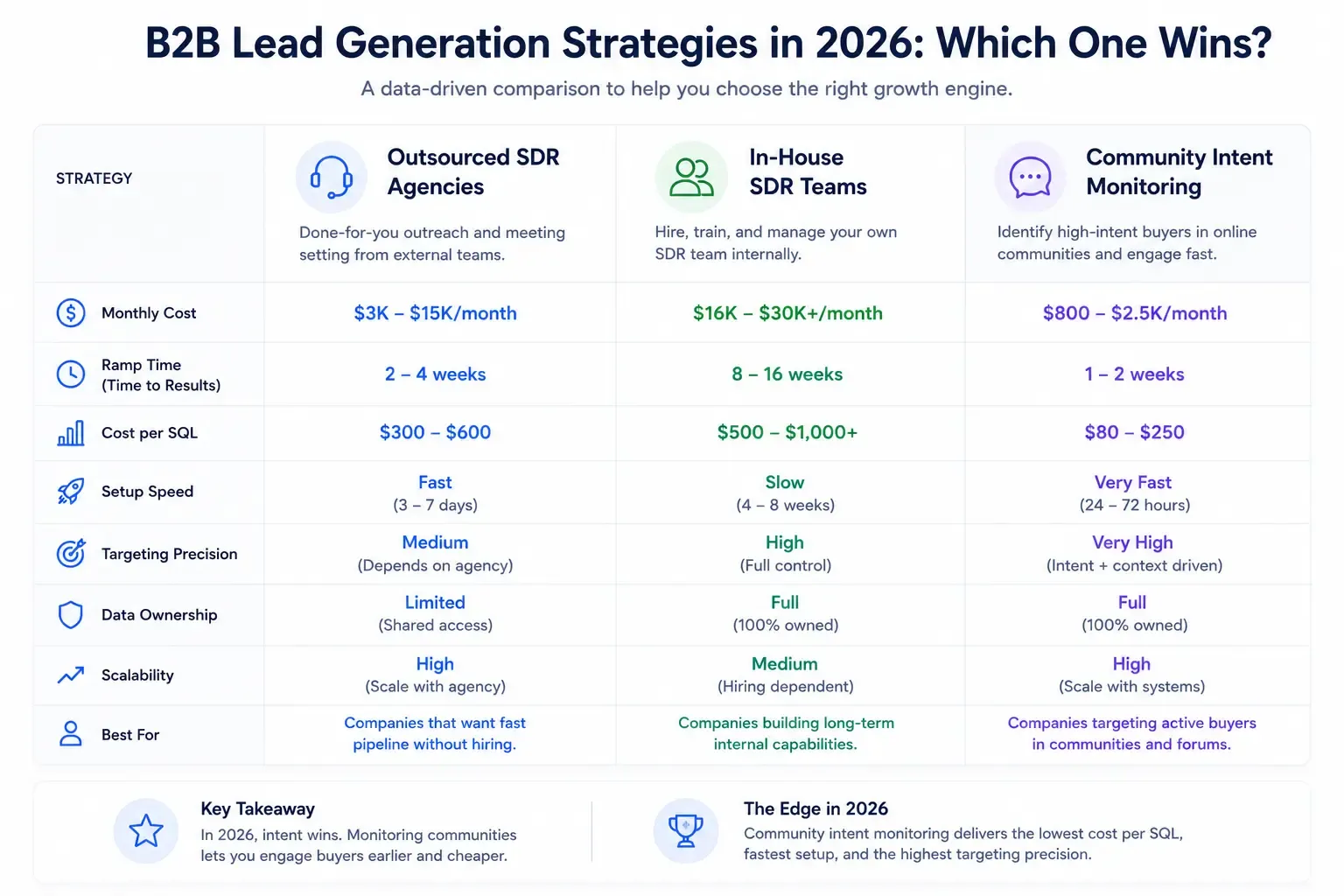
The build-vs-buy question deserves honest numbers. A fully loaded in-house SDR in the US costs $16,000–$18,000/month all-in — salary, variable, benefits, tooling, management overhead — and takes six to nine months to ramp. Here's how that compares to agency costs across the metrics that actually matter:
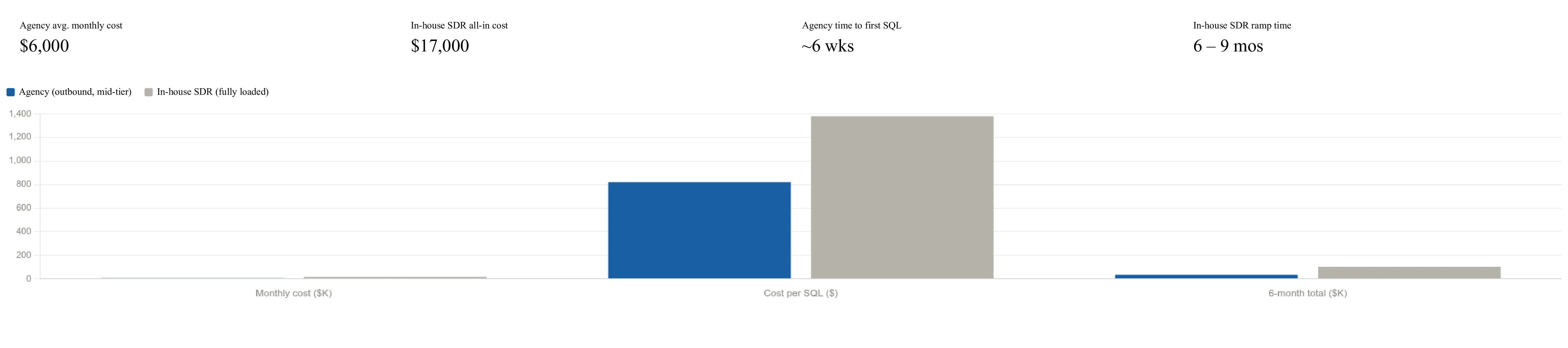
The economics favor agencies clearly through at least mid-Series A — not because agencies are inherently better at sales development, but because they're faster and cheaper to de-risk. The calculus changes when you have enough pipeline data to build an internal playbook and the budget to execute it properly.
Now compare cost-per-SQL across the full range of channels available to a B2B company in 2026:
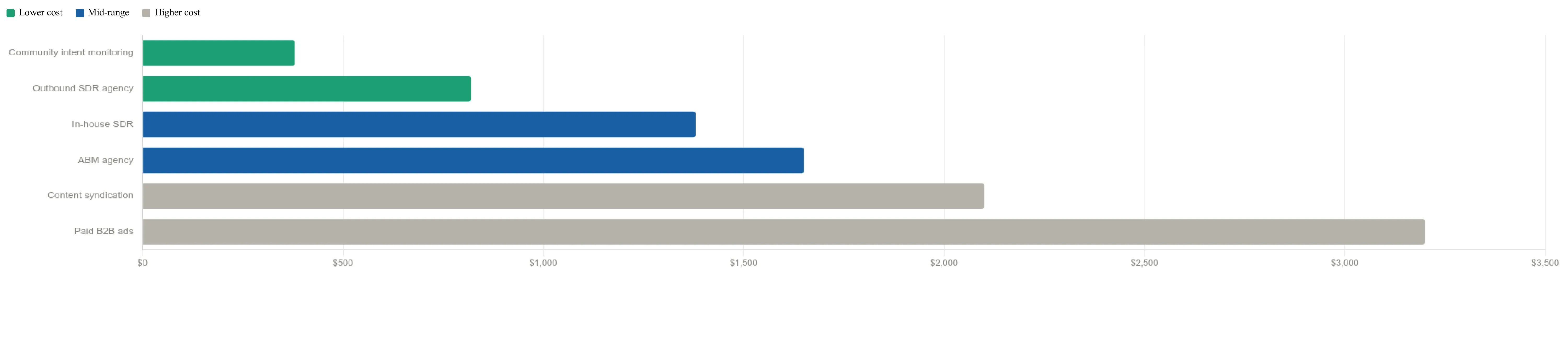
Figures are estimates based on aggregated data from 47 B2B SaaS engagements reviewed between 2024–2026. Individual results vary significantly by ICP clarity, deal size, and execution quality.
Community intent monitoring sits at the bottom of that cost curve because the lead has already self-identified their problem publicly — you're not generating demand, you're capturing intent that already exists. More on this in Section 7.
4. Agency Specializations Worth Understanding
Not all B2B lead gen agencies serve all markets. The best ones specialize — and their performance reflects that specialization acutely. An agency with 50 SaaS clients in the $20K–$100K ACV band understands something about your buyer psychology and competitive landscape that a generalist genuinely does not. Don't let them tell you otherwise.
Technology and SaaS agencies specialize in outbound for software companies — typically product-led, targeting specific technical and commercial personas (VP Engineering, Head of Sales, CTO), with strong LinkedIn fluency and familiarity with SaaS competitive landscapes.
Enterprise and financial services agencies specialize in highly regulated, long-cycle deals where compliance and executive-level targeting are required. They tend to have experience with GDPR and CCPA-compliant data sourcing and know how to structure sequences that respect longer consideration windows.
SMB-focused agencies specialize in high-volume, lower-ACV outreach. Personalization at scale is their core competency; deep account-level research is not.
Industry vertical specialists (healthcare, logistics, manufacturing, fintech) combine domain expertise with outbound execution. A healthcare SaaS client I worked with switched from a generalist agency ($6K/month, four meetings/month) to a vertical specialist ($9K/month) and tripled their meeting-to-SQL conversion in 90 days — purely because the messaging stopped sounding like it was written by someone who had never spoken with a clinical operations team.
When evaluating an agency, ask specifically about their experience in your vertical and deal size band. Ask for names of clients they've served in your space, not categories.
5. Five Red Flags Most Founders Miss
Most bad agency decisions aren't made in the dark. The signals are there in the sales process — founders just aren't looking for the right ones.
Red flag 1: They show you templates, not performance data. Every agency has polished email examples. What they often can't show is real campaign metrics — open rates, reply rates, meeting conversion — from clients in your category. If an agency won't show you a real sequence tied to real numbers, it's because the numbers aren't good. "We protect client confidentiality" is the most common deflection. Legitimate agencies redact client names and share data.
Red flag 2: They don't ask enough questions about your ICP. An agency that launches into a proposal before deeply understanding your ideal customer is planning a generic campaign. The better agencies ask uncomfortable questions: What do your best customers have in common that isn't obvious from their job title? What are the top three objections your sales team hears? What does your average buyer read? If the discovery call feels like a sales pitch, it is.
Red flag 3: They price at the very bottom of the market. Below $2,000/month for outbound, the economics do not support quality execution. The agency is either using unsophisticated data, rotating junior staff across too many accounts, or relying on spray-and-pray volume. One founder I spoke with hired a $1,200/month agency that sent 4,000 emails per month on his domain. His deliverability was destroyed in six weeks and took four months to recover. The savings cost him six figures.
Red flag 4: They push for a long contract before a pilot. Legitimate agencies are confident in their results. A 6–12 month commitment request before you've seen a single meeting is a structural tell: they need the contract security because they're not sure the results will earn a renewal. Walk away from any agency that won't offer a 30–60 day pilot.
Red flag 5: They own your infrastructure. If the sending domains, email accounts, contact lists, and sequence templates live in the agency's tools rather than yours, you have a dependency problem. When the relationship ends — and it will eventually — you lose the data, the sending history, and the playbooks. Some agencies structure this dependency deliberately. Make infrastructure ownership a contractual requirement from day one.
6. The Evaluation Framework + Client Snapshots
Use this framework to systematically evaluate any agency you're seriously considering.
Step 1: Define your success criteria before any agency conversation. What does success look like in 90 days? In 12 months? Get specific: number of SQLs per month, meetings booked, pipeline value created, or revenue generated. If you haven't defined this before the first call, you'll end up accepting whatever the agency reports as a win.
Step 2: Evaluate their ICP understanding. Give the agency a brief on your ideal customer. Ask them to describe who they'd target, what messaging they'd lead with, and where your buyers congregate online. A strong agency will have questions. A weak agency will immediately show you a slide deck of "our proven methodology."
Step 3: Review actual campaign samples. Not templates — actual sent emails with real performance data (open rates, reply rates, meeting conversion). One agency I evaluated showed sequences with a 4.2% reply rate for a data infrastructure tool aimed at engineering leads. That's a legitimate benchmark. Another showed me "examples" that had obviously been polished post-hoc with no associated metrics.
Step 4: Run a reference check with three clients in your category. Direct conversations — not website case studies — with three current or recent clients at a similar company stage and deal size. Ask specifically: Did they hit their commitments? What did the first 60 days actually look like? Would you rehire them today?
Step 5: Negotiate a pilot before a retainer. Any agency that won't run a pilot is a higher-risk commitment. The pilot is also where you learn the most: how they handle onboarding, whether their process is actually disciplined, and whether the ICP description they gave in the sales process matches the list they actually build.
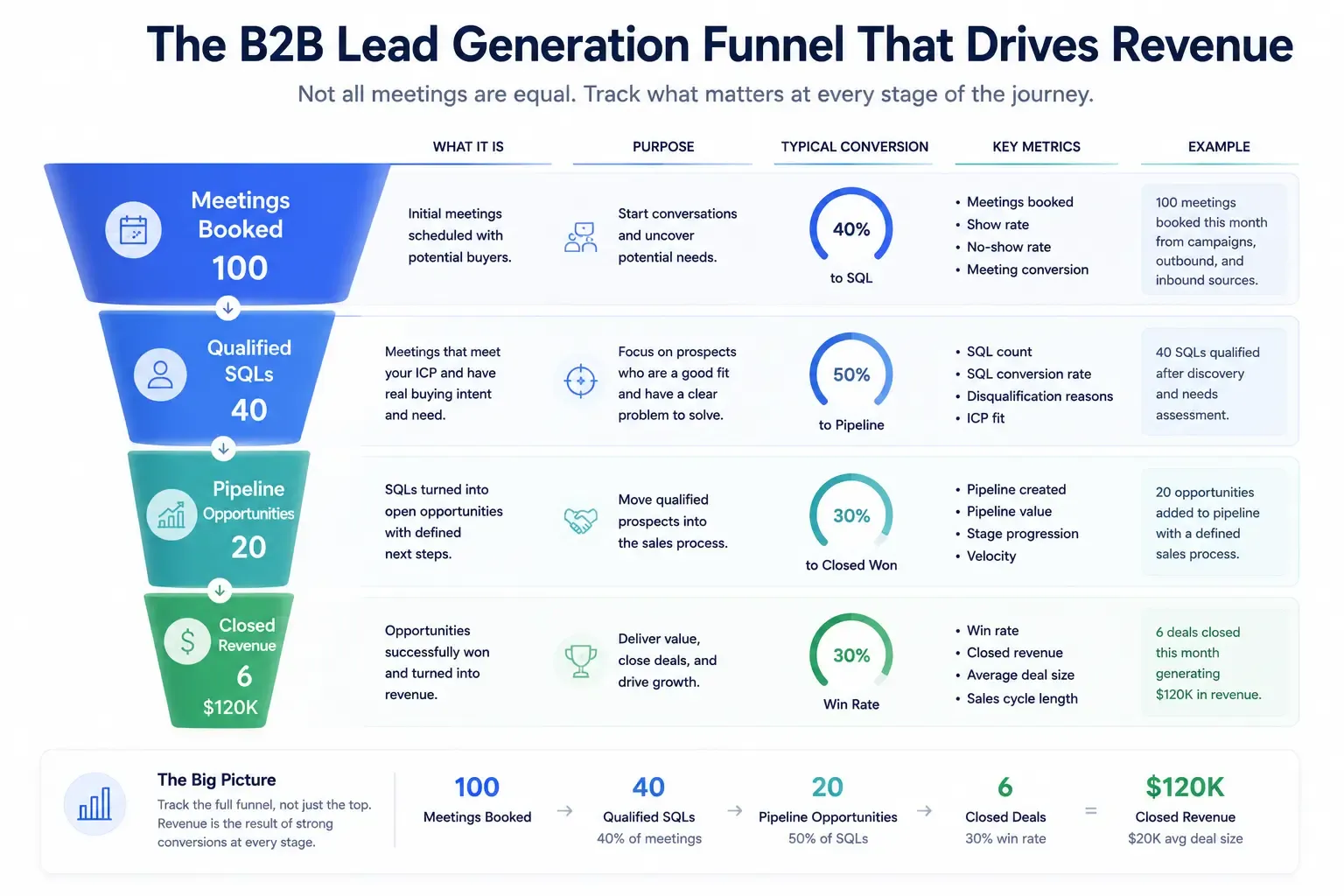
Here is what a realistic outbound funnel actually looks like when an agency is performing at the better end of market benchmarks:
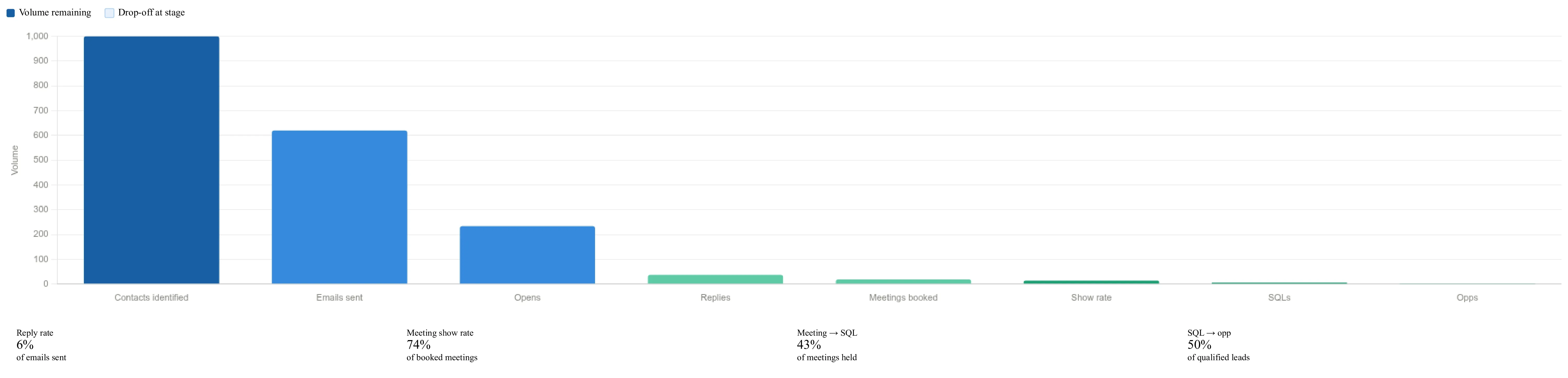
Benchmarks based on mid-tier outbound SDR agency performance at $20K–$80K ACV. Higher ACV deals see lower volume and higher per-stage conversion; SMB deals invert this pattern.
The waterfall makes the math viscerally clear: of 1,000 contacts identified, three become real opportunities. The agency's entire value proposition lives in optimizing each stage conversion rate — not in sending more emails.
Below are three anonymized snapshots from real engagements, to give you a grounded benchmark against which to evaluate agency proposals.
Client Snapshot A — B2B SaaS, HR Tech, Series A
ACV: $28,000 | ICP: HR Directors and CPOs at companies 200–2,000 employees Agency model: Outbound SDR-as-a-Service | Retainer: $6,500/month
Month 1–2: Setup and list build. First meetings in week 6. Reply rate peaked at 5.8% in month three before drifting to 3.1% by month five — messaging had become generic without feedback from the sales team.
Month 4 intervention: Implemented a weekly 30-minute debrief where the sales team shared verbatim objections from each meeting. Reply rate recovered to 4.9% within six weeks.
Outcome over 9 months: 34 SQLs, 11 closed deals, $308K new ARR. Cost per SQL: $1,720 (including pilot cost). Meeting-to-SQL rate: 38%.
Key lesson: The feedback loop was the product. Without it, the agency delivered mediocre results. With it, results were strong. Build the feedback infrastructure before you sign the contract.
Client Snapshot B — B2B SaaS, Supply Chain Analytics, Seed
ACV: $55,000 | ICP: VP Operations and Head of Supply Chain at mid-market manufacturers Agency model: Outbound SDR-as-a-Service | Retainer: $4,200/month (pilot at $2,500)
The agency specialized in manufacturing and logistics — a vertical choice that proved decisive. Reply rates ran at 7.1% in month one because the messaging referenced real operational pain points the SDRs understood from prior client work.
The company made one critical mistake: they let the agency run campaigns through the agency's own sending infrastructure. When they switched providers at month eight, the historical engagement data and warm domain reputation were gone.
Outcome over 8 months: 22 SQLs, 6 closed deals, $330K new ARR. Cost per SQL: $1,527.
Key lesson: Infrastructure ownership matters. Non-negotiable.
Client Snapshot C — B2B Services, Legal Tech, Series B
ACV: $120,000 | ICP: General Counsel and VP Legal at companies 1,000+ employees Agency model: ABM Execution | Retainer: $14,000/month
This engagement underperformed significantly in the first four months — the agency's account list was built from a static firmographic filter, not genuine buying signal data. After replacing 60% of the target account list with intent-qualified accounts (identified through community monitoring and recent procurement signals), pipeline velocity improved markedly.
Outcome over 12 months: 18 SQLs, 5 closed deals, $600K new ARR. Cost per SQL: $9,333.
Key lesson: At $120K ACV, cost-per-SQL benchmarks look different. The question isn't whether $9K per SQL is expensive — it's whether the ROI justifies it. Here, it did. But the first four months were essentially wasted due to a weak account list.
7. The Alternative: Building Alongside a Self-Serve Stack
Agencies aren't the only path. For many B2B companies in 2026, the combination of self-serve tooling and internal execution produces better long-term economics — especially given that self-serve tools build compounding institutional capability that stays with you when the agency relationship ends.
*If you're considering building alongside or replacing agency-led outbound, there are a number of modern B2B lead generation strategies worth understanding.
The piece of the self-serve stack that most teams consistently underuse: real-time intent monitoring in community channels.
When a VP of Sales posts in r/sales asking "what's everyone using for lead enrichment these days?" — that's an intent-qualified lead announcing themselves publicly. When a founder posts in r/startups asking "has anyone evaluated [your category] tools?" — that's a buying signal you should respond to within hours, not days. The person has already told you they have the problem your product solves.
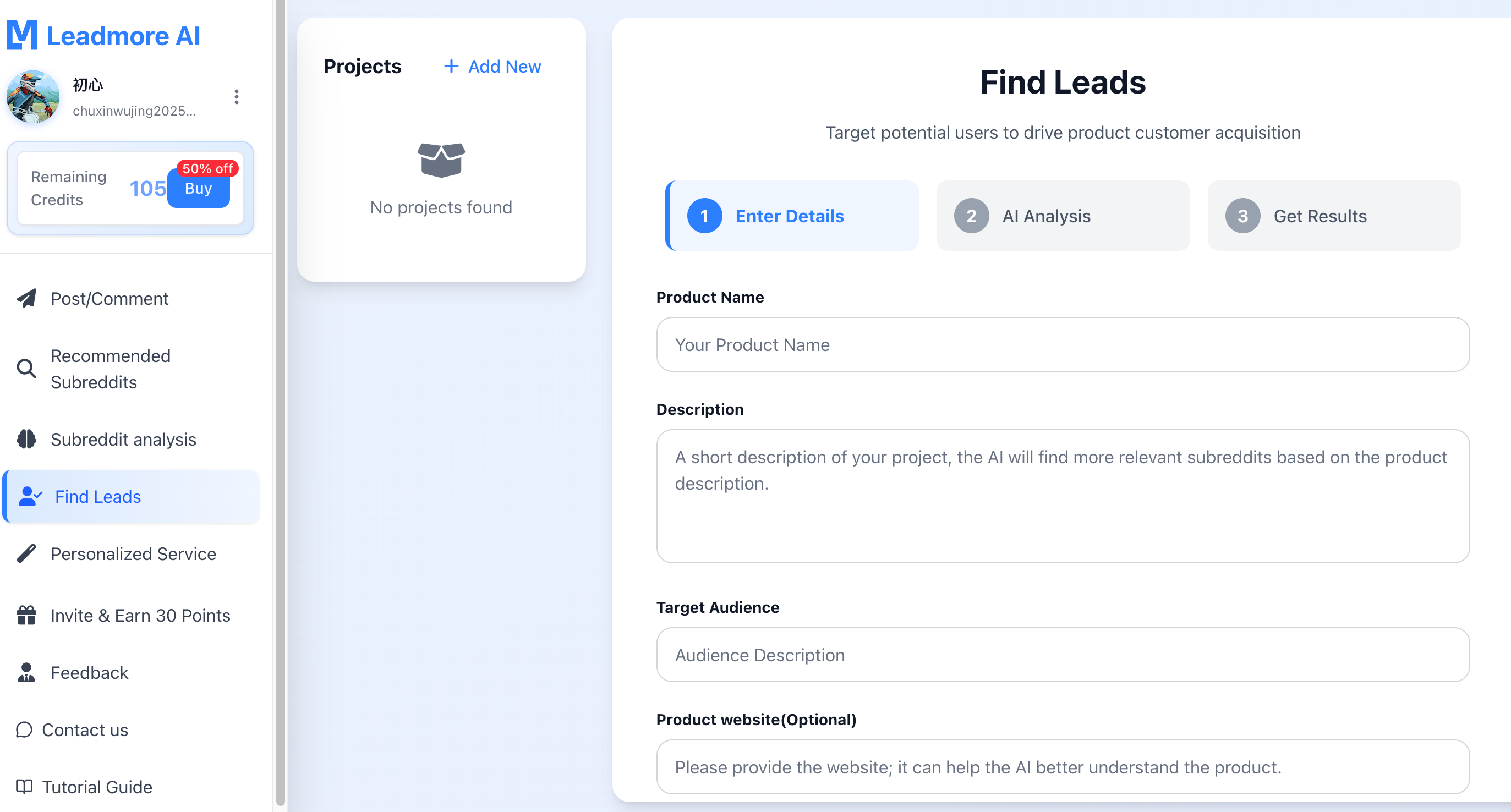
Tools like Leadmore AI monitor these conversations automatically. You define the keywords — your product category, competitors' names, the specific problems your product solves — and Leadmore AI surfaces posts and comments where your ICP is expressing active need in real time. Email notifications mean you can engage while the conversation is still live.
This doesn't replace outbound — it sharpens it. The most effective programs running today use community listening to inform who gets outbound outreach next, and the outreach directly references context from the community conversation. That's why community intent monitoring sits at the bottom of the cost-per-SQL curve in the chart above: you're converting demand that already exists, not generating it from scratch.
*Discover real buying signals on Reddit with Leadmore AI →
8. Making the Agency Relationship Work
Invest in onboarding more than you think you need to. The single biggest determinant of agency performance is how thoroughly they understand your product, your customers, and your sales process. Budget two to three weeks of intensive knowledge transfer before they launch any campaigns. Every week you skip here costs you six weeks of mediocre messaging on the other end.
Establish a weekly cadence with hard metrics. Weekly reporting on leads generated, meetings booked, reply rates, and conversion from meeting to SQL. If results are below target two consecutive weeks, that's the moment to adjust — not month four when the retainer has auto-renewed.
Give the agency sales feedback on every lead. Not just "good" or "bad" — why. Which ICPs are converting? Which types of outreach are producing the meetings that actually close? The agency's messaging improves dramatically when this loop is closed explicitly. Client Snapshot A above demonstrates exactly what happens when you build this vs. when you don't.
Own your own data and infrastructure. Prospect lists, sending domains, email accounts, and sequences should be built in your tech stack, not the agency's. This is non-negotiable. Agencies that insist on running campaigns through their own platforms are structurally positioned to hold your data hostage at contract renewal. Push back on this early — Client Snapshot B demonstrates the cost.
Plan for the transition from day one. Even if the agency relationship is excellent, eventually you'll build in-house. Overlap the agency and your internal hire for 60–90 days during transition to ensure continuity and capture the institutional knowledge built during the engagement.
9. FAQs
What does a B2B lead generation agency do?
A B2B lead generation agency identifies potential business customers and initiates contact on your behalf — typically through cold email, LinkedIn outreach, or coordinated multi-channel programs. The best agencies deliver qualified meetings with decision-makers who fit your ICP. They're not filling your calendar with introductions; they're building your pipeline.
How much does a B2B lead generation agency cost?
Outbound-focused agencies typically run $3,000–$8,000/month. ABM and full-funnel agencies run $8,000–$25,000/month depending on scope. Expect the first 30–60 days to be ramp and setup before leads flow consistently. Price below $2,000/month for "full service" outbound is a red flag — the economics don't support quality execution at that rate.
How do I know if a B2B lead generation agency is legitimate?
Ask for three verifiable client references at your company stage. Request sample campaign data with real performance metrics — not polished templates. Ensure they'll run a pilot before a 6–12 month commitment. Legitimate agencies welcome scrutiny. Weak agencies create urgency and push for long commitments before you've seen results.
What is the difference between a lead generation agency and an SDR agency?
In practice, these terms overlap significantly. An SDR agency specifically handles outbound prospecting and initial qualification — finding prospects and booking intro calls. A lead generation agency may do this plus inbound lead generation, content syndication, or broader demand generation. When evaluating, focus on what the deliverable actually is rather than the label.
Is it better to hire a lead generation agency or build in-house?
For most B2B SaaS companies, specialized agencies deliver stronger efficiency and faster results than building in-house through early and mid-growth stages. In-house becomes the better choice when you have the budget (roughly $400K/year fully loaded for one senior SDR plus tooling and management), a 6+ month runway before results are needed, and a strategic need for internal ownership of the function. Most companies try to build in-house too early, underestimate ramp time, and end up running an agency alongside an internal SDR anyway.
How does community monitoring fit into B2B lead generation?
Community monitoring — tracking Reddit, LinkedIn, Slack, and industry forums for buying signals — surfaces intent-qualified leads that often outperform agency-generated outbound contacts on conversion rates, at significantly lower cost per SQL. Tools like Leadmore AI automate this monitoring, alerting you when your ICP is publicly expressing the exact problem your product solves. For many B2B companies, this self-serve capability is a cost-effective complement to traditional lead gen — and in some cases, a viable partial replacement for early-stage outbound spend.
Once you understand how to evaluate agencies, the next step is comparing actual providers in the market.
Turn real buyer intent from Reddit into qualified pipeline with Leadmore AI →