What Is a Content Roadmap? The Practitioner's Guide (2026)
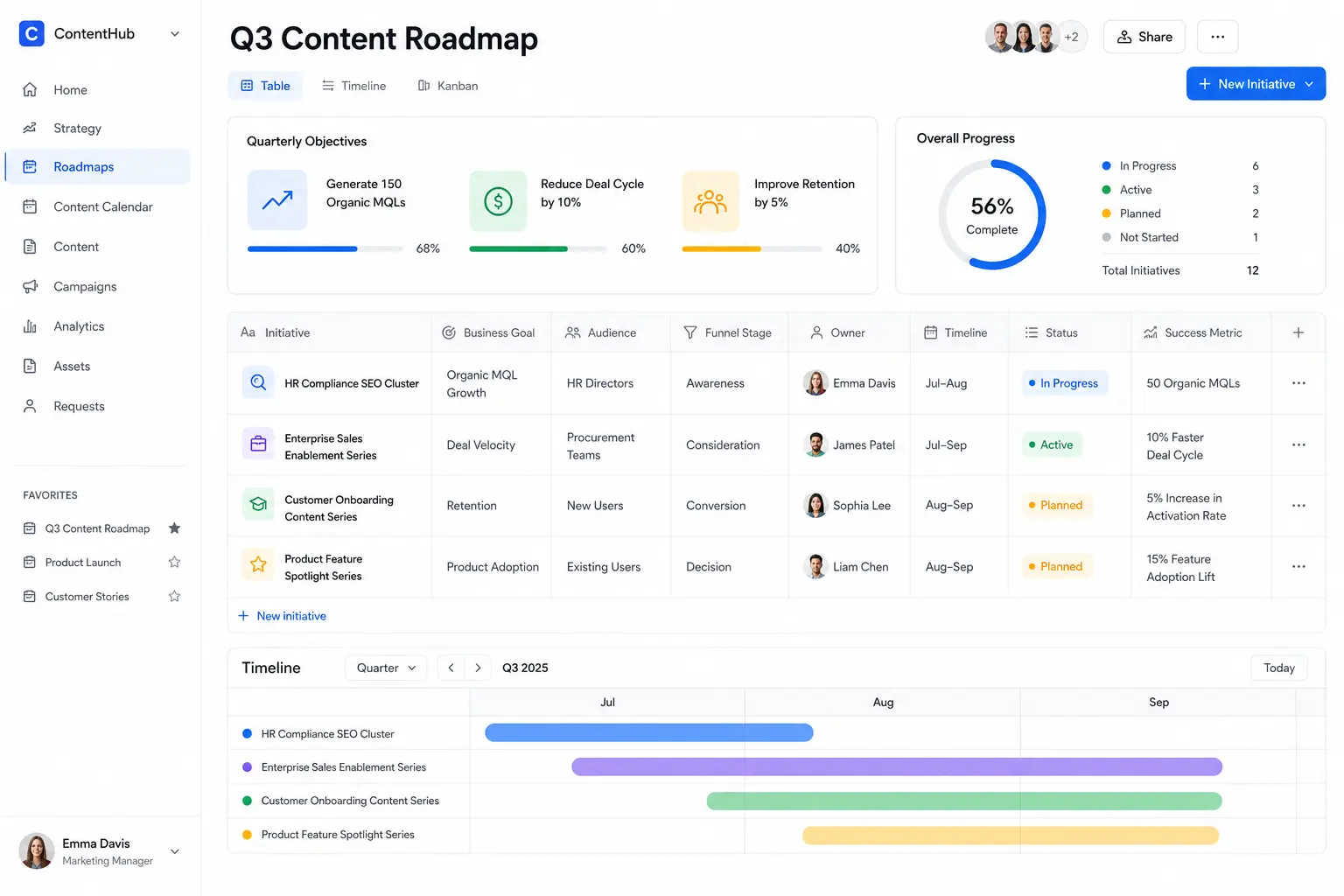
By Sarah Mitchell | Head of Content Strategy · 11 years building content programs at B2B SaaS companies · Former Content Director at two Series B startups
Here's a stat that should stop every content manager cold: according to the Content Marketing Institute's latest B2B research, companies with a documented content strategy are 3.5x more successful than those without one — and yet fewer than 40% of B2B marketers actually have a documented strategy. The gap isn't effort. It's structure.
A content roadmap is the document that closes that gap. But most teams either don't have one, or have one that stopped reflecting reality by week six.
This guide explains what a content roadmap actually is, why it's different from a content calendar, what goes inside one, and — crucially — the specific mistakes that cause most roadmaps to collect dust instead of drive results.
The Definition (Optimized for Quick Reference)
A content roadmap is a strategic planning document that maps what content you'll create, when it will be produced, and why each initiative exists in relation to a specific business goal. It bridges the ambition of your content strategy and the execution detail of your content calendar — connecting every piece of content to a measurable outcome, a target audience segment, or a stage of the funnel.
Unlike a content calendar (which answers when and what goes live), a content roadmap answers what we're building, why we're building it, and whether it's working.
Why Most Content Programs Are Running Blind
A few numbers from the Content Marketing Institute's 2025 B2B Content Marketing Benchmarks report tell a sobering story:
58% of B2B marketers rate their content strategy as only "moderately effective."
56% of B2B marketers say they struggle to attribute ROI to content efforts.
Among those with less effective strategies, 42% cite a lack of clear goals as the primary reason.
Only 29% of marketers with a documented strategy rate it as "extremely or very effective."
These numbers don't describe a skill problem. They describe a structural one. Content teams are producing on schedule — blogs go out three times a week, the newsletter lands every Tuesday, social never misses a day — but the connection between that output and business outcomes is invisible. The work feels productive. The results feel random.
That's what a content roadmap is designed to fix.
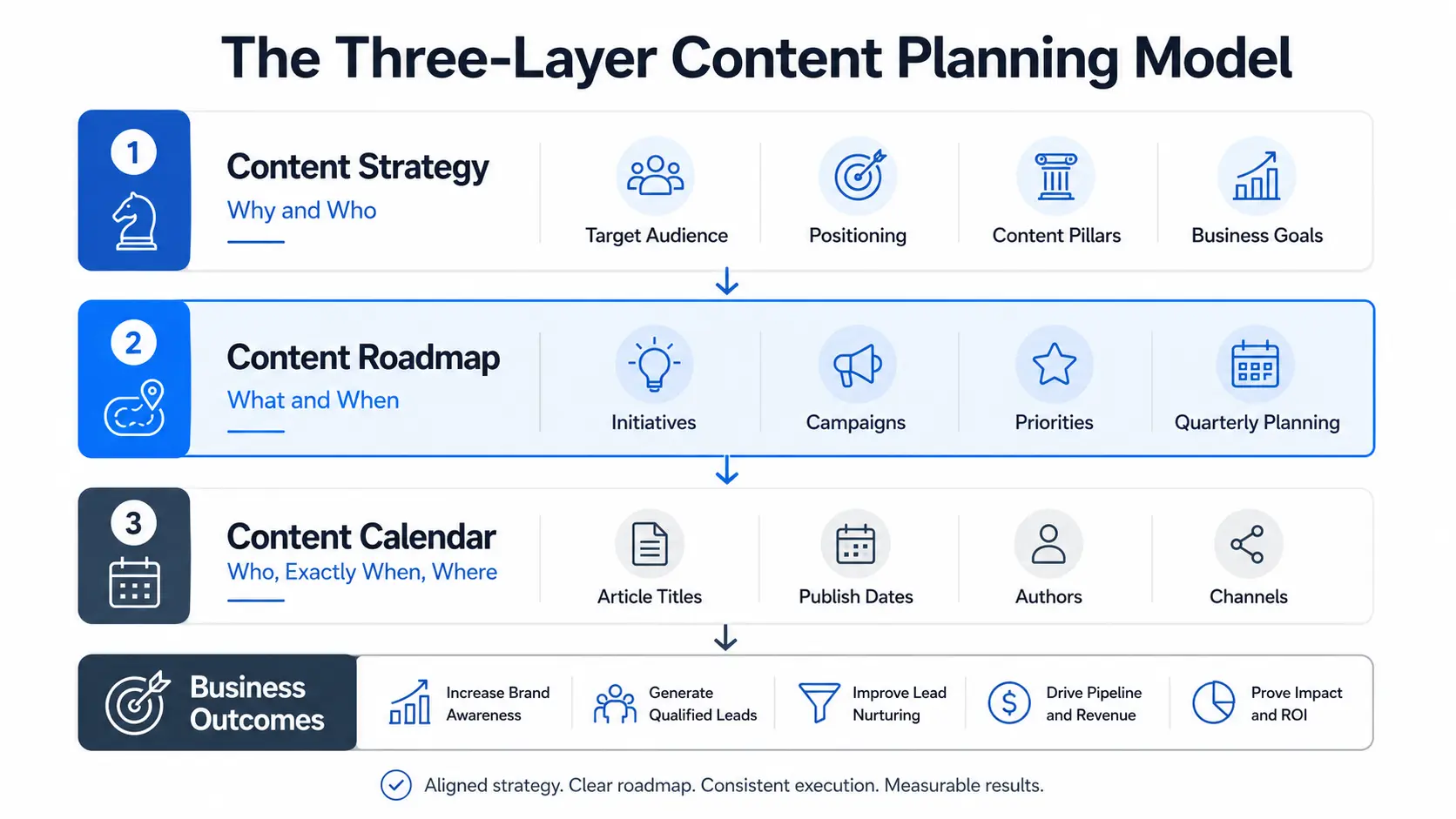
The Three-Layer Model (Where the Roadmap Lives)
Understanding a content roadmap is impossible without seeing where it sits in relation to two other planning tools most teams already have:
Layer 1 — Content Strategy: The why and who. Defines your target audiences, your positioning, your content pillars, and the role content plays in your broader marketing and business goals. Typically reviewed quarterly or annually.
Layer 2 — Content Roadmap: The what and when, at the initiative level. Translates strategy into a prioritized set of content programs, campaigns, and projects with rough timelines — typically covering a rolling quarter to a year.
Layer 3 — Content Calendar: The exact who, exactly when, and precisely where. The operational view: individual article titles, publish dates, authors, channels, and status.
Most teams maintain Layer 1 and Layer 3 while skipping Layer 2 entirely. They have a strategy doc on Confluence no one has opened since Q1, and a calendar in CoSchedule or Notion that's meticulously maintained — but the two things are unconnected. The calendar doesn't know why it exists. That's the roadmap's job.
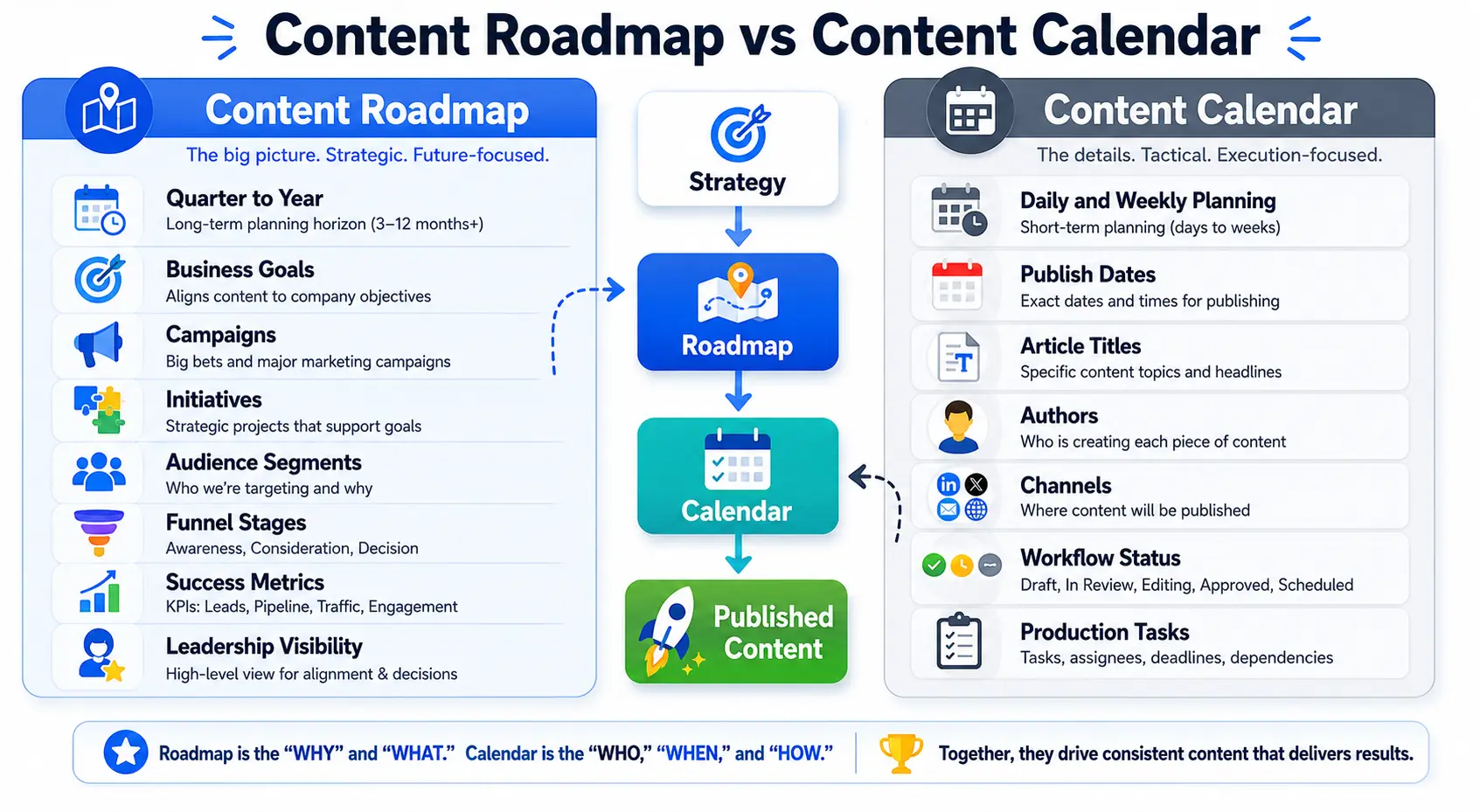
Content Roadmap vs. Content Calendar: The Clearest Explanation You'll Find
This comparison gets made constantly. Here's the version that actually sticks.
A content calendar answers: "What goes live this Tuesday, who's writing it, and where does it get posted?"
A content roadmap answers: "What content initiatives are we running this quarter, what business outcomes are they supposed to drive, and are we on track?"
The practical test: Pull up your content calendar. Now ask: "Why are we covering this topic this week instead of that one?"
If your team can answer that immediately — because the roadmap said this month is focused on mid-funnel comparison content to support the enterprise sales cycle — you have a roadmap. If the answer is "someone suggested it in Slack" or "it was on the list" — you don't.
An editorial calendar tells you what's happening. A content roadmap tells you what it's for.
Quick comparison:
Content Roadmap
Content Calendar
Time horizon
Quarter to year
Days to weeks
Primary question
Why this? For whom?
When? By whom?
Unit of planning
Initiatives and campaigns
Individual assets
Primary audience
Leadership, cross-functional teams
Content team
Updated
Monthly
Daily/weekly
Lives in
Notion, Airtable, Asana
CoSchedule, Trello, Sheets
What a Content Roadmap Actually Contains
Different organizations build roadmaps that look different — but any complete content roadmap should include these seven components:
1. Strategic objectives The 2–4 business outcomes content is supposed to contribute to. Not content metrics like "publish 3x per week" — real outcomes like "generate 200 qualified organic leads per month" or "support enterprise sales by building a library of security-focused content." Every initiative on the roadmap must connect to one of these.
2. Content initiatives or themes Rather than listing individual articles, a roadmap organizes work into meaningful clusters. Examples: "Q3 SEO expansion into HR compliance topics," "Product launch support for feature X," "Customer retention content series for onboarding phase." These are the units of strategy.
3. Target audience and funnel stage For each initiative: who exactly is this for, and where are they in the buying journey? Top-of-funnel awareness content for HR directors looks completely different from bottom-of-funnel comparison content for IT procurement managers — and both should appear explicitly on the roadmap.
4. Content types and formats What form will the output take? A pillar page + three supporting articles? A video series? A lead-gen report? A campaign microsite? Format decisions belong in the roadmap, not just the calendar.
5. Distribution and channel plan Where will each initiative live, and how will it reach the audience? A roadmap that plans for creation without planning for distribution is half a roadmap. This is where you note organic search, email, LinkedIn organic, paid amplification, or syndication partnerships.
6. Ownership and resourcing Who owns each initiative? What internal and external resources are required? This surfaces resourcing conflicts before they become missed deadlines.
7. Timeline and success metrics What are the major milestones, and how will you know an initiative worked? Setting success metrics at the roadmap level — before the work starts — is what transforms a content plan from an activity list into an accountable program.
What Happens Without One: A Realistic Scenario
Consider a scenario I've seen play out at multiple B2B companies: A six-person content team heading into Q3 with 20 initiatives on the roadmap — new SEO topic clusters, a product launch campaign, a mid-funnel comparison guide series, an email nurture rebuild.
By mid-October, only seven of those initiatives were active. Not because the team wasn't working hard. Because two major things happened that the roadmap hadn't accounted for: sales leadership pushed for more competitive battle cards after losing three deals to the same competitor, and the product team moved the launch date up by three weeks.
Without a roadmap, this kind of shift causes chaos. Teams scramble, priorities are reset via Slack at 10 PM, and half-finished initiatives get quietly abandoned. With a roadmap, the same situation becomes a managed decision: you look at the current initiatives, identify which three have the least momentum, formally deprioritize them, and rebalance the team toward the new priorities — with documentation that explains why the shift happened.
This is the difference between reacting to the business and aligning with it. The roadmap isn't what prevents change. It's what makes change navigable.
A Real Content Roadmap Template (What It Actually Looks Like)
Here's a simplified version of a working Q3 content roadmap for a mid-market B2B SaaS company.
This is the kind of structure you'd build in Airtable or Notion — not a list of article titles, but a plan of initiatives:
Q3 CONTENT ROADMAP — [Company Name]
Period: July 1 – September 30

BUSINESS OBJECTIVES THIS QUARTER:
1. Generate 150 new MQLs from organic search
2. Support enterprise sales cycle (reduce average deal length by 10%)
3. Improve 60-day retention rate for new customers (target: +5%)

────────────────────────────────────────────────────────────────────────
INITIATIVE 1: HR Compliance SEO Cluster
Goal: Objective 1 (organic MQLs)
Audience: HR Directors, mid-market (500–2,000 employees)
Funnel Stage: TOFU/MOFU
Deliverables: 1 pillar page, 4 supporting articles, 1 checklist download
Channels: Organic search, email newsletter, LinkedIn organic
Owner: [Content Lead]
Timeline: July 1 – August 15
Success Metric: 500 organic sessions/month by end of Q3; 25 checklist downloads/week

────────────────────────────────────────────────────────────────────────
INITIATIVE 2: Enterprise Sales Enablement Series
Goal: Objective 2 (deal velocity)
Audience: IT Procurement, enterprise (2,000+ employees)
Funnel Stage: BOFU
Deliverables: 3 comparison guides, 2 ROI calculators, 1 security whitepaper
Channels: Sales outreach, dedicated landing page, Highspot
Owner: [Product Marketing]
Timeline: July 15 – September 1
Success Metric: Used in 80% of enterprise deals; cited in at least 5 won-deal reviews

────────────────────────────────────────────────────────────────────────
INITIATIVE 3: Customer Onboarding Content Series
Goal: Objective 3 (retention)
Audience: New users (0–60 days post-signup)
Funnel Stage: Post-sale
Deliverables: 6-part email series, 3 in-product tooltips, 1 "quick win" video
Channels: Product email, in-app, YouTube
Owner: [Customer Success + Content]
Timeline: August 1 – September 15
Success Metric: 60-day retention rate for users who engaged with series vs. control group

────────────────────────────────────────────────────────────────────────
PARKING LOT (Deprioritized for Q3, revisit Q4):
- Podcast launch
- Industry benchmark report
- LinkedIn Thought Leadership series for CEO
Notice what this roadmap doesn't include: individual article titles, specific publication dates, or per-task assignments. Those belong in the calendar (CoSchedule, Trello, ClickUp) and project management tool (Asana, Linear). The roadmap stays at the initiative level — high enough to be strategic, specific enough to be accountable.
Why Most Content Roadmaps Fail
Building a roadmap is easier than maintaining one. Here's where teams consistently go wrong:
The "file-and-forget" problem. A roadmap that isn't reviewed monthly isn't a roadmap — it's a time capsule. The most common failure mode is a team that spends two days building a beautiful Airtable roadmap in January, feels accomplished, and then runs the content operation entirely off the calendar from February onward.
Building it in a silo. Many roadmaps are built by a single content manager, without input from sales ("here's what's stalling deals"), from SEO ("here's where we have ranking opportunity"), from customer success ("here's what new users don't understand"), or from product ("here's what's launching"). A roadmap built without cross-functional input is one person's best guess dressed up as a strategy.
Measuring output instead of outcomes. A roadmap organized around content volume — "publish 40 pieces in Q2" — will produce 40 pieces. Whether any of them move a business metric is a separate question nobody asked. According to CMI's research, 56% of B2B marketers struggle to connect content to ROI; content roadmaps built around output metrics instead of outcomes are a major reason why.
Over-engineering it. Some teams build roadmaps so granular and inflexible that any shift in business priorities requires a full rebuild. Roadmaps should operate at the initiative level, not the task level — specific enough to be real, loose enough to adapt.
Making it invisible. A roadmap that only the content team ever reads is missing its most important function: alignment. The content roadmap is what you show sales leadership to explain what's coming. It's what you bring to the quarterly business review to demonstrate that content is a function with direction, not just a publishing machine.
How to Build a Content Roadmap: The 6-Step Process
You don't need a specialized tool to start. A well-structured Google Sheet or Notion database will work until you outgrow it. Here's the process:
Step 1: Define your business objectives for the period. Before you write a single content idea, list the 2–4 outcomes your content program is supposed to contribute to this quarter. These are your constraints — every initiative on the roadmap must connect to one of them.
Step 2: Audit your existing content. Before planning new content, understand what you already have. What's performing? What's outdated? Where are the ranking opportunities you haven't captured? A quick audit using SEMrush or Ahrefs often reveals that updating a strong existing piece delivers more ROI than creating something new.
Step 3: Gather cross-functional inputs. Thirty minutes with your sales team is worth a week of keyword research. Talk to sales, customer success, and product before you lock anything in. You're looking for the questions prospects actually ask, the objections that stall deals, the knowledge gaps that cause churn, and what's launching next quarter.
Step 4: Group ideas into initiatives, not articles. Resist planning at the individual article level. Group related content ideas into campaigns or clusters. "A four-part series on procurement ROI for enterprise buyers" is a roadmap-level initiative. "Article: How to calculate software ROI" is a calendar item.
Step 5: Prioritize ruthlessly. For each initiative, assess the likely business impact, the effort required, and the urgency. A roadmap with 25 initiatives is a wish list. A roadmap with 5–8 well-resourced initiatives is a plan.
Step 6: Assign ownership and schedule your review cadence. Every initiative needs a single owner. And the roadmap needs a standing monthly review — not to report on task completion, but to assess whether initiatives are on track toward their outcomes and to make deliberate decisions about what to kill, accelerate, or add.
Tools for Building Your Content Roadmap
There's no single "right" tool — the best choice depends on your team size and how much you want the roadmap to integrate with your execution workflow.
For simple, flexible roadmaps: Notion or Google Sheets. Easy to build, easy to share, requires the most manual discipline to maintain.
For team-level roadmaps with task integration: Airtable (especially with its timeline and Kanban views) or ClickUp. These let you connect roadmap-level initiatives directly to production tasks.
For roadmaps embedded in content operations: CoSchedule or Contentful. These tools are purpose-built for content teams and allow the roadmap and calendar to live in the same system.
For roadmaps that connect to marketing performance data: HubSpot's Content Hub or Semrush's Content Marketing Platform. Useful when you want to tie roadmap initiatives directly to traffic, leads, and conversion data without switching between tools.
The tool matters less than the discipline. A well-maintained roadmap in a spreadsheet will outperform a neglected one in enterprise software every time.
When You Actually Need a Content Roadmap
A content roadmap isn't right for everyone. Solo creators who publish to one channel on one schedule may be better served by a simple content calendar with a clear goal pinned at the top.
You need a content roadmap when:
More than one person is involved in content — writers, designers, SEO strategists, social managers. Coordination without shared strategic context is just expensive chaos.
Content serves more than one business goal — acquisition, activation, retention, enablement. Without a roadmap, these goals compete for resources without any clear resolution framework.
You need to communicate content direction to non-content stakeholders — leadership, sales, product, investors. A calendar is opaque to people outside your team. A roadmap is legible to everyone.
You're managing more than one channel — blog, email, social, video, in-product. Cross-channel coherence without a shared initiative map is nearly impossible.
Your business is growing or changing — new products, new markets, new competitive dynamics. The roadmap is how content keeps pace with business reality instead of lagging six weeks behind it.
The Mental Model That Makes It All Click
Think of your content operation like a road trip.
Your content strategy is the destination — it defines where you're going and why it matters.
Your content roadmap is the navigation plan — the route you've chosen, the major stops, the estimated arrival, and the flexibility to reroute when conditions change.
Your content calendar is the turn-by-turn GPS — "In 200 meters, publish the case study. Merge left into LinkedIn."
Most teams have the destination and the turn-by-turn directions. They're missing the navigation plan. And so they drive hard in a direction that feels productive, without any reliable way to know whether they're actually getting closer to where they want to go.
Frequently Asked Questions
What's the difference between a content roadmap and a content strategy?
Your content strategy defines the overall direction — who you're creating content for, what role content plays in your business, and what success looks like. It's the "why" document. A content roadmap is more concrete and time-bound: it translates strategy into specific initiatives, owners, and timelines for a given period. Strategy answers where you're going; the roadmap answers how you'll get there this quarter.
How long should a content roadmap cover?
Most effective roadmaps plan the current quarter in detail and sketch the following two quarters at a higher level. Planning a full year at initiative-level detail typically results in a document that stops reflecting reality by week eight.
Does a content roadmap replace a content calendar?
No — they work in sequence. Build your roadmap first, then use it to populate your calendar. The roadmap defines what initiatives matter and why; the calendar handles the day-to-day production schedule.
What's the best tool for building a content roadmap?
For small teams: Notion or Google Sheets. For medium teams needing task integration: Airtable or ClickUp. For teams wanting content ops in one system: CoSchedule or HubSpot's Content Hub. Start simple and add sophistication when the process is working.
How often should a content roadmap be updated?
Monthly, at minimum. The roadmap should have a standing review where you assess initiative progress, make deliberate decisions about what to kill or accelerate, and incorporate new inputs from sales, product, and customer success.
Can a solo content creator benefit from a roadmap?
Yes — though a lighter version is appropriate. Even as a single creator, a one-page roadmap that connects your planned content clusters to specific goals prevents reactive publishing and keeps your effort pointed at outcomes, not just output.
Bottom Line
A content roadmap is the document that transforms content from a publishing schedule into a business function. It doesn't just track what's being created — it explains why, for whom, and toward what end.
According to CMI's research, companies with a documented content strategy are 3.5x more successful than those without one. But documentation alone isn't the differentiator. The teams that pull ahead are the ones who treat the roadmap as a living navigation tool — reviewed regularly, updated intentionally, and shared widely enough that every stakeholder understands what the content program is actually trying to accomplish.
Build it with business outcomes in front of you, not topic ideas. Keep it at the initiative level. Review it monthly. And when the business pivots — which it will — use the roadmap to make the change visible and deliberate, rather than letting it quietly collapse your publishing schedule.
Last updated: June 2026 | Estimated reading time: 12 minutes
About the Author
Sarah Mitchell is a content strategist with 11 years of experience building content programs at B2B SaaS companies. She has led content teams of up to 15 people, overseen editorial pipelines producing 200+ assets per quarter, and helped two early-stage startups build the content infrastructure that supported their Series B fundraises. She specializes in connecting content operations to revenue and has consulted for brands across HR tech, fintech, and cybersecurity. She writes regularly on content strategy, content operations, and measurement.
Sources: Content Marketing Institute, B2B Content Marketing Benchmarks, Budgets, and Trends: Outlook for 2025 & 2026; Demand Metric / CMI Lead Generation Data; HubSpot State of Marketing 2026.