Best Time to Post on Social Media in 2026: A Data-Backed Guide for Every Platform
Updated June 2026 — based on a synthesis of 2B+ engagements and 52M+ analyzed posts
The best time to post on social media in 2026 is Tuesday through Thursday between 9 AM and 1 PM in your audience's local time zone — but that answer, on its own, is almost useless. Every platform runs on a different clock. Instagram peaks at midday. TikTok spikes after dinner. LinkedIn just shifted from mornings to late afternoons. And Reddit's upvote system means your publishing hour can be the difference between 30 views and 30,000.
What actually matters isn't a magic hour on a chart. It's understanding why certain windows work — and how to find the one that fits your specific audience, platform mix, and content type.
This guide synthesizes findings from Sprout Social's analysis of nearly 2 billion engagements across 307,000 social profiles, Buffer's 2026 State of Social Engagement report covering 52 million posts from 200,000+ accounts, and several other large-scale studies. We'll break down the data by platform, explain the algorithm mechanics behind the numbers, and give you a practical framework for finding your own best times — not just copying someone else's.
Why Posting Time Still Matters (More Than You Think)
You've probably heard that "content is king" and timing is secondary. That's half-true. Content quality determines your ceiling; timing determines whether you ever reach it.
Here's how it actually works in 2026. Every major social platform now uses a staged distribution model. When you publish a post, the algorithm doesn't push it to all of your followers at once. It shows it to a small seed group — roughly 1% to 20% of your audience — and watches what happens. If that seed group engages quickly (likes, comments, saves, shares, or watch time in the first 30 to 60 minutes), the algorithm pushes the post wider: to more followers, then to non-followers through Explore pages, recommendation feeds, and For You algorithms. Weak early signals, and the post stalls.
This is called engagement velocity, and it's the reason timing matters so much more than it did five years ago. According to Buffer's research, creators who respond to comments within the first hour of posting see 2.1x more total engagement, because algorithms interpret that early interaction as a quality signal. On TikTok, content performance in the first one to two hours after posting largely determines how far the algorithm pushes it. On LinkedIn, posts that receive comments in the first hour see roughly 30% more distribution than those that don't.
So the real job of "posting at the right time" isn't about catching every eyeball at once. It's about publishing when enough of your audience is already scrolling, so genuine engagement arrives fast and triggers the algorithmic distribution cascade. Post into a dead hour, and even your best content gets judged against an empty room.
The Cross-Platform Cheat Sheet
Before diving into each platform, here's the high-level view. These are starting-point windows based on aggregate data — all in your local time zone.
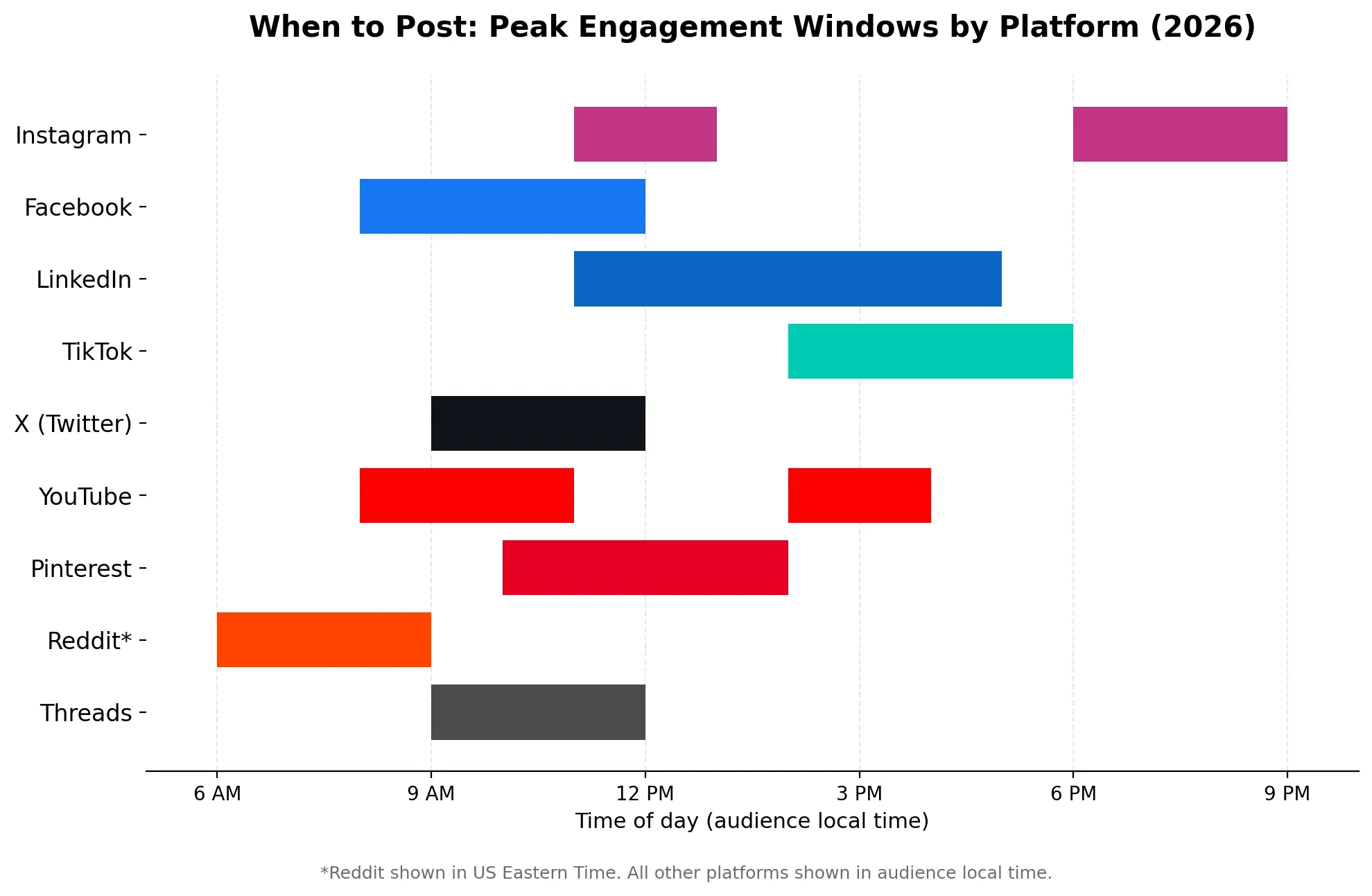
Figure: Peak engagement windows by platform, based on Sprout Social and Buffer's 2026 data. Times shown in your audience's local time zone (Reddit shown in US Eastern).
Instagram: Wednesday and Thursday, 11 AM–1 PM and 6–9 PM. Wednesday is the single strongest day. Carousels outperform Reels in engagement by 109%, according to Buffer's 2026 analysis of 9.6 million posts, so schedule your best carousel content for the midday peak.
Facebook: Wednesday and Thursday, 8 AM–12 PM. Morning energy dominates here, driven by the platform's largest demographic (ages 25–44) checking feeds during their morning routines and early work hours. Engagement drops notably in the afternoon.
LinkedIn: Tuesday through Thursday, 11 AM–5 PM. This is a notable shift from 2025, when peak engagement sat firmly within morning working hours. Buffer's analysis of nearly 5 million LinkedIn posts found that afternoon and evening engagement now outperforms mornings — likely reflecting remote-work habits where professionals scroll LinkedIn as a wind-down activity rather than a start-the-day habit.
TikTok: Tuesday through Friday, 2–6 PM. TikTok's immersive, sound-on environment demands active attention, and audiences wait until the workday winds down to dive into their feeds. The platform's algorithm is less time-sensitive than Instagram's because the For You page can surface content days later — but early momentum still matters for the initial push.
X (Twitter): Tuesday through Thursday, 9 AM–12 PM. The platform's real-time, text-first feed decays fast, making it the most time-sensitive network. Recency is weighted more heavily on X than on any other major platform.
YouTube: Sunday, Tuesday, and Wednesday, 8–11 AM and 2–4 PM. The smartest strategy is to upload two to three hours before peak viewing time, giving the algorithm time to index and begin recommending your video.
Pinterest: Tuesday through Thursday, 10 AM–2 PM. Pinterest functions more like a visual search engine than a social feed; users actively plan future purchases and projects during early afternoon lulls. Shoppable Pins and static images drive the most interaction.
Reddit: Tuesday through Thursday, 6–9 AM US Eastern. Reddit is unique — every post starts at position zero in the subreddit's "new" queue and must earn its way up through upvotes. The first hour is everything, and timing matters more here than on any algorithm-driven platform. For a detailed breakdown by subreddit category, see our full guide to the best time to post on Reddit.
Threads: Wednesday through Friday, 9 AM–12 PM. Still an emerging platform, but early data suggests morning posting outperforms evenings, and the algorithm rewards engagement within the first hour — somewhat similar to X's real-time feed behavior.
Platform-by-Platform Deep Dive
Instagram: The Midday Aesthetic Break
Instagram's audience reliably turns to the app to disconnect during the workday, creating a dense active window from late morning through the early afternoon. Sprout Social's 2026 data describes this midday block as a kind of digital break room — people step away from emails and meetings to seek quick visual stimulation. A second, often stronger peak emerges in the evening (6–9 PM), when users browse more deliberately and have time to watch Reels, swipe through carousels, and explore Stories.
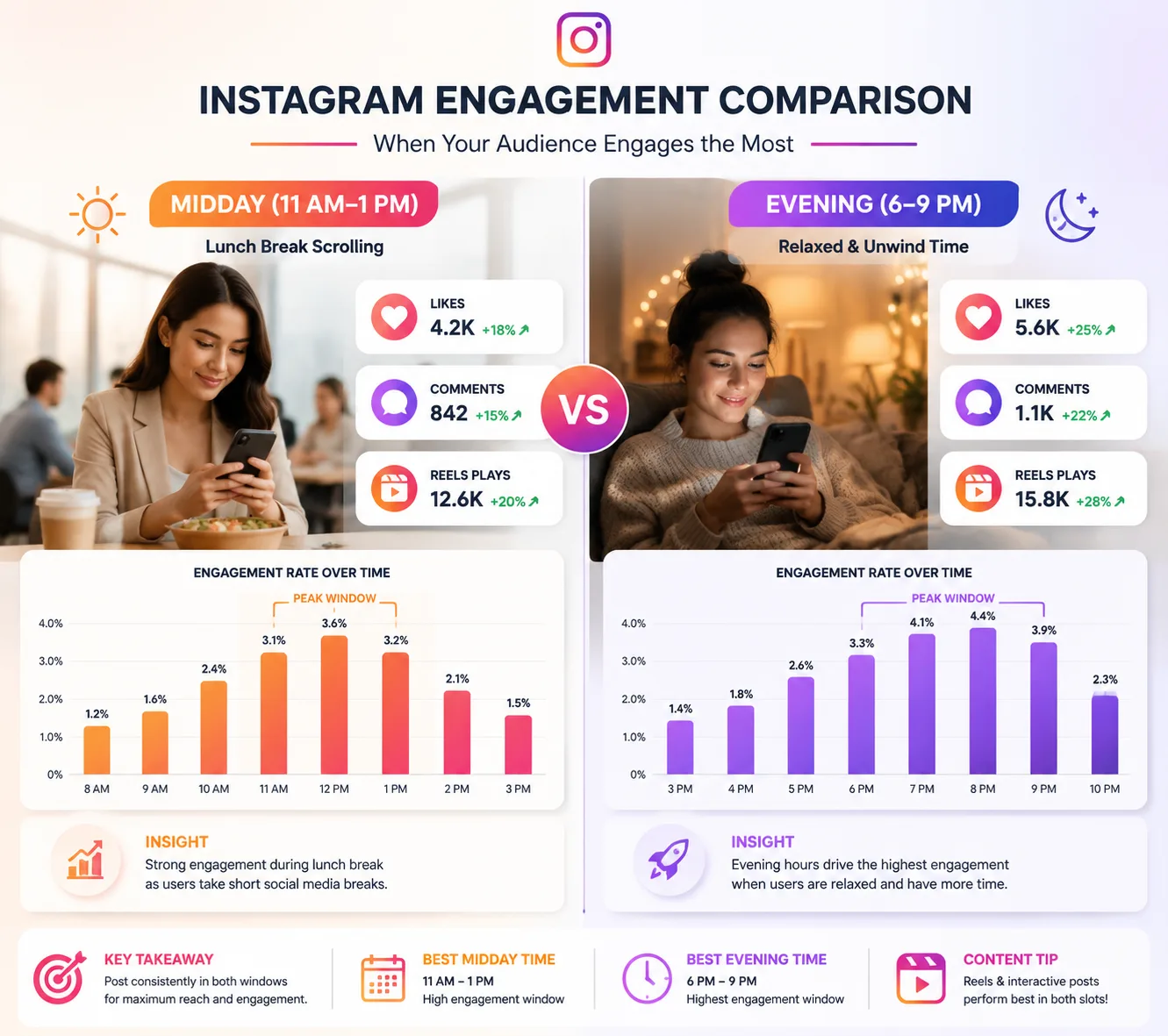
The standout finding from 2026 is how much content format changes the picture. Buffer found that evening hours (6–11 PM) generate the strongest engagement on every weekday except Thursday, when a powerful early-morning peak appears between 7 and 9 AM. Carousels perform best during focused scrolling sessions (mornings and lunch), while Reels skew toward evenings when people are in entertainment mode. Stories, which disappear after 24 hours, are the least time-sensitive format — frequency matters more than exact timing.
Instagram's head, Adam Mosseri, has confirmed that "sends per reach" — how often people DM your post to a friend — is now the platform's most important algorithmic factor in 2026, especially in Reels and Discover feeds. That means your timing strategy should optimize for moments when people are relaxed enough to share, not just scroll past.
For a detailed hour-by-hour breakdown by day, content format, and industry, check out our full guide to the best time to post on Instagram.
Facebook: The Morning Scroll and the Contrarian Advantage
Facebook's engagement curve in 2026 peaks in the morning and sustains into early afternoon, then rises again in the evening. According to Buffer's analysis of over 14 million Facebook posts, Thursday at 9 AM is the single strongest posting slot, with Wednesday and Sunday mornings also performing well. Engagement tends to drop off during the afternoon hours (12–5 PM).
This morning-first pattern makes sense when you consider who uses Facebook. The platform's largest demographic is 25 to 34 years old, and Pew Research Center's 2025 survey found that 52% of U.S. adults who use Facebook visit it at least once a day, with 37% checking in multiple times daily. The primary reason? Keeping up with friends and family (93% cite this as a reason), which naturally aligns with morning routines — a quick catch-up over coffee before the day gets busy.
But here's a strategic wrinkle most guides miss: Jon Loomer's analysis found that Facebook posts published during non-peak hours can receive significantly higher engagement than those posted at peak times, because there's less competition in the feed. If you're a smaller page struggling to break through, this "contrarian window" is worth testing — try posting between 6 and 7 AM or after 7 PM.
Facebook now distributes up to half of feed content from accounts users don't follow, through AI-driven recommendations. That means your follower count matters less than it used to, and the first-hour engagement velocity matters more. Timing your post to hit when real people are ready to react is how you trigger that recommendation engine.
For format-specific breakdowns (Reels vs. video vs. photos vs. link posts) and industry-level data, see our dedicated guide to the best time to post on Facebook.
LinkedIn: The Afternoon Shift
LinkedIn saw one of the most significant timing shifts of any platform in 2026. In prior years, peak engagement sat squarely within morning business hours. This year, Buffer's analysis of nearly 5 million LinkedIn posts found that engagement starts building in the afternoon and holds steady into the evening — with 4 PM on Wednesday and 3–4 PM on Friday emerging as the top slots.
The shift likely reflects changes in remote and hybrid work patterns. Professionals now check LinkedIn as a wind-down activity in the late afternoon rather than a start-the-day ritual. Text-based posts remain the most engaging format on the platform (preferred by 51% of users, according to Sprout Social's 2026 Content Strategy Report), and these perform best when people have time to read and comment thoughtfully — which is more likely at 4 PM than 8 AM.
One tactical detail: LinkedIn's algorithm evaluates content value within the first hour through meaningful engagement signals (comments, shares with captions), and continues distributing high-quality posts for weeks. This longer distribution tail means a well-timed LinkedIn post has more staying power than one on Instagram or X.
TikTok: The After-Work Theater
TikTok's engagement pattern is straightforward: people use it when they can give it their full attention, which usually means after work hours. Sprout Social's 2026 data points to Tuesday through Friday between 2 and 6 PM as the prime window. Buffer's analysis of 7.1 million TikTok videos largely agrees, though it also identifies strong weekend engagement — Saturday is TikTok's best weekend day, the opposite of nearly every other platform.
TikTok's algorithm is unique in that it's the least time-sensitive of the major platforms. Because the For You page surfaces content based on interest signals rather than recency, a video can go viral days or even weeks after publishing. But that doesn't make timing irrelevant — it makes the first one to two hours critical for the initial push. Strong early engagement signals (watches, likes, shares, comments) tell the algorithm the content is worth showing to broader audiences. A creator with 2,000 followers can out-reach one with 200,000 if the early velocity is stronger.
TikTok's median engagement rate in 2026 is 3.70% — far higher than Instagram (0.48%), Facebook (0.15%), or X (0.12%). That's a function of its algorithm-driven discovery model, but it also means competition for attention on TikTok is fierce. Timing your post to land in the after-work leisure window is how you stack the odds.
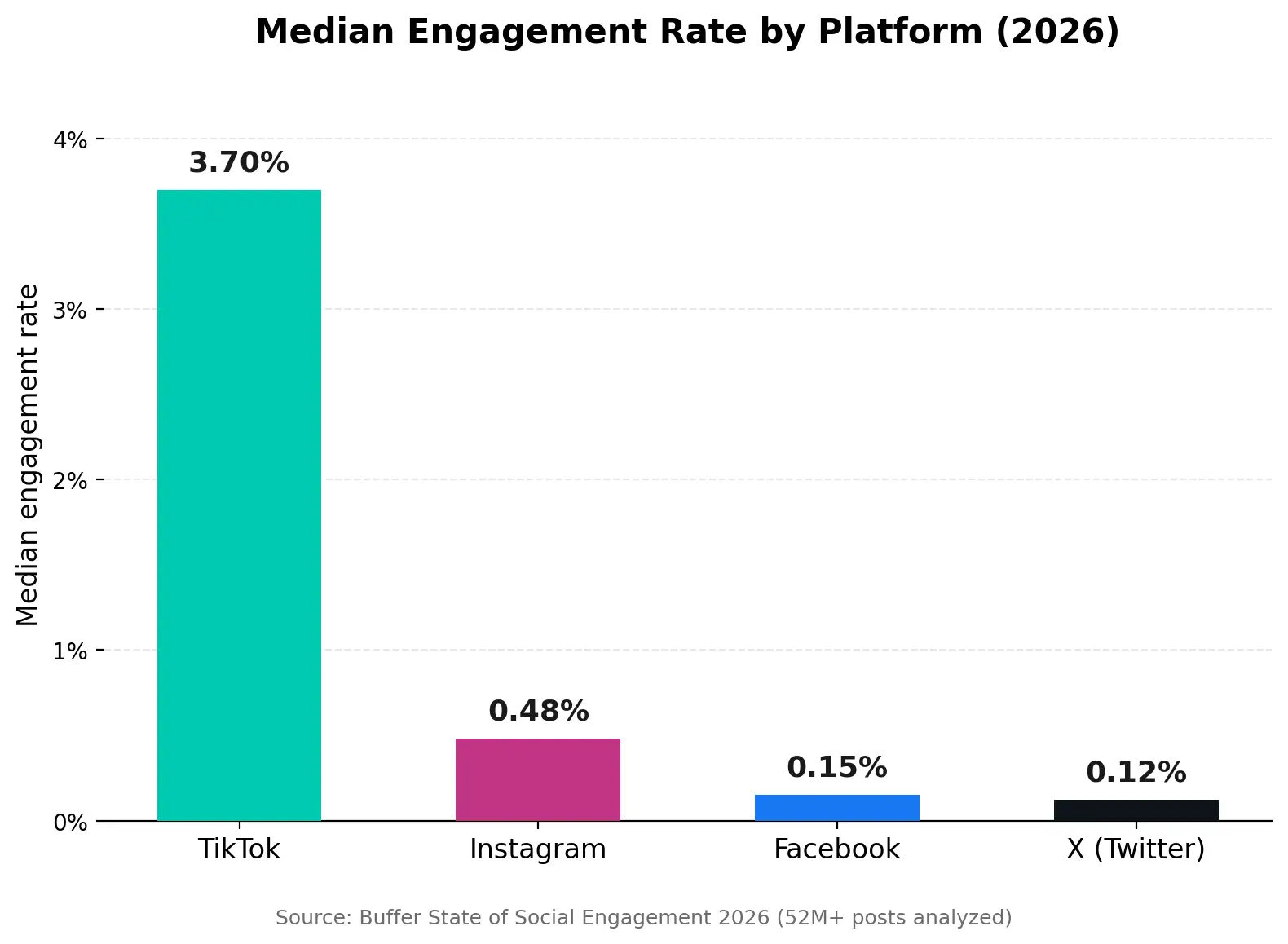
Figure: Median engagement rate by platform, per Buffer's 2026 analysis of 52M+ posts (engagement rate = likes + comments + shares + saves ÷ followers × 100).
X (Twitter): The Real-Time Wire
X remains the most time-sensitive platform because its feed prioritizes recency more heavily than any other network. Sprout Social's 2026 data shows peak engagement from midday through late afternoon (12–6 PM) Tuesday through Thursday, as people use it for real-time news, industry commentary, and trending conversations. Buffer's data points to mornings (9–11 AM) and around lunchtime as the strongest windows. Wednesday edges out other days for overall performance.
The practical takeaway: treat X like a wire service. Plan multiple posts per day (three to five is the common recommendation for brand accounts), space them across the morning-to-afternoon band, and tie them to trending topics whenever relevant. Content decays rapidly on X, so a single well-timed daily post won't cut it the way it might on Instagram or LinkedIn.
Reddit: Where Timing Is Everything
Reddit is the one platform where posting time genuinely decides whether your submission is seen by dozens or tens of thousands. There's no follower feed catching your post — every submission starts at the bottom of a subreddit's "new" queue and has to earn upvotes fast enough to climb to "hot" and eventually the front page.
The Reddit-wide sweet spot is weekday mornings, specifically Tuesday through Thursday between 6 and 9 AM US Eastern. That window catches the US audience waking up while Europe is in its mid-afternoon browsing window — maximizing the pool of early upvoters. But Reddit's real timing secret is that every subreddit runs on its own clock. Business and tech subreddits peak in the morning. Gaming subreddits peak at night. News subreddits spike around major US news cycles.
If you're serious about Reddit, timing your posts to the specific subreddit — not to Reddit overall — is the single biggest lever you have. For a heatmap broken down by subreddit category and time zone, see our full guide to the best time to post on Reddit.
Pinterest: The Search Engine That Plans Ahead
Pinterest operates more like a visual search engine than a social feed, which changes how timing works. Users actively plan future purchases, recipes, and projects, so pins published during early-afternoon lulls (Tuesday through Thursday, 10 AM–2 PM) tend to catch people in planning mode. Shoppable Pins and static images perform strongest, with 38% of users most likely to interact with static images and 34% with Shoppable Pins, according to Sprout Social's 2026 data.
But here's what makes Pinterest different from every other platform: pins have an exceptionally long shelf life. Unlike an Instagram post that lives or dies in the first hour, a pin can accumulate saves and clicks for months through Pinterest's search-driven discovery. This means timing matters less for Pinterest than for any other platform — but it still helps to launch your pin when active users are around to give it that initial boost.
The Data Sources Behind These Numbers
Not all "best time to post" studies are created equal. Here are the ones we've drawn from, so you can evaluate the data yourself:
Sprout Social (2026): Analyzed nearly 2 billion engagements across roughly 307,000 social profiles spanning 30,000+ customers globally, covering the period from November 2025 to February 2026. Covers Facebook, Instagram, LinkedIn, Pinterest, TikTok, and X.
Buffer — State of Social Engagement 2026: Examined over 52 million posts across 10 platforms from 200,000+ accounts, including 9.6 million Instagram posts, 14 million Facebook posts, 7.1 million TikTok videos, and 4.8 million LinkedIn posts. Data spans January 2024 to December 2025. Measured median engagement rates (likes + comments + shares + saves / followers × 100) to avoid skew from outlier posts and large accounts.
Pew Research Center (2025): Surveyed 5,022 U.S. adults (February–June 2025) and a separate survey of 5,123 adults (February–March 2025) on platform usage frequency. While Pew doesn't study posting times directly, their demographic and usage data is essential for understanding why certain platforms peak when they do.
SocialPilot (2026): Studied 7 million Instagram posts and 700,000 TikTok videos.
Metricool (2026): Published platform-specific timing studies for Instagram, LinkedIn, and TikTok based on user data from their analytics platform.
One important caveat: these studies use different datasets, industries, time periods, and definitions of "engagement." That's why the recommended times don't always agree. Where Buffer says Instagram evenings are best, Sprout Social points to midday. Both are correct — for their datasets. The value is in the convergence: where multiple independent studies agree (midweek, midday, professional hours for B2B), the signal is strong.
Why Wednesday Keeps Winning
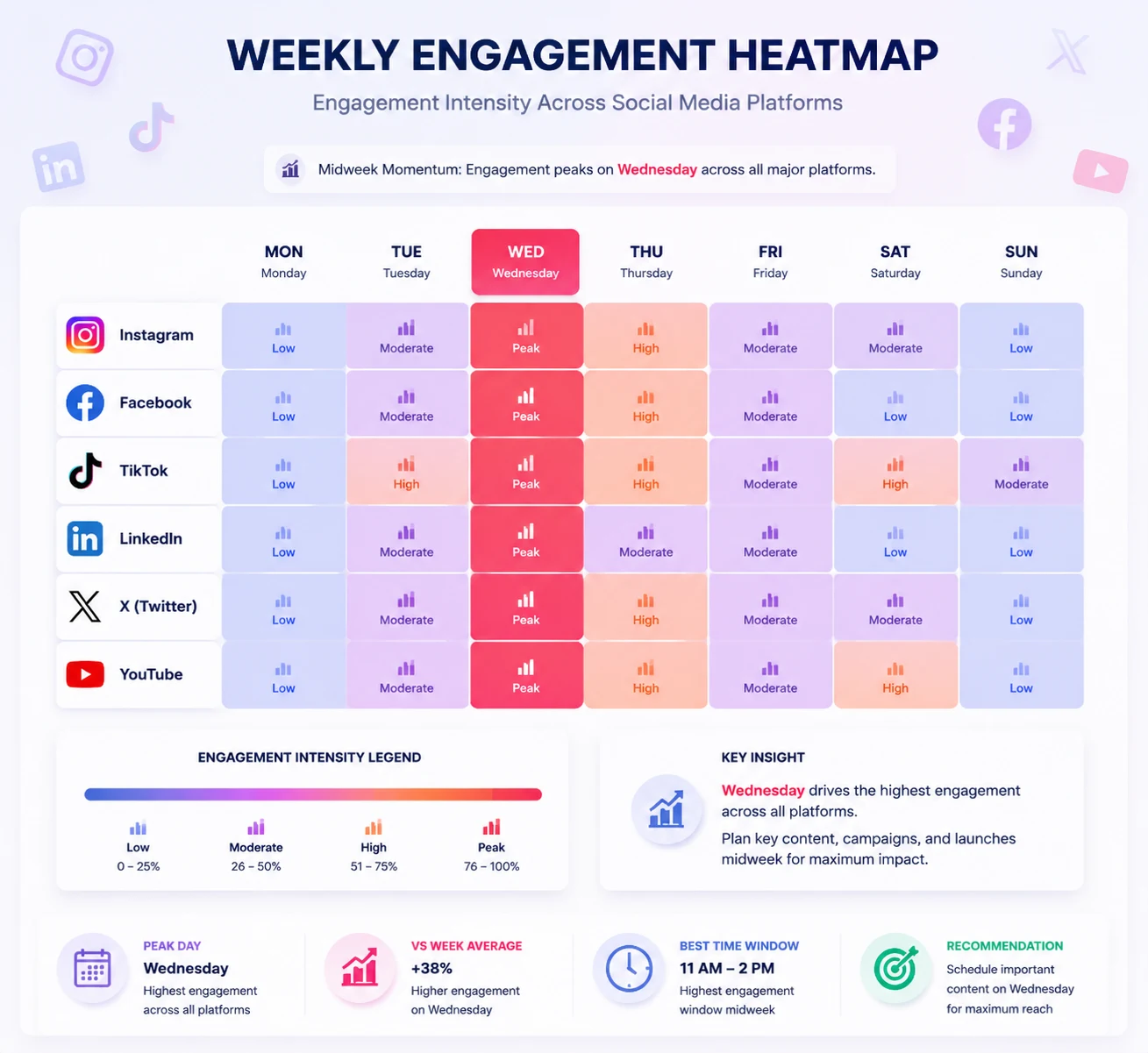
One pattern emerges so consistently that it deserves its own explanation: Wednesday is the single best day to post on almost every platform. It tops or ties for the top on Instagram, Facebook, LinkedIn, Threads, YouTube, X, and Pinterest across multiple studies.
Why? There are a few behavioral dynamics at play.
First, there's the workweek rhythm. Monday is recovery — people are catching up on emails, planning the week, and less likely to browse social media leisurely. By Wednesday, the productive intensity of the week has peaked and begins to ease. People take more mental breaks, check social feeds during pauses, and have the cognitive space to engage with content rather than just scroll past it.
Second, there's a content supply dynamic. Many brands batch-schedule their posts for Monday (start-of-week pushes) or Friday (weekend anticipation). Wednesday sits in a relative content valley — less competition in the feed means your post has a better shot at standing out. This is the same principle behind the "contrarian off-peak" strategy, just applied to days rather than hours.
Third, there's the algorithmic compounding effect. If your Wednesday post earns strong initial engagement, it has Thursday and Friday to continue gathering momentum before the weekend dip. On Instagram and LinkedIn especially, the algorithm continues distributing posts that perform well for 24 to 48 hours after publishing. A strong Wednesday launch gives you two full business days of algorithmic tailwind.
The Contrarian Strategy: Why Off-Peak Hours Sometimes Win
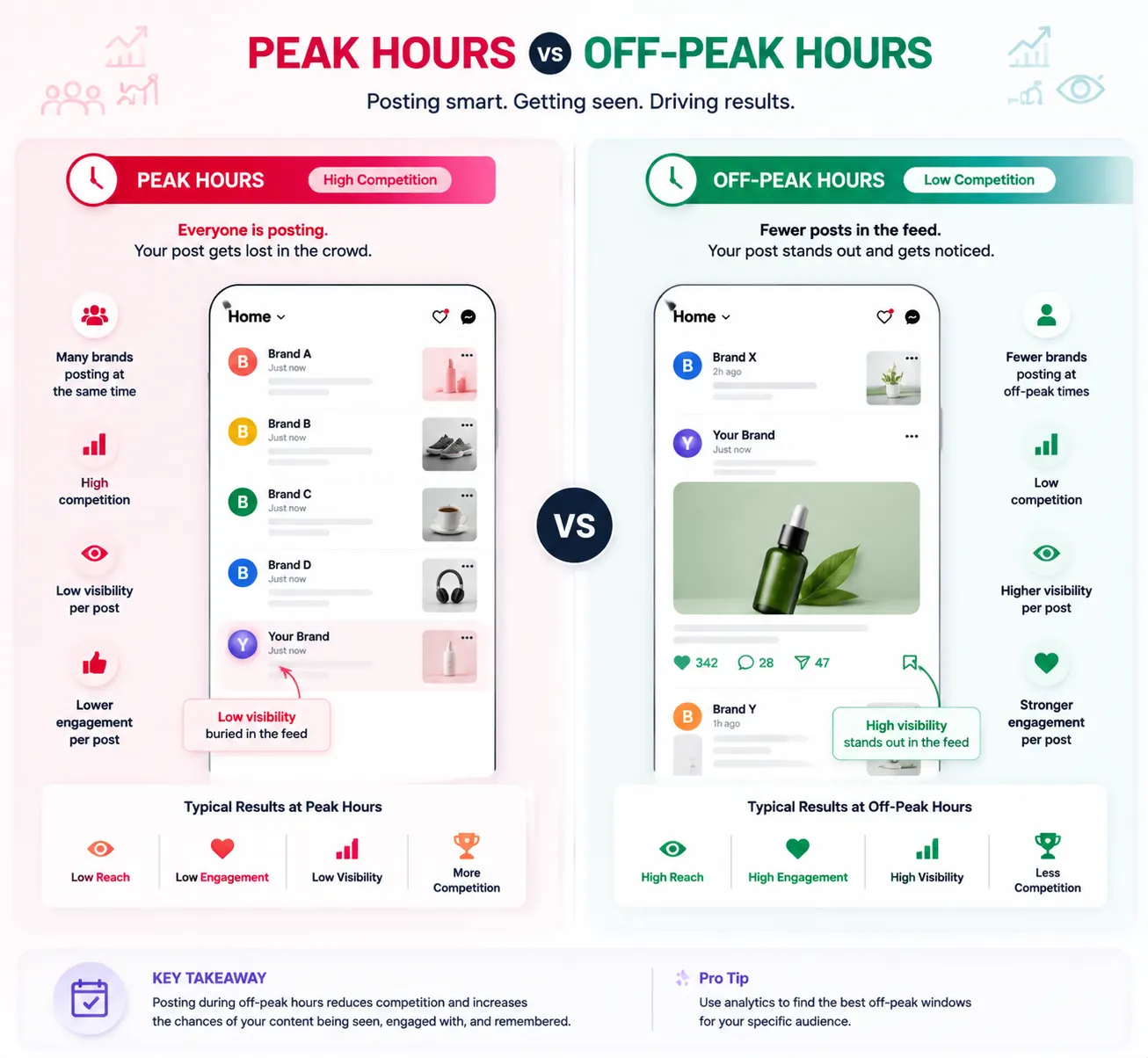
Most guides stop at "post during peak hours." That advice isn't wrong — but it's incomplete, and for some accounts it's actually counterproductive.
The logic is simple: peak hours mean peak competition. When every brand, creator, and influencer publishes at 11 AM on Wednesday, the feed is flooded. Your post is competing against thousands of others for the same eyeballs. If you're a large account with an engaged following, you'll still win — you have enough followers online to generate the engagement velocity you need. But if you're a smaller account, your post can drown.
Research.com, synthesizing findings from 27 timing studies, highlights Jon Loomer's analysis: Facebook posts published during non-peak hours can receive significantly higher engagement than peak-time posts, likely because fewer brands are competing for attention. A Harvard Business Review study of 5,706 Facebook posts found that morning posts generated stronger click-through performance than posts at other times — partly because the morning window had less brand competition when the study was conducted.
Later's 2026 analysis of over 6 million Instagram posts found a surprising result: content posted between 3 AM and 6 AM showed higher-than-average engagement rates every day of the week. This early-morning window catches users during their very first scroll of the day — before the feed is crowded with new content. It also benefits accounts with geographically diverse followers, because a 5 AM post in New York hits 10 AM in London and 2 PM in Dubai.
The takeaway: if you have a large, established audience in a single time zone, follow the peak windows. If you're growing, competing against larger accounts, or have a global audience, test off-peak windows where your content faces less competition for the same algorithmic slots.
Find Your Best Time: A Quick-Reference Calculator
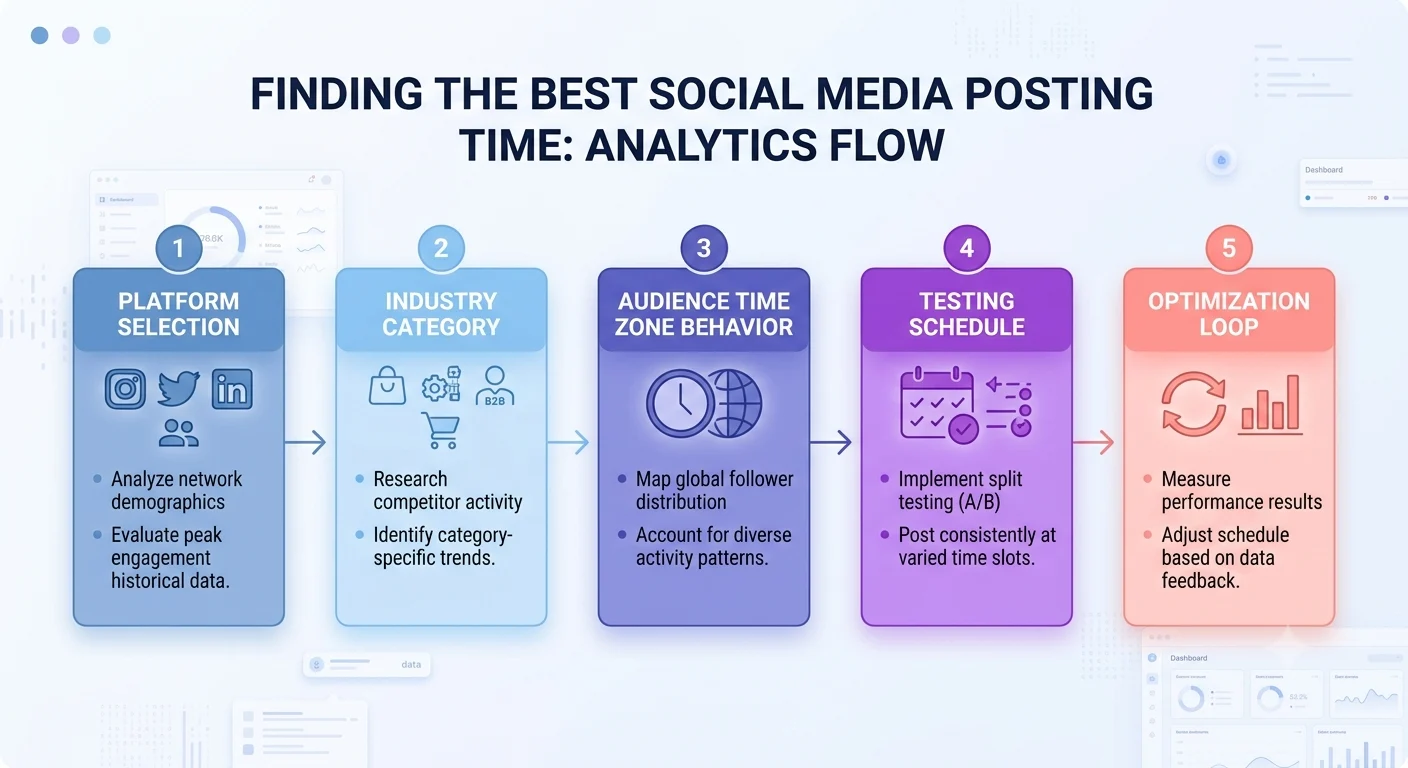
Benchmark data is a starting point. Your best time is the one proven by your own audience data. Use the four steps below like a manual posting-time calculator: work through them in order, and you'll land on a starting window that's already adjusted for your platform, your industry, and your audience — before you even open an analytics dashboard.
Step 1: Start with your platform and industry
Begin with the platform-specific windows in the Cross-Platform Cheat Sheet above, then narrow further by industry. "Best time to post" data is aggregated across all industries — but a fitness brand and a B2B SaaS company have almost nothing in common when it comes to audience behavior.
Industry | Typical peak window | Platforms to prioritize |
|---|---|---|
Fitness & wellness | 5–7 AM | Instagram, TikTok |
Food & beverage | 11 AM–2 PM, 6–9 PM | Instagram, Pinterest |
B2B / SaaS / tech | 9 AM–12 PM (weekdays) | LinkedIn, X |
E-commerce & retail | 12–2 PM, 6–9 PM | Instagram, Pinterest, TikTok |
Travel & hospitality | Sunday and Monday evenings | Instagram, Facebook |
Sprout Social's 2026 data found that engagement patterns vary significantly across industries even on the same platform. For platform-specific industry breakdowns, see our dedicated guides for Instagram and Facebook, which include interactive heatmaps filterable by industry and content type.
Step 2: Adjust for your account size and audience spread
Peak windows assume you're competing for attention in a crowded feed — which is exactly the right strategy if you have the engaged following to win that competition. If not, the math changes.
Your situation | Recommended approach |
|---|---|
Large, established following in one time zone | Stick to the peak windows above — you already have enough active followers to hit engagement velocity fast. |
Growing account competing with bigger brands | Test contrarian off-peak windows (e.g., 3–6 AM on Instagram, before 7 AM or after 7 PM on Facebook) where there's less competition for the same algorithmic slots. |
Audience spread across time zones | Post very early in your primary time zone (around 5 AM) — it can land at "first scroll of the day" for two or three other regions at once. |
See The Contrarian Strategy above for the research behind this.
Step 3: Test against your own analytics
Every platform offers insights into when your followers are most active — Instagram's Professional Dashboard, Facebook Insights, LinkedIn Analytics, TikTok Analytics, and YouTube Studio all show follower activity by hour and day. Start there, then run a two-week test: pick three time slots (one from the benchmark data above, one from your native analytics, and one off-peak "contrarian" window), post similar-quality content at each slot, and track engagement rate — not total engagement, since rate normalizes for follower count and reach.
Match the metric to your goal: engagement rate for community interaction, reach for visibility, click-through rate for traffic, and saves and shares if you care about algorithmic distribution — these are the signals Instagram, TikTok, and Facebook weight most heavily in 2026.
Step 4: Revisit quarterly and adjust by content type
Platform algorithms shift, audience behavior changes with seasons, and your follower base evolves as you grow. The best posting time in January may not be the best in July — LinkedIn's dramatic shift from mornings to afternoons in 2026 is proof enough that what worked last year may not work now.
Different formats also perform best at different times. A carousel that works at 11 AM may flop at 7 PM; a Reel that soars in the evening might underperform at lunch. Build separate timing strategies for each format you use regularly.
The One Thing That Matters More Than Timing
Here's the honest truth that every timing guide should include but most don't: the best posting time in the world won't save mediocre content, and great content posted at the "wrong" time will still outperform average content posted at the "right" time. Timing is a multiplier, not a replacement for substance.
Buffer puts it well: if there's a secret sauce for social media success, it's consistency — not timing. The 2026 data shows the optimal posting frequency across platforms is five to seven posts per week, with diminishing returns above ten. Consistency in both schedule and quality is what trains the algorithm to prioritize your content over time.
The brands and creators winning on social media in 2026 aren't the ones who found a single magic hour. They're the ones posting quality content at reasonable times, on a consistent schedule, across the platforms their audience actually uses — then using their analytics to refine from there.
Use the benchmark data in this guide as a starting point. Test it against your own numbers. Adjust quarterly. And spend more energy on what you're posting than when you're posting it.
Frequently Asked Questions
What is the best time to post on social media in 2026?
Across most platforms, Tuesday through Thursday between 9 AM and 1 PM in your audience's local time zone is the strongest general window. But that's only a starting point — each platform runs on its own clock, so the more useful question is which window fits your specific platform, industry, and content type. See the Cross-Platform Cheat Sheet above for exact windows by platform.
Does posting time still matter in 2026?
Yes, more than it did five years ago. Major platforms now use staged distribution: a post is shown to a small seed group of 1–20% of followers first, and only spreads wider if that group engages quickly. Posting when your audience is already active increases the odds of fast engagement — what's known as engagement velocity — which is what triggers the algorithm to push your content further.
Is Wednesday really the best day to post?
For most platforms, yes. Wednesday tops or ties for the top spot on Instagram, Facebook, LinkedIn, Threads, YouTube, X, and Pinterest across multiple 2026 studies. It benefits from a midweek energy peak, lighter content competition (many brands batch-schedule for Monday and Friday instead), and extra algorithmic momentum heading into Thursday and Friday before the weekend dip.
What is the best time to post on Instagram in 2026?
Wednesday and Thursday, 11 AM–1 PM and 6–9 PM, are Instagram's strongest windows. Carousels perform best at midday during focused scrolling sessions, while Reels do better in the evening leisure window. Saturday is Instagram's weakest day overall.
What is the best time to post on TikTok in 2026?
Tuesday through Friday, 2–6 PM, is TikTok's prime window, as audiences turn to the app once the workday winds down. TikTok's algorithm is the least time-sensitive of the major platforms — videos can go viral days later — but strong engagement in the first one to two hours still drives the initial push.
What is the best time to post on LinkedIn in 2026?
LinkedIn shifted significantly in 2026: Tuesday through Thursday, 11 AM–5 PM, now outperforms the morning hours that used to dominate, with Wednesday at 4 PM and Friday at 3–4 PM as the single strongest slots. The shift reflects professionals checking LinkedIn as an afternoon wind-down activity rather than a start-the-day ritual.
What is the best time to post on X (Twitter) in 2026?
Tuesday through Thursday, 9 AM–12 PM, is X's strongest window. X's feed is the most recency-driven of any major platform, so content decays fast — posting three to five times a day, spaced through the morning and afternoon, outperforms a single daily post.
Should I post during peak hours or off-peak hours?
It depends on your account size. Large, established accounts generally do best during peak hours, since they have enough active followers to generate fast engagement. Smaller or growing accounts sometimes do better off-peak — research from Jon Loomer on Facebook and Later on Instagram both found higher engagement during low-competition windows, likely because there's less content competing for the same attention.
How many times a week should I post?
Five to seven posts per week is the sweet spot across platforms in 2026, with diminishing returns above ten, according to Buffer's research. Consistency in both schedule and content quality matters more than chasing a single "perfect" hour — timing is a multiplier on good content, not a substitute for it.
At a Glance: Best Times to Post by Platform (2026)
Platform | Best days | Best times (local) | Worst day |
|---|---|---|---|
Wednesday, Thursday | 11 AM–1 PM, 6–9 PM | Saturday | |
Wednesday, Thursday | 8 AM–12 PM | Saturday | |
Tuesday–Thursday | 11 AM–5 PM | Sunday | |
TikTok | Tuesday–Friday | 2–6 PM | Monday |
X (Twitter) | Tuesday–Thursday | 9 AM–12 PM | Sunday |
YouTube | Sun, Tue, Wed | 8–11 AM, 2–4 PM | Monday |
Tuesday–Thursday | 10 AM–2 PM | Sunday | |
Tuesday–Thursday | 6–9 AM ET | Saturday | |
Threads | Wednesday–Friday | 9 AM–12 PM | Sunday |
All times are in your audience's local time zone unless noted otherwise. Data synthesized from Sprout Social (2B+ engagements, 307K profiles), Buffer (52M+ posts, 200K+ accounts), and other major 2026 studies.
Sources: Sprout Social Best Times to Post 2026; Buffer State of Social Engagement 2026; Pew Research Center Americans' Social Media Use 2025; Metricool 2026 Instagram Study; Later Best Time to Post 2026; SocialPilot 2026 Instagram and TikTok studies; Research.com synthesis of 27 timing studies.