Influencer Marketing 2026: A Data-Driven Framework to Build High-ROI Creator Programs

Last updated: June 2026 | Based on data from Influencer Marketing Hub, Aspire, Grand View Research, impact.com, Statista, Sprout Social, the Federal Trade Commission, and Imperial College Business School.
What Is Influencer Marketing? — Definition
Influencer marketing is a form of marketing where brands collaborate with individuals who have built trust with an audience to promote products or services. Unlike traditional advertising, which interrupts attention, influencer marketing works through trust transfer — the creator's earned credibility with their audience extends, partially and conditionally, to the brand they recommend.
In 2026, influencer marketing is a performance-driven strategy where brands partner with creators to generate measurable ROI through trust-based content distribution across social platforms including Instagram, TikTok, YouTube, LinkedIn, and community channels like Reddit.
The global influencer marketing industry reached $32.55 billion in 2025 and is projected to surpass $40 billion in 2026. Brands earn an average of $5.78 for every $1 spent, and 86% of U.S. marketers now partner with creators.
This guide provides the strategic frameworks, original models, and data-backed decision architecture you need to build an influencer marketing strategy that compounds over time.
TL;DR — Influencer Marketing Strategy 2026 in 200 Words
Influencer marketing has evolved from a niche awareness tactic into a $32.55+ billion performance channel. Average ROI is $5.78 per $1, with top campaigns returning $11–$18. Yet most programs underperform — not because the channel is broken, but because the strategy hasn't kept up.
This guide introduces The Influence Stack, an original four-layer framework: Trust Infrastructure (long-term ambassadors), Content Engine (creator assets for paid amplification), Commerce Layer (affiliate and performance tracking), and Community Seeding (organic presence in Reddit, forums, and niche communities).
Inside you'll find a creator tier decision matrix, platform comparison tables, four real brand case studies (Sephora, Gymshark, Veradek, Daniel Wellington), head-to-head comparisons (influencer marketing vs. paid ads, TikTok vs. Instagram, micro vs. macro), a budget allocation model, and a 90-day launch roadmap.
We also address the AI authenticity paradox — why 52% of consumers disengage from AI-suspected content — and provide a complete FTC compliance checklist.
Whether you're launching your first creator campaign or restructuring a seven-figure program, this influencer marketing guide gives you the strategic architecture to outperform in 2026.
Key Takeaways
The market is massive and accelerating. The influencer marketing industry hit $32.55B in 2025 and is projected to surpass $40B in 2026 (Influencer Marketing Hub; Mordor Intelligence).
ROI is proven — when strategy is right. Average return is $5.78 per $1 spent. Top campaigns hit $11–$18 per dollar (Market.us).
Nano and micro-influencers dominate performance. Nano-influencers achieve 10.3% engagement on TikTok vs. under 1% for mega accounts (Archive.com).
Influencer marketing outperforms paid ads on trust, engagement, and cost-efficiency — but paid ads still win on scale and targeting precision. The best strategies combine both.
AI is a double-edged sword. 52% of consumers reduce engagement when they suspect AI-generated content. The marketer-consumer perception gap is 44 points wide.
Community-based influence is the most underrated channel. Reddit threads dominate Google search results for product recommendations, creating a high-trust layer most brands ignore.
FTC enforcement is intensifying. Violations can reach $51,744+ per incident. Brands share legal liability with creators.
Table of Contents
What Is Influencer Marketing? — Definition
The Evolution of Influencer Marketing (2010–2026)
Why Influencer Marketing Works (and When It Doesn't)
Market Size and Growth Data
The Influence Stack: Strategy Framework
Influencer Marketing vs. Paid Advertising
Creator Tier Selection Matrix
Micro-Influencers vs. Macro-Influencers: Deeper Comparison
Platform Comparison: TikTok vs. Instagram vs. YouTube
TikTok vs. Instagram for Influencer Marketing
Real Brand Case Studies
The AI Authenticity Paradox
Budget Allocation Model
Tools and Tech Stack
FTC Compliance Guide
Measurement and ROI
90-Day Launch Roadmap
FAQ
The Evolution of Influencer Marketing (2010–2026)
Influencer marketing didn't emerge fully formed. It evolved through four distinct eras — each driven by platform shifts, changing consumer behavior, and new business models. Understanding this evolution explains why the strategies that worked in 2018 don't work in 2026.
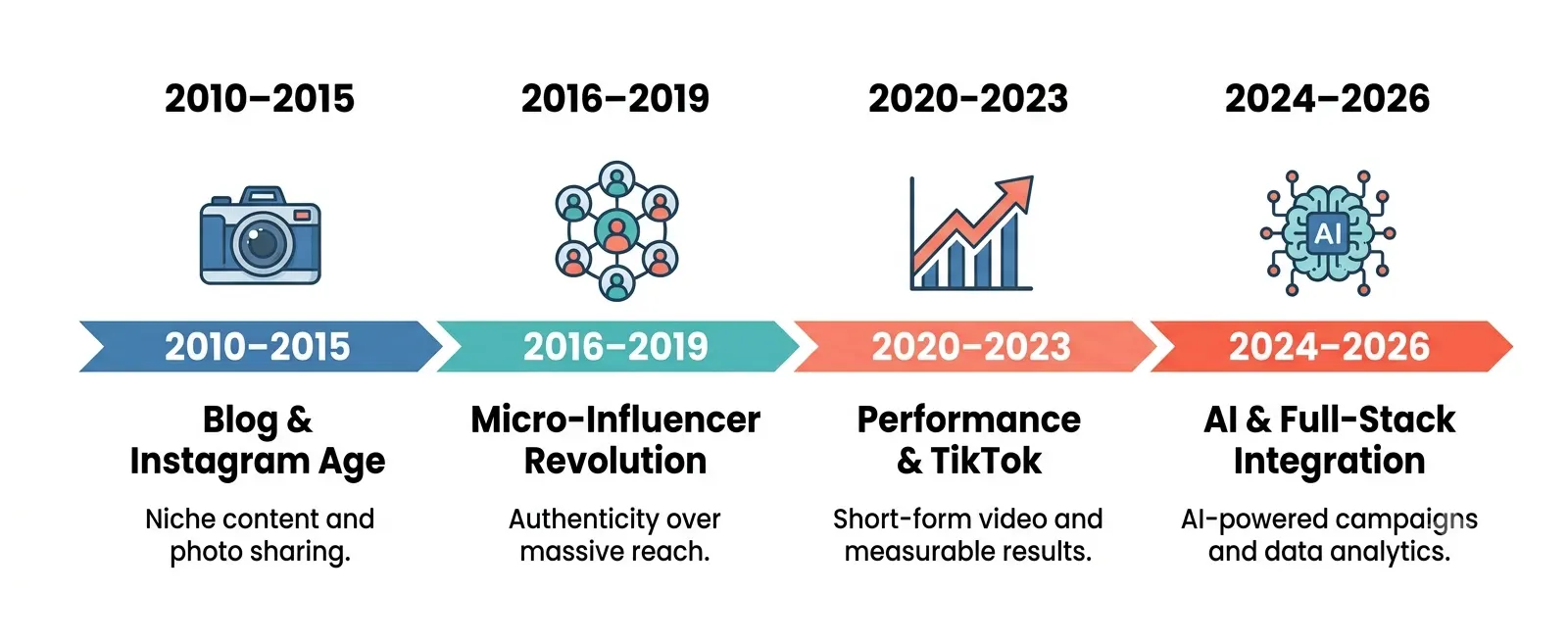
Era 1: The Blog and Early Instagram Age (2010–2015)
Influencer marketing began with bloggers. Fashion, beauty, and lifestyle bloggers built dedicated readerships and became the first generation of independent digital voices that brands could partner with.
Instagram's launch in 2010 accelerated everything. The platform's visual-first format created a new type of creator — one who built audiences around aesthetics, lifestyle aspiration, and curated personal brands. By 2015, Instagram had become the default influencer platform.
Dominant model: Flat-fee sponsored posts. Brands paid for access to audiences with almost no performance tracking. Success was measured in follower counts and "likes." CPM was low because the market was unstructured.
Era 2: The Micro-Influencer Revolution (2016–2019)
As celebrity and macro-influencer pricing skyrocketed, brands discovered that smaller creators often delivered better engagement per dollar. The term "micro-influencer" entered the marketing lexicon, and with it came a fundamental insight: trust scales inversely with audience size.
Research began validating this. Academic studies and industry benchmarks consistently showed that engagement rates declined as follower counts increased. A creator with 5,000 followers often drove more conversions per impression than one with 500,000.
Dominant model: Volume-based micro-influencer campaigns. Brands partnered with 20–50 micro-creators for the cost of a single macro partnership. The trade-off was management complexity for better engagement economics.
Era 3: The Performance and Platform Expansion Phase (2020–2023)
TikTok reshaped the landscape. Its algorithmic distribution — where content could go viral regardless of follower count — democratized reach and created a new generation of creators who built audiences through content quality rather than network effects.
Simultaneously, influencer marketing professionalized. Affiliate tracking matured. Performance-based compensation emerged. And the pandemic accelerated social commerce, making creator-driven purchasing a mainstream consumer behavior.
The FTC's 2023 Endorsement Guides revision — the most significant update in over a decade — signaled regulatory maturity. Influencer marketing was no longer a gray area.
Dominant model: Hybrid compensation (base fee + performance commission). Creator content began flowing into paid media. The line between "influencer marketing" and "digital advertising" started blurring.
Era 4: The AI and Full-Stack Integration Phase (2024–2026)
The current era is defined by three forces converging:
AI integration across discovery, workflow management, and analytics. 59% of marketers now use AI in their influencer programs (Aspire 2026). But AI-generated content is triggering consumer backlash — creating the authenticity paradox this guide explores in depth.
Full-funnel attribution. Platform-native commerce tools (Instagram affiliate tagging, TikTok Shop, YouTube product shelves) have closed the measurement gap. For the first time, brands can track from creator post to purchase natively.
Channel diversification beyond social feeds. Community platforms like Reddit, LinkedIn thought leadership, and niche forums are becoming critical influence surfaces. The industry's center of gravity is shifting from "social media marketing" to "trust-based distribution across all channels where purchase decisions are shaped."
Dominant model: Multi-layered programs spanning awareness, content production, commerce, and community — what this guide calls The Influence Stack.
Why Influencer Marketing Works (and When It Doesn't)
Influencer marketing works because it meets consumers where they are — inside the feeds and communities they already trust. Three data points make the case:
63% of shoppers are more likely to buy a product recommended by a trusted influencer (Traackr)
91% of brands report creator content drives more ROI than traditional digital ads (Aspire 2025 Report)
67% of consumers trust influencers as of 2026, up from 61% in 2025. Among Gen Z, 94% trust influencers more than traditional ads (Ringly.io compiled data)
Research from Imperial College Business School, drawing on 185 interviews across brands, agencies, influencers, and consumers worldwide, found a key insight: consumers trust amateur enthusiasts more than credentialed professionals. Everyday runners were trusted more than Olympic athletes. Expertise felt more credible when it was earned through relatable experience.
When Influencer Marketing Fails
It doesn't fail because the channel is broken. It fails because the strategy is. The most common failure modes:
Misaligned creators. A fitness influencer promoting financial software creates cognitive dissonance, not trust. Audience-brand fit matters more than audience size.
Over-scripted content. 79% of consumers say UGC influences their buying decisions — but only when it feels authentic. Scripted content reads as advertising and gets filtered out.
No measurement infrastructure. Only 20% of brands track customer acquisition cost from influencer campaigns. The other 80% make budget decisions on intuition.
One-off partnerships. Single sponsored posts generate a blip, not a brand association. Long-term relationships compound — brand-creator repeat partnerships are up 40% year-over-year (Aspire 2026).
Bottom line: Influencer marketing doesn't fail because of the channel. It fails because of the strategy behind it.
Influencer Marketing Market Size 2026
The numbers confirm a channel that's crossed from experimental to essential infrastructure.
Metric | Figure | Source |
|---|---|---|
Global industry size (2025) | $32.55 billion | Influencer Marketing Hub |
Projected industry size (2026) | $40.51 billion | Mordor Intelligence |
Platform market size (2026) | $45.25 billion | Grand View Research |
Average ROI per $1 spent | $5.78 | Market.us |
U.S. marketers using influencers | 86% | Sprout Social |
Marketers increasing budgets (2026) | 74% | Aspire 2026 Report |
CAGR since 2020 | ~30% | Influencer Marketing Hub |
B2B influencer marketing growth YoY | 47% | Digital Applied |
Three Structural Shifts Shaping the Market
1. Attribution has been solved.
Instagram now lets creators tag affiliate products inside Reels with native conversion tracking through Meta. TikTok Shop adoption nearly doubled year-over-year, with 32% of brands already selling and 25% planning to join (Aspire 2026). Trackable links, unique discount codes, and platform-native commerce tools have closed the measurement gap.
2. Creators are closing sales, not just driving awareness.
During Cyber Week 2025, influencer-driven spend jumped 51% while commission costs stayed flat (impact.com). The creator role has shifted from top-of-funnel to full-funnel conversion.
3. AI is reshaping operations — with a critical catch.
59% of marketers use AI for creator discovery and workflow management (Aspire). But 52% of consumers reduce engagement when they sense AI-generated content. More on this paradox in the AI section below.
The Influence Stack: An Influencer Marketing Strategy Framework
Most influencer marketing guides organize advice by platform or creator tier. That's useful for tactics — useless for strategy.
The Influence Stack is a four-layer strategic framework that treats influencer marketing as an integrated system. Each layer serves a distinct function. The strongest programs in 2026 operate across all four simultaneously.
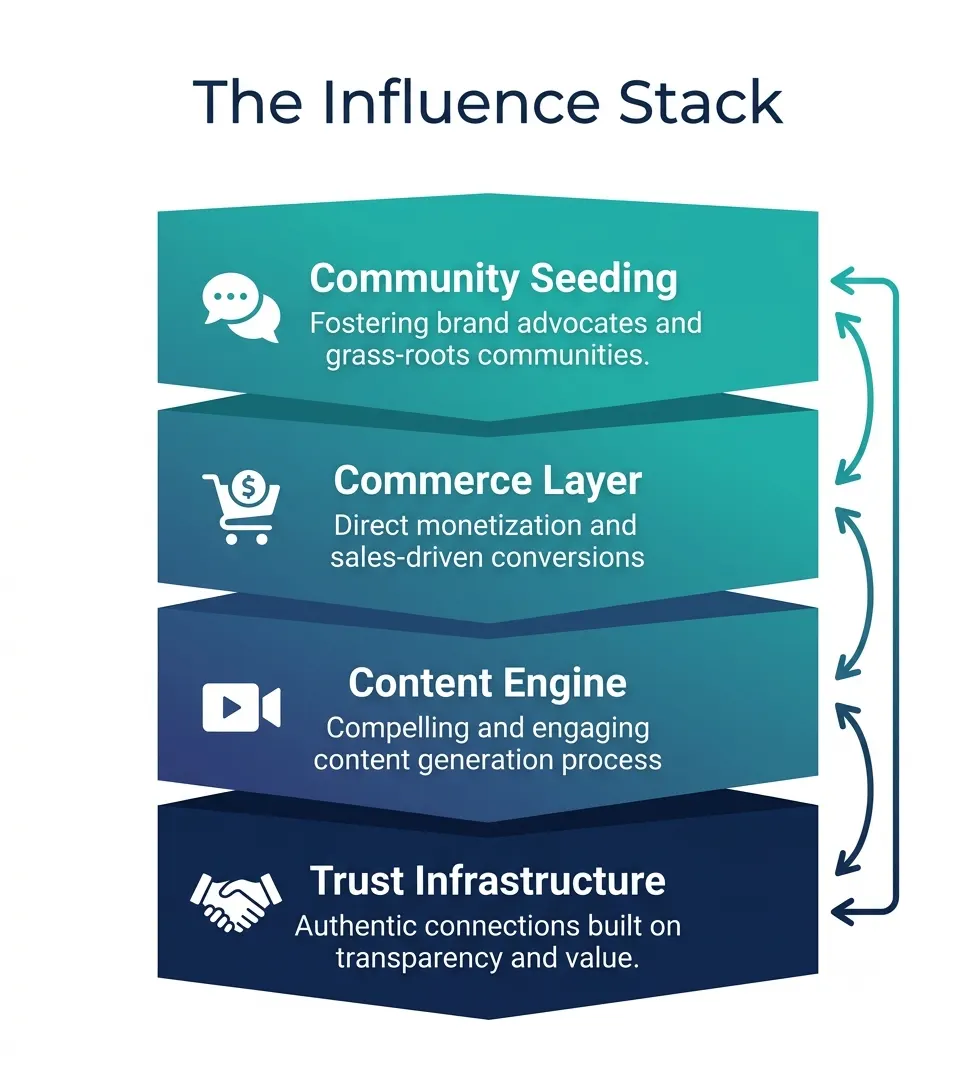
Layer 1: Trust Infrastructure — Long-Term Creator Partnerships
Strategic function: Brand equity and compounding credibility.
Long-term ambassador relationships with creators who genuinely use your product. Audiences see the creator reference your brand across months, and the endorsement gains credibility with each appearance.
Data: Brand-creator repeat partnerships are up ~40% year-over-year. The pattern of one brand renewing with one creator across 5+ deals per quarter is becoming standard among top performers (Aspire 2026).
Case in point: Sephora's Squad program selects creators who are already genuine brand advocates, prioritizing authentic affinity over follower counts.
Action item: Identify 5–10 creators who already mention your brand organically. Approach them for long-term partnerships before competitors do.
Layer 2: Content Engine — Creator Assets for Paid Amplification
Strategic function: Scalable, high-performing creative for paid media.
This layer treats creators as content production partners. The output isn't the creator's organic post — it's the creative asset itself, which the brand then amplifies through paid channels.
Data: 77% of marketers now repurpose creator content in paid social (Aspire 2026).
Case in point: Veradek used influencer content as primary paid media creative, achieving 27x ROAS — roughly 5x the return of brand-produced creative.
As Meta's Andromeda system shifts toward AI-driven ad optimization that rewards creative diversity, brands need a steady stream of varied, authentic content. Creators produce that stream faster and cheaper than in-house teams.
Action item: Structure creator briefs around paid amplification from the start. Request raw footage and multiple format variations alongside organic posts.
Layer 3: Commerce Layer — Affiliate and Performance Partnerships
Strategic function: Directly attributable revenue.
Performance-based compensation now leads as the most frequently used payment model at 53% adoption (Archive.com). The model combines a base fee with commission on tracked conversions.
Data: Creators drove over $52 million in attributed affiliate sales through Aspire's platform alone in 2025 — a 45% year-over-year increase. 41% of creators participated in 5+ affiliate campaigns per year (Aspire 2026).
Case in point: Gymshark grew from a garage startup to a $1B+ valuation largely through an influencer affiliate model — unique discount codes, performance commissions, and creators who were authentic product users.
Action item: Implement trackable affiliate links for every creator partnership. Even ambassador programs should include a performance tracking layer.
Layer 4: Community Seeding — Organic Presence in High-Trust Environments
Strategic function: Credibility in the spaces where purchase decisions actually happen.
Not all influence happens on social feeds. Reddit threads, Discord servers, and niche forums shape purchase decisions in ways that social media campaigns can't replicate. These environments are high-trust precisely because they're hard to game.
Why it matters now: Reddit threads consistently occupy top Google search positions for product queries. When someone searches "best [product category] 2026," Reddit discussions often outrank brand websites and review publications.
The catch: Direct promotion in community environments backfires. Users are sophisticated and hostile to anything that reads as marketing. The strategy requires genuine participation, product seeding with authentic community members, and long-term relationship building.
Action item: Identify 3–5 online communities where your target customers seek recommendations. Begin building genuine presence through valuable contributions — before you need anything.
How the Layers Reinforce Each Other
The Stack isn't four separate programs — it's one system where each layer compounds the others. Ambassadors (Layer 1) produce content that feeds paid amplification (Layer 2). Affiliate tracking (Layer 3) validates which creators drive revenue. Community presence (Layer 4) generates organic buzz that lifts every other layer. Data from all layers feeds back into strategy optimization.
Influencer Marketing vs. Paid Advertising: A Head-to-Head Comparison
One of the most common strategic questions: should you invest in influencer marketing or paid advertising? The answer is almost always "both" — but knowing where each channel excels determines how you allocate.
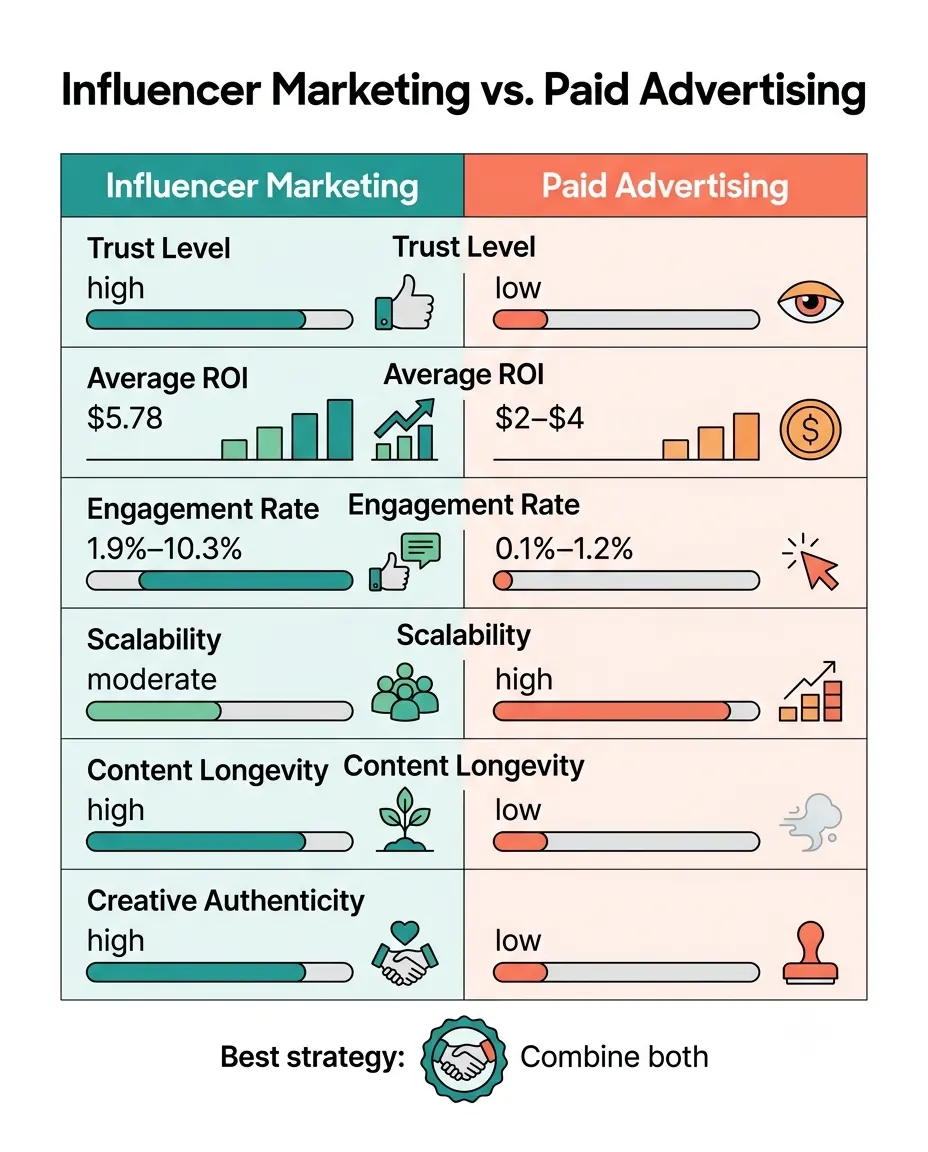
Side-by-Side Comparison
Dimension | Influencer Marketing | Paid Advertising (Meta/Google) |
|---|---|---|
Trust level | High — audiences trust the creator | Low — consumers recognize and filter ads |
Average ROI | $5.78 per $1 spent | $2–$4 per $1 (varies by platform/industry) |
Engagement rate | 1.9%–10.3% (varies by tier) | 0.1%–1.2% (display/social ads) |
Targeting precision | Moderate — based on creator audience alignment | High — granular demographic and behavioral targeting |
Scalability | Moderate — limited by creator availability and management | High — spend scales linearly with budget |
Speed to launch | Slow — requires outreach, negotiation, content creation | Fast — campaign live within hours |
Content longevity | High — creator posts remain discoverable for months | Low — visibility ends when budget stops |
Creative authenticity | High — content matches organic feed experience | Low — ads look like ads regardless of creative quality |
Brand safety risk | Moderate — creator behavior is unpredictable | Low — full control over messaging |
Attribution | Improving — native platform tools + affiliate tracking | Mature — pixel-based, event-driven attribution |
When Influencer Marketing Wins
Influencer marketing outperforms paid advertising when trust, engagement, and cost-efficiency matter more than precision targeting and immediate scale.
Specific scenarios where influencer marketing has the edge:
New brand or product launch where no existing brand awareness or consumer trust exists
Categories driven by recommendation — beauty, wellness, SaaS tools, consumer electronics
Content-hungry paid strategies — using creator assets as paid ad creative delivers 2–5x ROAS improvement over brand-produced content (Veradek case: 27x ROAS)
Gen Z and millennial audiences — 94% of Gen Z trust influencers more than traditional ads
Long-tail discovery — creator content remains discoverable in feeds and search long after publication
When Paid Advertising Wins
Paid advertising outperforms when scale, speed, and targeting precision are the priority:
Retargeting existing audiences — paid ads excel at re-engaging known visitors
Flash sales and time-sensitive promotions — ads scale instantly; creator campaigns take weeks
Granular demographic targeting — paid platforms offer targeting precision that creator audiences can't match
Mature brands with established trust — when credibility isn't the bottleneck, reach efficiency matters more
The Compound Strategy
The strongest programs in 2026 combine both channels. Creator-generated content fed into paid amplification pipelines (Layer 2 of the Influence Stack) consistently outperforms brand-produced ad creative. The data is unambiguous: 91% of brands report creator content drives more ROI than traditional digital ads.
The optimal allocation isn't either/or. It's using influencer marketing to generate trust and authentic creative, then using paid advertising to amplify the best-performing assets at scale.
How to Choose the Right Influencer Tier
Choosing the right creator tier is one of the most consequential decisions in any influencer marketing strategy. Here's a decision framework — not just descriptions, but when to use each tier and when not to.
Influencer Tier Comparison Table
Tier | Followers | Avg. Engagement (IG) | Avg. Engagement (TikTok) | Cost Per Post | Best For | Avoid When |
|---|---|---|---|---|---|---|
Nano | 1K–10K | 2.71% | 10.3% | Free product – $250 | Product seeding, UGC, niche communities | You need large-scale reach quickly |
Micro | 10K–100K | ~1.8% | ~5.3% | $100–$1,000 | Performance campaigns, affiliate, content production | You need mainstream press pickup |
Macro | 100K–1M | ~1.2% | ~2.5% | $1,500–$10,000 | Product launches, brand repositioning | Cost-per-acquisition is primary KPI |
Mega | 1M+ | <1% | ~1.5% | $10,000–$100,000+ | Cultural moments, mass awareness | Budget is limited or ROI must be direct |
Sources: Archive.com, Influee, Influencer Advisory
The Blended Portfolio Approach
Top-performing programs don't choose a single tier. They run a portfolio:
2–3 macro/mega partnerships for cultural credibility and press amplification
15–25 micro-influencers for sustained performance and content production
50–100+ nano-influencers for organic seeding, UGC, and community penetration
This maps directly onto the Influence Stack: macro partners serve Layer 1, micro-influencers power Layers 2 and 3, and nano-influencers fuel Layer 4.
Micro-Influencers vs. Macro-Influencers: A Deeper Comparison
This is one of the most debated decisions in influencer marketing strategy. The data paints a nuanced picture — neither tier is universally "better." The right choice depends entirely on your objective.
Performance Comparison
Metric | Micro-Influencers (10K–100K) | Macro-Influencers (100K–1M) |
|---|---|---|
Avg. engagement rate (IG) | ~1.8% | ~1.2% |
Avg. engagement rate (TikTok) | ~5.3% | ~2.5% |
Cost per post (IG) | $100–$1,000 | $1,500–$10,000 |
Cost per engagement | Lower | Higher |
Conversion rate | Higher (trust-driven) | Lower (awareness-driven) |
Content production quality | Variable | Consistently polished |
Audience trust | Higher — perceived as peers | Lower — perceived as celebrities |
Reach per post | 5K–50K impressions | 50K–500K impressions |
Brand safety risk | Lower (less public visibility) | Higher (more media scrutiny) |
Management complexity | Higher (need more partnerships) | Lower (fewer relationships) |
Budget share (industry-wide) | ~40% of total influencer budgets | ~25% of total influencer budgets |
Sources: Archive.com, Influencer Advisory
When to Choose Micro-Influencers
Your primary KPI is cost-per-acquisition or conversion rate
You're in a niche category where audience alignment matters more than mass reach
You need a high volume of varied content for paid amplification
You're running affiliate or performance-based campaigns
Your budget is under $50,000
When to Choose Macro-Influencers
You need guaranteed reach at a specific scale for a product launch
Your campaign requires high production quality (luxury, automotive, fashion)
You're building cultural credibility or repositioning a brand
You need press amplification — media outlets cover macro-influencer campaigns
Your audience spans multiple demographics rather than a single niche
The Verdict
For most brands in 2026, the optimal strategy is micro-influencer heavy with selective macro partnerships. Industry-wide data confirms this: micro-influencers receive ~40% of total budgets while nano-influencers represent 75.9% of Instagram's influencer base (Archive.com). The market has voted, and it's voting for trust over reach.
Influencer Marketing Platform Comparison 2026
Each social platform serves a different function in your influencer marketing strategy. Choosing the right platform mix is as important as choosing the right creators.
Platform-by-Platform Breakdown
Platform | Avg. Engagement | Top Content Format | Commerce Features | Best For | Key Stat |
|---|---|---|---|---|---|
1.9% (influencer) | Reels | Native affiliate tags, Shop, product tags | Full-funnel, commerce campaigns | 84% of U.S. marketers use it | |
TikTok | 3.70% (brand) | Short-form video | TikTok Shop, in-app checkout | Discovery, Gen Z, viral potential | 32% of brands sell on TikTok Shop |
YouTube | ~1.8% (travel peak) | Long-form + Shorts | Affiliate links, product shelves | Reviews, tutorials, 30+ day recall | 52% prefer short-form; 49% long-form |
2.3x vs. brand posts | Thought leadership | Limited native commerce | B2B campaigns, professional reach | B2B influencer growth: 47% YoY | |
Community-driven | Text posts, AMAs | No native commerce | Product research, SEO, peer recs | Dominates Google "[product] reviews" |
Sources: Sprout Social, Socialinsider, Aspire, Digital Applied
How to Choose Your Platform Mix
If your goal is direct sales: Instagram (native commerce) + TikTok Shop (discovery-to-purchase).
If your goal is brand building: YouTube (long-form credibility) + Instagram (visual storytelling).
If you sell B2B: LinkedIn (professional trust) + Reddit (peer validation).
If you're entering a new market: Reddit and community platforms first (build credibility), then social campaigns.
TikTok vs. Instagram for Influencer Marketing
This is the most common platform decision brands face. Both are essential — but they serve different strategic functions and the performance gap varies dramatically by objective.
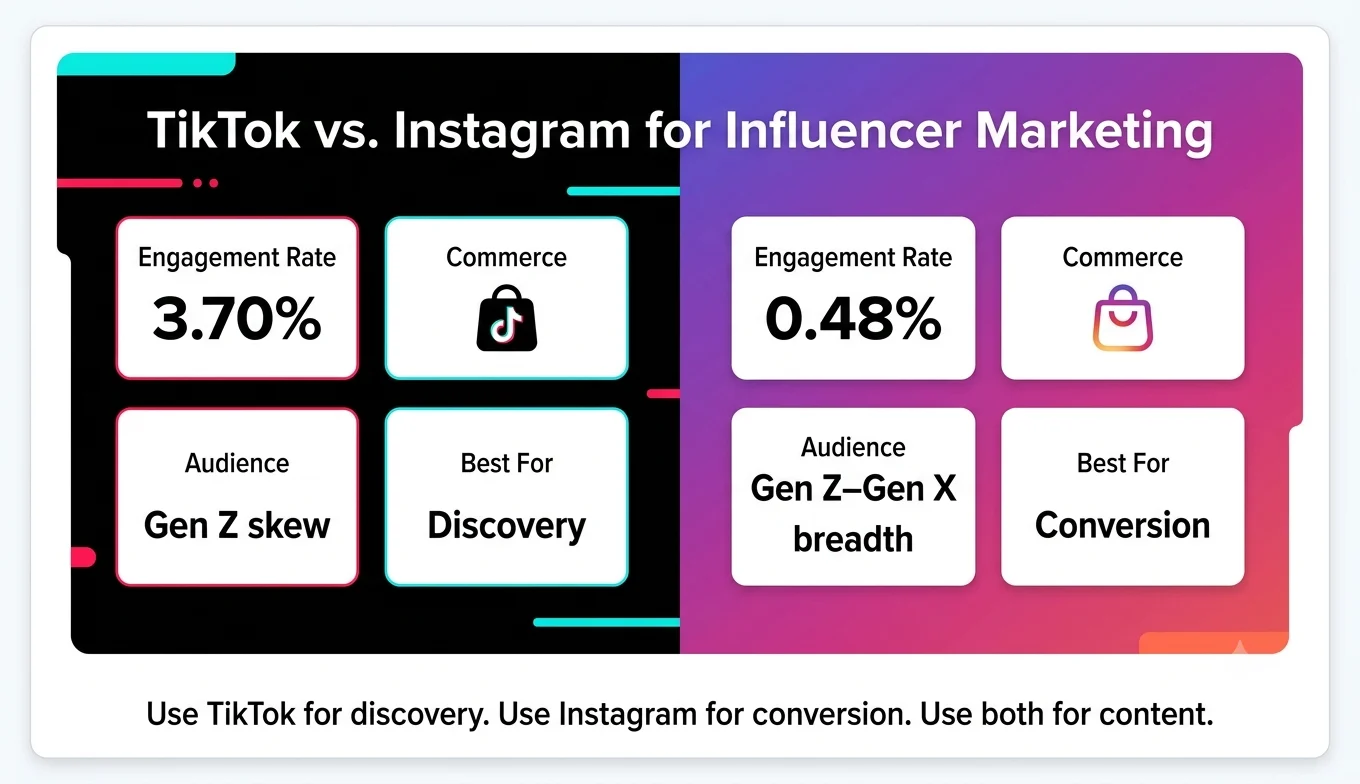
Head-to-Head Comparison
Dimension | TikTok | |
|---|---|---|
Avg. engagement rate (brand content) | 3.70% | 0.48% |
Avg. engagement rate (influencer content) | ~5.3% (micro) | ~1.9% (influencer avg.) |
Content discovery model | Algorithm-first (content > followers) | Hybrid (followers + algorithm) |
Commerce infrastructure | TikTok Shop (32% adoption, fast-growing) | Native affiliate tags, Shop tab, product tags (mature) |
Audience skew | Gen Z + younger Millennials | Gen Z through Gen X (broader) |
Content format | Short-form video dominant | Reels, Stories, carousels, static posts |
Brand recall duration | Short-term (high impact, fast decay) | Medium-term |
Influencer marketer adoption | Growing rapidly | 84% of U.S. marketers (industry default) |
Regulatory risk | High (U.S. ban threats, ~17.2% intent drop) | Low (stable regulatory environment) |
Best for | Viral discovery, Gen Z reach, product demos | Full-funnel, commerce, broad demographics |
Sources: Socialinsider (70M+ posts analyzed), Sprout Social, Archive.com, Aspire
TikTok's Advantage: Discovery and Engagement
TikTok's algorithm distributes content based on quality and relevance, not follower count. This means a creator with 2,000 followers can generate millions of views if the content resonates. For product discovery — especially with younger audiences — nothing else comes close.
TikTok Shop's rapid growth (adoption nearly doubled year-over-year) is collapsing the funnel from awareness to purchase into a single interaction. When 66.17% of social commerce brands use TikTok Shop, it's no longer experimental.
Instagram's Advantage: Infrastructure and Breadth
Instagram's commerce infrastructure is more mature. Native affiliate tagging in Reels lets creators embed shoppable product links with conversion data flowing natively through Meta — no redirect or third-party tool required.
Instagram's audience is broader, spanning Gen Z through Gen X, making it the safer bet for brands targeting multiple demographics. And the platform's regulatory stability contrasts with TikTok's ongoing U.S. uncertainty.
Strategic Recommendation
Run TikTok for discovery. It's where new audiences find your brand for the first time.
Run Instagram for conversion. It's where those audiences take action.
Use both for content production. The best creator content crosses platforms.
If forced to choose one, brands targeting Gen Z should start with TikTok; brands targeting mixed demographics or prioritizing commerce should start with Instagram.
Influencer Marketing Case Studies: What High-ROI Programs Look Like
Theory is useful. Proof is better. Here are four brands that built influencer marketing strategies delivering measurable results — each illustrating a different layer of the Influence Stack.
Case Study 1: Sephora — Trust Infrastructure at Scale
Strategy: Sephora's Squad program recruits creators who are already authentic brand advocates. Instead of paying for reach, Sephora invests in a highly vetted cohort that prioritizes genuine product affinity.
Result: The program creates a virtuous cycle — Squad members produce consistently authentic content because they were selected for real enthusiasm. Sephora gets sustained, credible brand representation without the authenticity risk of transactional partnerships.
Influence Stack layer: Layer 1 (Trust Infrastructure)
Source: impact.com Influencer Marketing Trends 2026
Case Study 2: Veradek — Creator Content Outperforming Brand Creative by 5x
Strategy: During an off-season campaign, Veradek used influencer-generated content as primary paid media creative rather than producing brand content in-house.
Result: Influencer content delivered 27x ROAS — roughly 5x the return of brand-produced creative.
Influence Stack layer: Layer 2 (Content Engine)
Source: Raechelle Dias, Social Media and Partnerships Lead at Veradek, quoted in Aspire's 2026 Strategy Report
Case Study 3: Gymshark — Affiliate Model Building a Billion-Dollar Brand
Strategy: Gymshark built its brand through an influencer-first model. Fitness creators received unique discount codes and commissions, tying every partnership to measurable revenue while authentic product usage built organic brand credibility.
Result: Grew from a garage startup to a brand valued at over $1 billion, with influencer marketing as the primary growth driver. The affiliate model was directly measurable and self-reinforcing.
Influence Stack layer: Layer 3 (Commerce)
Case Study 4: Daniel Wellington — Nano-Influencer Volume Strategy
Strategy: Instead of celebrity endorsements, Daniel Wellington sent free watches to thousands of nano- and micro-influencers, requesting only a photo with a branded hashtag.
Result: Generated massive organic visibility at a fraction of traditional advertising costs. Became one of the most recognized watch brands on Instagram, proving that nano-influencer volume can outperform expensive macro partnerships.
Influence Stack layer: Layer 4 (Community Seeding) + Layer 1 (Trust Infrastructure)
AI and Influencer Marketing: The Paradox Brands Must Navigate
AI is transforming how influencer marketing operates. It's also creating the most significant risk the industry has faced. Understanding this paradox is essential to any influencer marketing strategy in 2026.
Where AI Helps (Use It Here)
Creator discovery: 59% of marketers use AI to find and vet creators (Aspire 2026). AI dramatically accelerates matching at scale.
Campaign management: Workflow automation, brief generation, scheduling, performance tracking.
Analytics and optimization: Real-time dashboards, predictive modeling, ROI attribution.
Fraud detection: Three-layer verification (AI fraud detection + manual audience audit + performance payment) reduces fraud by 89% (Digital Applied).
Where AI Hurts (Avoid This)
Audience-facing content generation: 52% of consumers reduce engagement when they suspect AI-generated content (New Engen).
The perception gap is dangerous: 77% of marketers believe AI crafts emotionally resonant content. Only 33% of consumers agree. A 44-point gap.
The Strategic Principle
Use AI as invisible infrastructure — improving operations behind the scenes. Keep visible output unmistakably human. The worst strategy: mass-producing "influencer-style" AI content through creator accounts. Audiences will detect the shift, and the entire trust mechanism collapses.
Virtual Influencers: A Special Case
Virtual influencers now account for ~$1.37 billion in annual brand spending with engagement rates averaging 5.67% — higher than equivalent human influencers (Digital Applied). They work for specific use cases (product demos, brand mascots) but can't replace human trust transfer.
How Much Does Influencer Marketing Cost?
Costs vary dramatically by creator tier, platform, content format, and usage rights. Here's what to expect in 2026.
Cost Benchmarks by Creator Tier
Tier | Instagram Post | TikTok Video | YouTube Video | Instagram Story |
|---|---|---|---|---|
Nano (1K–10K) | Free – $250 | Free – $200 | $100 – $500 | Free – $100 |
Micro (10K–100K) | $100 – $1,000 | $200 – $2,000 | $500 – $5,000 | $50 – $500 |
Macro (100K–1M) | $1,500 – $10,000 | $1,000 – $8,000 | $5,000 – $25,000 | $500 – $2,500 |
Mega (1M+) | $10,000 – $100K+ | $5,000 – $50K+ | $25,000 – $100K+ | $2,500 – $15,000 |
Sources: Influee, Influencer Advisory
Important: Whitelisting (running paid ads through a creator's account) adds a surcharge compressing from ~100% to ~75% of base fee (Influencer Advisory).
Budget Allocation Models by Strategic Objective
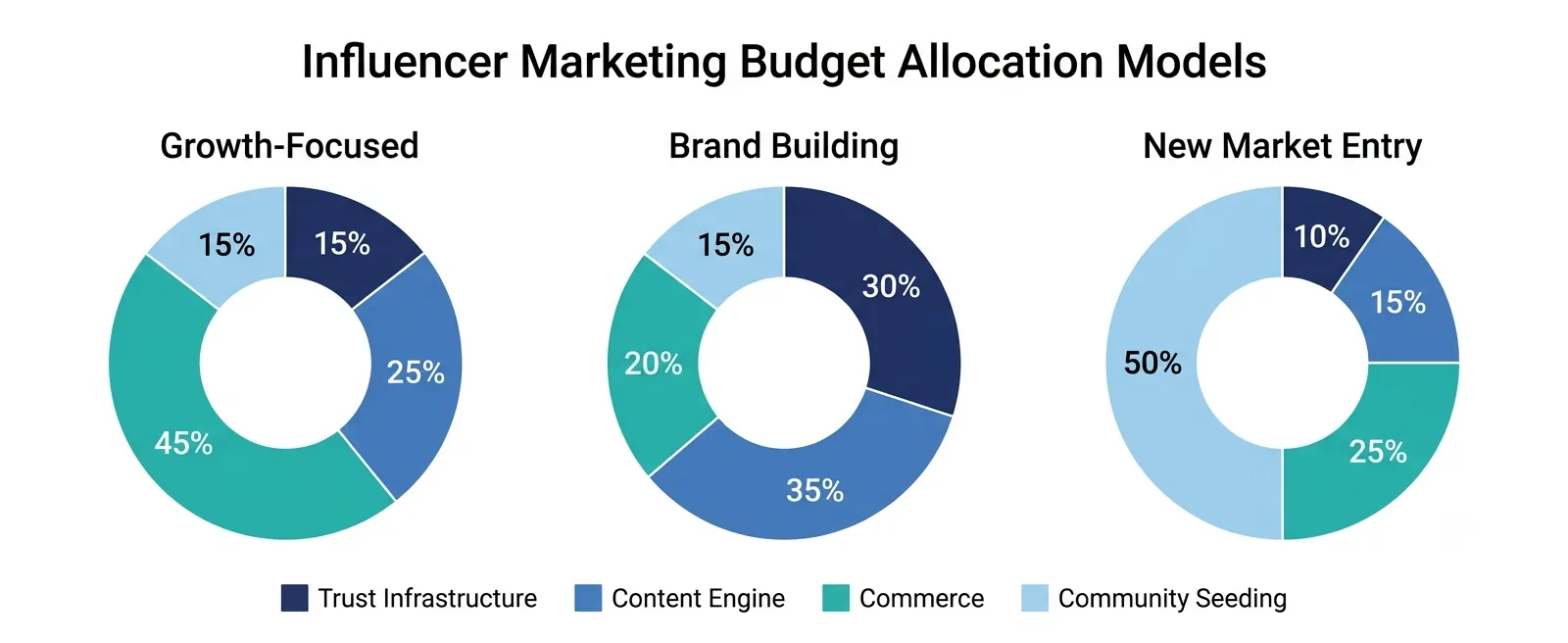
Growth-focused brands (primary KPI: customer acquisition):
Influence Stack Layer | Allocation | Purpose |
|---|---|---|
Layer 1: Trust Infrastructure | 15% | Ambassador relationships |
Layer 2: Content Engine | 25% | Creator content for paid amplification |
Layer 3: Commerce | 45% | Affiliate and performance partnerships |
Layer 4: Community Seeding | 15% | Reddit, forums, organic presence |
Brand-building-focused (primary KPI: awareness and equity):
Influence Stack Layer | Allocation | Purpose |
|---|---|---|
Layer 1: Trust Infrastructure | 30% | Deep ambassador storytelling |
Layer 2: Content Engine | 35% | High-quality content production |
Layer 3: Commerce | 20% | Baseline attribution tracking |
Layer 4: Community Seeding | 15% | Organic credibility building |
New market entry (primary KPI: establishing presence):
Influence Stack Layer | Allocation | Purpose |
|---|---|---|
Layer 1: Trust Infrastructure | 10% | Initial relationship building |
Layer 2: Content Engine | 15% | Localized content creation |
Layer 3: Commerce | 25% | Market validation through performance data |
Layer 4: Community Seeding | 50% | Heavy community credibility investment |
Influencer Marketing Tools 2026: Building Your Tech Stack
The influencer marketing platform market is projected to reach $45.25 billion in 2026 (Grand View Research). Here are the tools that matter, organized by function.
Creator Discovery and Campaign Management
Tool | Best For | Key Strength |
|---|---|---|
Aspire | End-to-end campaign management | Product seeding workflows, affiliate tracking, benchmarks |
CreatorIQ | Enterprise-scale programs | Creator intelligence, competitive benchmarking |
Upfluence | Integrated workflow | Discovery + social management in one platform |
Modash | Influencer search and vetting | Deep audience analytics, fraud detection |
Sprout Social | Unified social + influencer | Influencer management alongside organic social |
Affiliate and Performance Tracking
Tool | Best For | Key Strength |
|---|---|---|
impact.com | Creator commerce at scale | Full partnership lifecycle, attribution modeling |
Shopify Collabs | DTC e-commerce | Native integration, simple affiliate setup |
Community-Based Influence
Tool | Best For | Key Strength |
|---|---|---|
Leadmore AI | Subreddit discovery, lead tracking, safe content publishing | |
SparkToro | Audience research | Identifies where audiences spend time and who they follow |
Brand24 | Social listening (multi-platform) | Reddit + social monitoring, sentiment analysis |
GummySearch | Reddit-specific monitoring | Product mentions, buying-intent signal tracking |
Compliance and Legal
Automated FTC disclosure checking is built into major platforms (Aspire, CreatorIQ). Standalone compliance tools are emerging as enforcement intensifies.
Principle: The right tech stack covers your active Influence Stack layers without introducing friction. Start lean — add tools as complexity demands.
FTC Influencer Marketing Compliance 2026
FTC compliance isn't a checkbox. It's risk management. Violations can reach $51,744+ per incident and stack across every non-compliant post (FTC Endorsement Guides, 2023 revision).
What Must Be Disclosed
Any material connection between a creator and a brand requires clear, conspicuous disclosure:
Cash payment (flat fee, commission, per-post)
Free products or gifted items (regardless of value)
Affiliate commissions or revenue share
Perks (brand trips, event access)
Business or employment relationships
Personal/family connections tied to promotion
How to Disclose Correctly
Clear language: "#ad" or "#sponsored" at the beginning of captions — not buried after hashtags
Video content: Disclose both visually and verbally. Repeat in long content
Platform tools supplement but don't replace: Instagram's "Paid Partnership" tag isn't sufficient alone
Every post, every time: Required on each piece of content, not just the first
Critical: Brands Share Liability
The FTC is explicit — brands that direct, finance, or benefit from an endorsement share liability when disclosure fails. Compliance must be built into infrastructure, not just contracts.
2026 Updates
The 2023 revision extended requirements to virtual influencers and AI-generated endorsements. Same standards apply.
Action item: Build automated disclosure verification into your pre-publication workflow. Screen every piece of creator content before it goes live.
How to Measure Influencer Marketing ROI
Average return is $5.78 per $1, with top campaigns hitting $11–$18. But variation between programs is enormous — the difference comes down to measurement infrastructure.
Metrics by Influence Stack Layer
Layer | Primary Metrics | Secondary Metrics | Timeline |
|---|---|---|---|
Layer 1: Trust | Brand lift, share of voice, sentiment | Brand search volume, NPS shift | 3–6 months |
Layer 2: Content | ROAS on amplified content, CPM, CTR | Creative fatigue rate, cost-per-asset | 2–4 weeks |
Layer 3: Commerce | Attributed revenue, CAC, AOV | Customer LTV of influencer-acquired customers | Real-time + 90-day |
Layer 4: Community | Brand mentions, sentiment, referral traffic | Reddit ranking, organic search visibility | 3–12 months |
The Measurement Mistake Most Brands Make
Applying Layer 3 (commerce) metrics to Layer 1 (trust) activity. An ambassador program measured solely on conversions will always look underwhelming vs. an affiliate program — but killing the ambassador program degrades the trust foundation that makes everything else work.
Each layer needs metrics appropriate to its strategic function.
Attribution Setup Checklist
Unique discount codes for every creator
UTM parameters on all shared links
Platform-native affiliate tagging (Instagram Reels, TikTok Shop)
Post-purchase survey: "Where did you hear about us?"
Brand search volume monitoring correlated with campaign timing
How to Start Influencer Marketing: A 90-Day Launch Roadmap
Whether you're building from scratch or resetting an underperforming program, this roadmap gets you to a data-informed, scalable influencer marketing strategy.
Days 1–30: Foundation
Define primary strategic objective (growth / brand / market entry)
Choose budget allocation model from frameworks above
Set up attribution: trackable links, discount codes, UTMs
Identify target platforms and communities
Research 50–100 potential creators — don't commit yet
Review FTC Endorsement Guides and build compliance into process
Days 31–60: Activation
Launch product seeding with 20–30 nano-influencers
Negotiate 2–3 paid micro-influencer partnerships with tracking
Begin organic presence in 3–5 relevant communities
Collect baseline performance data
Test different content formats and platforms
Days 61–90: Optimization
Analyze top-performing creators, platforms, and formats
Propose long-term ambassador relationships with top performers
Begin repurposing best creator content for paid amplification
Document processes and build operational playbook for scale
Set quarterly review milestones
By day 90: You should have performance data, proven creator relationships, a content pipeline, and a clear picture of highest-return activities.
Influencer Marketing FAQ
What is influencer marketing in 2026?
Influencer marketing is a form of marketing where brands collaborate with individuals who have built trust with an audience to promote products or services. In 2026, it has evolved into a $32.55+ billion performance channel that drives measurable sales, brand equity, and customer acquisition across Instagram, TikTok, YouTube, LinkedIn, and community platforms like Reddit. The average ROI is $5.78 per dollar spent, and 86% of U.S. marketers now include influencer partnerships in their marketing mix.
How much does influencer marketing cost?
Costs range widely by tier: nano-influencers (1K–10K followers) cost free product to $250 per post; micro-influencers (10K–100K) range $100–$1,000 per Instagram post; macro-influencers (100K–1M) cost $1,500–$10,000; and mega-influencers (1M+) can exceed $100,000 per post. Most brands allocate $100,000–$500,000 annually. Effective programs can start much smaller with product seeding and nano partnerships.
Does influencer marketing still work in 2026?
Yes — and the data is definitive. Brands earn $5.78 per $1 spent on average, with top campaigns returning $11–$18 per dollar. 91% of brands report creator content outperforms traditional digital ads on ROI. Consumer trust in influencers reached 67% in 2026 (94% among Gen Z). Success requires strategic creator selection, proper attribution, and authentic partnerships.
Which platform is best for influencer marketing?
It depends on your objective. Instagram is most widely used (84% of marketers) with the most mature commerce features. TikTok delivers highest engagement (~3.70%) for discovery and Gen Z. YouTube offers the longest brand recall (30+ days) for detailed reviews. LinkedIn is fastest-growing for B2B (47% YoY). Reddit is underutilized but increasingly dominates Google product-recommendation searches. Most brands benefit from a multi-platform strategy.
What is the ROI of influencer marketing?
Average ROI is $5.78 per $1 spent. Top campaigns reach $11–$18. ROI varies by creator selection, content quality, platform, and measurement infrastructure. The 20% of brands tracking customer acquisition cost make substantially better decisions than the 80% relying on engagement metrics alone.
How do I find the right influencers for my brand?
Start with alignment, not reach. Look for creators whose audience matches your target customer and whose content style fits your brand. Use discovery tools like Aspire, CreatorIQ, Modash, or Sprout Social for social platforms. For community channels, tools like Leadmore AI (Reddit), SparkToro (audience research), and GummySearch (Reddit monitoring) identify authentic voices. Always vet audience quality — three-layer verification reduces fraud by 89%.
What are the FTC disclosure requirements for influencer marketing?
The FTC requires clear disclosure of any material connection (payment, free products, commissions, perks) between creator and brand. Disclosures must appear before caption truncation, be both visual and verbal in video, and use clear language like "#ad." Brands share legal liability with creators. Violations exceed $51,744 per incident. The 2023 revision extended requirements to virtual influencers and AI-generated content.
What is the difference between micro-influencers and macro-influencers?
Micro-influencers (10K–100K) deliver higher engagement (1.8% IG vs. 1.2% macro), lower costs ($100–$1,000 vs. $1,500–$10,000), and stronger conversion rates. Macro-influencers offer greater reach, higher production quality, and cultural signal value. Micro-influencers receive ~40% of industry budgets. The best strategies use a blended portfolio with micro as the performance backbone and selective macro partnerships for credibility.
Is influencer marketing better than paid advertising?
They serve different functions. Influencer marketing excels at trust, engagement, and cost-efficiency ($5.78 ROI vs. $2–$4 for typical paid). Paid advertising wins on targeting precision, scalability, and speed to launch. The strongest programs combine both — using creator content as paid ad creative consistently outperforms brand-produced ads by 2–5x. It's not either/or; it's an integrated strategy.
This influencer marketing strategy guide is maintained and updated quarterly to reflect the latest industry data, platform changes, and regulatory developments. All statistics are sourced from named research organizations with direct links. For the latest data, refer to the original sources linked throughout.